Background:
Timely diagnosis of acute HCV infection with subsequent treatment with direct-acting antivirals among at-risk populations is the most effective and feasible way to cease HCV transmission. However, the optimal frequency of HCV RNA testing has rarely been assessed among people living with HIV (PLWH).
Methods:
In this multi-center study involving 11 hospitals designated for HIV care around Taiwan, we conducted 3-stage pooled-plasma HCV RNA testing every 3 months among PLWH who were at high risk for acute HCV viremia, including PLWH recently diagnosed with sexually transmitted diseases (STDs), those with HCV clearance spontaneously or with antiviral therapy, and those with elevated aminotransferases. Repeat enrollment was allowed. We estimated the incidence rates of HCV viremia during the 1-year follow-up and examined the proportions of delayed detection of HCV viremia if the testing frequency had been changed from every 3 months to every 6 or 12 months.
Results:
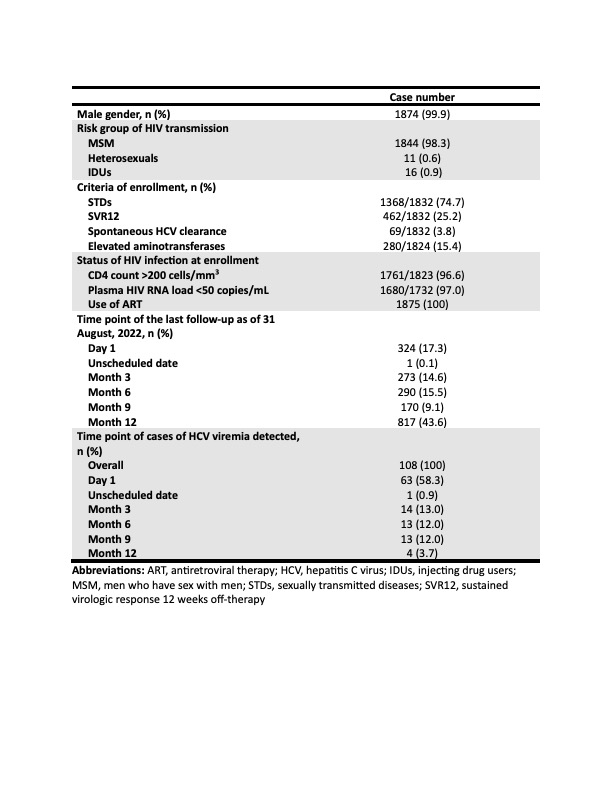
A total of 1,875 PLWH were enrolled between June 2019 and August 2022; 99.9% were men and 98.3% were men who have sex with men (Table). At enrollment, 74.7% of the participants were included because of recent STDs, 25.2% and 3.8% because of HCV viral clearance by antiviral therapy and spontaneously, respectively, and 15.4% because of elevated aminotransferases. A total of 108 cases of HCV viremia were detected during the study period, with 63 cases (58.3%) detected at enrollment and the remaining 45 cases (41.7%) detected during 1,208.11 person-years of follow-up (PYFU), which led to an incidence rate of HCV viremia of 37.25 cases per 1000 PYFU. The mean HCV RNA load of the 45 incident cases was 5.41 (range, 1.30-7.77) log10 IU/mL. If the testing frequency had been changed to every 6 or 12 months, the incidence rates would have decreased to 37.05 and 36.66 per 1000 PYFU, respectively. However, the diagnosis of 62.2% (28/45) cases of acute HCV viremia (mean HCV RNA load, 6.10; range, 2.48-7.77 log10 IU/mL) and 91.1% (41/45) (mean HCV RNA load, 5.53; range 1.30-7.77 log10 IU/mL) would have been delayed, respectively, before their HCV viremia could have been detected at months 6 and 12, respectively.
Conclusions:
With HCV RNA testing performed every 6 or 12 months among high-risk PLWH, the detection of a large proportion (62.2-91.1%) of PLWH who recently acquired HCV would be delayed, which may contribute to onward HCV transmission with longer durations.
Characteristics of the enrolled 1,875 PLWH