Background:
‘Getting to zero’ and ending new HIV transmissions by 2030 is a major focus for HIV prevention in the UK. To achieve this, national funding was provided to expand opt-out testing for HIV across all South London emergency departments (ED) from April 2022 for attendances aged over 16-18 years having a blood test for any reason. We describe new HIV diagnoses in South London during the first 12 months of testing and compare HIV prevalence and new diagnoses rates in ED to national published data.
Methods:
Demographic data were collated and summarised for all new HIV diagnoses across South London ED. Prevalence data were calculated, including previously known HIV diagnoses, overall and by region and compared to local published prevalence data. The project was registered as service evaluation.
Results:
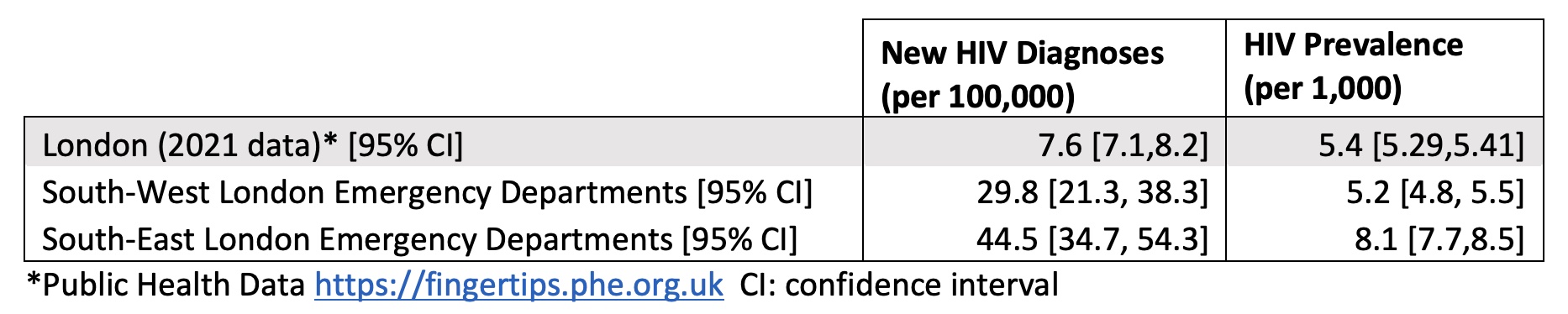
Between April 2022 and March 2023, across 10 acute hospital EDs, there were 446881 eligible attendees and 335263 HIV tests performed. HIV test uptake increased from 61% in April 22 to 80% in March 2023. We identified 128 new HIV diagnoses: 65% male, 72% heterosexual, median age 43.5 years (range 16-77), 55% black ethnicity, 84% within the lowest multiple deprivation deciles (1-5). 92% were engaged in care within median (IQR) 5 (2-13) days with median (IQR) baseline CD4 271.2 (79-385.3 cells/uL), mean (SD) viral load 5.0 (1.2) log copies/ml. 69% had a CD4<350 and 41% CD4<200 cells/uL. 75% overall, 64% with CD4<350 and 35% with CD4<200, did not report HIV indicator conditions at presentation to ED. 22% were subsequently diagnosed with an AIDS related illness. After median (IQR) 6.8 (3.8-9.9) months follow up, median CD4 was 350 (210-600) and 70% had an undetectable viral load. New diagnosis rates in the ED population exceeded the overall new diagnosis rates in London by almost 6-fold and 4-fold in South-East and South-West London respectively. In South-East London, HIV prevalence in ED was higher than previous reported estimates across London (Table).
Conclusions:
ED HIV opt out testing was successful in achieving high rates of new diagnoses, in areas of high deprivation, with excellent linkage to care. Over two-thirds of diagnoses were late (CD4<350) and less than a quarter had indicator conditions at presentation. This intervention is a powerful tool to reach individuals who would not have otherwise been identified, reduce health inequalities and address key gaps in testing for groups such as heterosexual men, who may not attend traditional testing services such as antenatal and sexual health.