Background:
The World Health Organization recommends a 1-dose human papillomavirus (HPV) vaccination strategy to increase coverage and accelerate cervical cancer elimination. However, the duration of efficacy of 1-dose is uncertain among women living with HIV (WLHIV); immune dysregulation may limit vaccine durability. We modelled the potential impact of a 1-dose HPV vaccination strategy on cervical cancer outcomes for WLHIV in Kenya.
Methods:
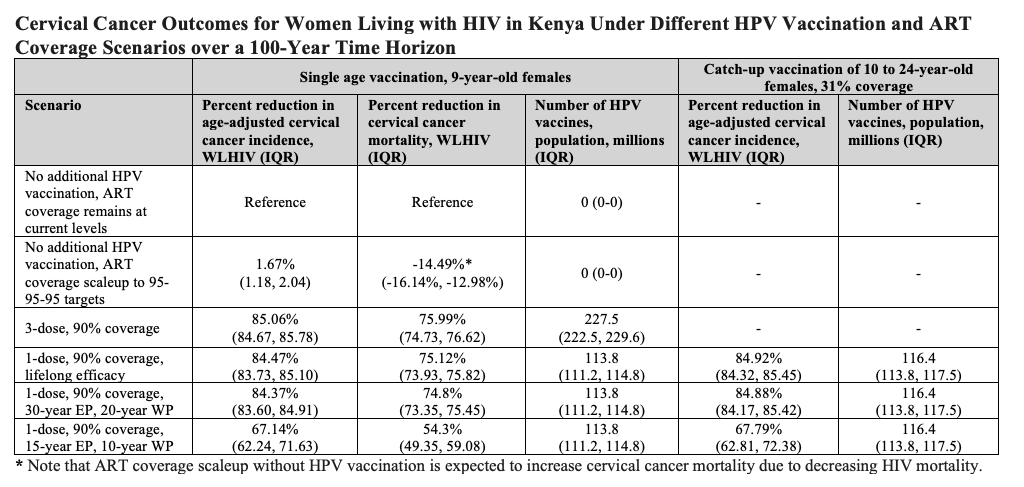
Using a validated dynamic compartment transmission model for Kenya simulating bidirectional interactions between HIV and HPV, we modelled the impact of a) expanded HIV interventions on cervical cancer outcomes, b) going from a multi-dose to 1-dose HPV vaccine strategy assuming 90% coverage of 9-year-old girls and lifelong efficacy, c) reduced durability scenarios with an efficacy period (EP) of 15-30 years and waning period (WP) of 10-20 years, and d) leveraging 5-year cost savings from a potential switch to a 1-dose strategy on a catch-up vaccination program. Multi-dose vaccine efficacy was assumed to be 100%, and 1-dose efficacy for WLHIV assumed to be aligned with women without HIV at 97.5% (95% CI, 90.0-99.4%). We evaluated the percent reduction in cervical cancer incidence and mortality.
Results:
If Kenya achieves UNAIDS targets by 2030 without additional HPV vaccination, we expect a 1.7% cervical cancer incidence reduction amongst WLHIV compared to a baseline of no vaccination and current ART coverage. Achieving UNAIDS targets as well as 90% coverage of a 3-dose HPV vaccine for WLHIV would further reduce incidence to 85.1%. A 1-dose scenario with lifelong efficacy would have similar reductions in incidence and mortality. The worst-case waning scenario of 15-year EP/10-year WP would weaken the incidence reduction by a difference of 17% compared to the 1-dose lifelong efficacy scenario, while the best-case waning scenario of 30-year EP/20-year WP would limit the reduction by 0.1%. Catch-up vaccination has the potential to avert some of the impact of HPV vaccine waning.
Conclusions:
Assuming 1-dose efficacy results are consistent for women living with and without HIV, durability differences between dosing strategies will not significantly impact cervical cancer outcomes for WLHIV. While waning vaccine efficacy for 1-dose could increase cervical cancer cases compared to multi-dose strategies, general population vaccination could mitigate some of this change. Empiric data on single-dose HPV vaccine efficacy and duration for women living with HIV are needed.