Background:
Transgender (TG) women in India have a 14 times higher burden of HIV compared to the general population. They also face substantial societal challenges with access to HIV prevention and treatment services. Further, for most transwomen access to hormone replacement therapy (HRT), cosmetology, and social entitlements take precedence over HIV services. Consequently, we established a comprehensive care model for the TG community including HIV and non-HIV services.
Methods:
As part of a PEPFAR-funded program, three comprehensive community-led trans clinics (“Mitr Clinics”) were established in the Indian cities of Hyderabad, Pune and Thane since February 2021. These clinics provided HIV prevention and testing services with referral to the government program for free antiretroviral therapy (ART). The clinics also provided free consultation for HRT, cosmetology, and assistance with access to social protection schemes. Diagnostics for syphilis and nucleic acid testing for C trachomatis and N gonorrhoeae were offered free of cost on-site. Client data was routinely collected at all sites and correlates of uptake of HIV testing were explored using logistic regression.
Results:
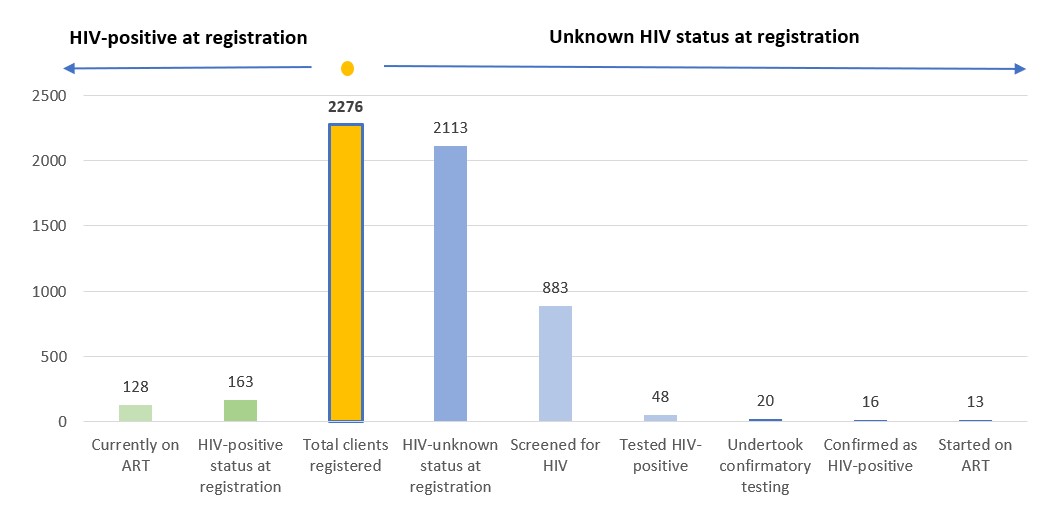
Between February 2021-July 2022, 2276 individuals were registered across the 3 clinics. The majority (54%) had never received services as part of the government’s targeted interventions (TI) program. Median age was 26 years and 87% self-identified as a transwoman; 29% reported a history of transactional sex. The most utilized service was laser therapy (56%), followed by HIV services (54%). Of the total clients, 163 (7%) were aware of their HIV status at entry and 128 were currently on ART. 883 clients were screened for HIV at the clinics. HIV screening was significantly more common among those who visited the clinic for HRT (aOR 2.35; 95% CI: 1.66, 3.33) or condoms (aOR 2.25; 95% CI: 1.5, 3.37). 48 clients newly screened HIV-positive at the clinics, of whom 20 completed confirmatory testing and 13 initiated ART (Figure). Additionally, 336 clients were tested for syphilis, 79 for CT and NG with a prevalence of 9%, 4%, and 0%, respectively.
Conclusions:
These data highlight the role of integrating non-HIV services as entry points to generate demand for facilities from communities previously unreached by HIV programming. Integrating essential HIV and other STI services including confirmatory testing, ART and PrEP into such facilities will promote a “person-centric” approach to HIV care to this marginalized, vulnerable community.
Figure – Clients’ HIV Status and Testing Cascade