Background:
The World Health Organization recommends dolutegravir (DTG)-based 3-drug antiretroviral therapy (ART) in children >4 weeks weighing >3kg. DTG-based ART achieves rapid viral load decline in adults and low rates of treatment failure in older children, but outcomes for children treated from birth, a time when adherence challenges are of particular concern, are limited.
Methods:
We compared prevalence of 24-week HIV-1 RNA suppression in early-treated children on lopinavir-ritonavir (LPV/r)–based ART in the EIT cohort (2015-2018) to DTG-based ART in the Moso cohort (2022-2023) in Botswana. All children started nevirapine (NVP)+lamivudine (3TC)+zidovudine (ZDV) in the first week of life and switched to LPV/r+3TC+ZDV at 2-5 weeks (in EIT) or DTG+abacavir (ABC)+3TC at 4-6 weeks (in Moso). The proportion of children with HIV-1 RNA<40 copies/ml at 24 weeks of age was compared between both cohorts and logistic regression models were fit to evaluate risk factors for non-suppression.
Results:
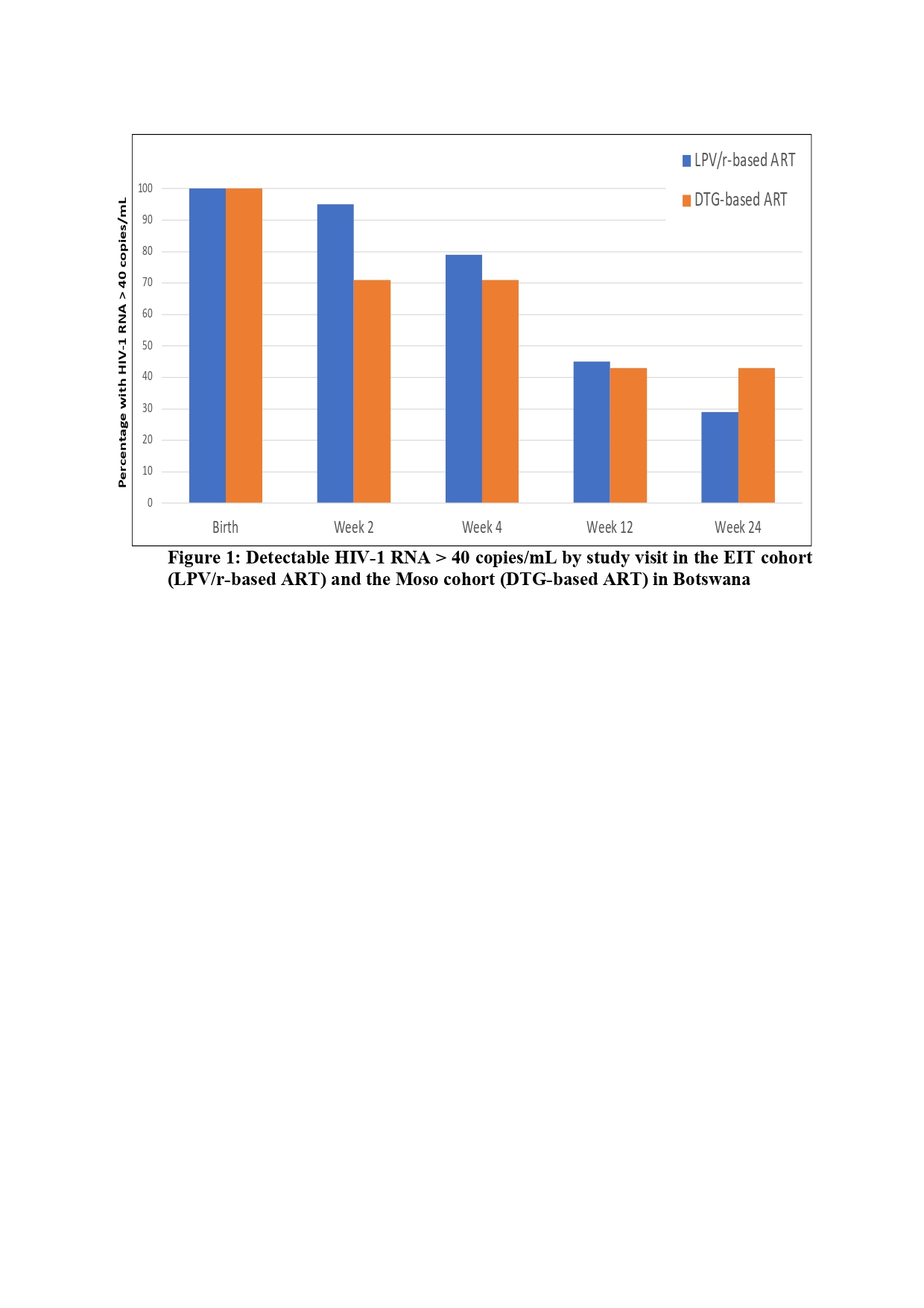
Thirty-eight of 40 EIT participants and 7 of 11 Moso participants had 24-week results (2 EIT deaths <24 weeks; 1 Moso death <24 weeks and 3 Moso participants <24 weeks follow-up). HIV-1 RNA was <40 copies/mL at the 24-week visit in 27/38 (71%) EIT participants on LPV/r and in 4/7 (57%) Moso participants on DTG. Figure 1 summarizes viremia over time in both cohorts. Median log10 infant HIV-1 RNA at birth was 4.1 copies/mL and 3.8 copies/mL for EIT and Moso, respectively. Median time on LPV/r and DTG prior to 24 weeks was 154 days (range 130, 168) and 140 days (range 126, 148), respectively. No maternal or infant factors significantly predicted viral suppression at 24 weeks in either cohort, but caregiver-reported adherence challenges were common in most children with detectable viremia at 24 weeks.
Conclusions:
Despite its proven benefit for achieving rapid and durable viral suppression in adults and older children, data from a small number of early-treated infants in Botswana indicate no improvement in viral suppression with the use of DTG-based ART through 24 weeks.