Background:
Over one-third of all individuals infected with severe acute respiratory syndrome coronavirus 2 (SARS-CoV-2) experience persistent residual symptoms. Previously, we found that COVID convalescents with pulmonary symptoms had elevated low-density granulocyte (LDG) levels and enhanced ability to form neutrophil extracellular traps (NETs) and aggregation with platelets. Although evidence supports that immunothrombosis plays a crucial role in COVID-19 pathogenesis, its involvement in pulmonary post-acute sequelae of SARS-CoV-2 infection (PPASC) is poorly known.
Methods:
To analyze markers linked to thrombosis and inflammation in COVID-19 convalescents, plasma samples collected from participants naïve to SARS-CoV-2 (NP; n=11), infected with SARS-CoV-2 with no residual symptoms (NRS; n=10), and with pulmonary symptoms (PPASC; n=12) were used. We assessed ten analytes (coagulation: vWF-a2, Protein C, ADAMTS13, Tissue Factor (TF); inflammation: IFN-gamma (IFN-γ), MMP-9, MPO; complement pathway: Complement component C2, C5, and C9 in the plasma samples by Luminex assay. To identify factors involved in neutrophil activation in COVID-19 convalescents, we further assessed associations between LDG parameters (number, activation, NET formation) and soluble factors.
Results:
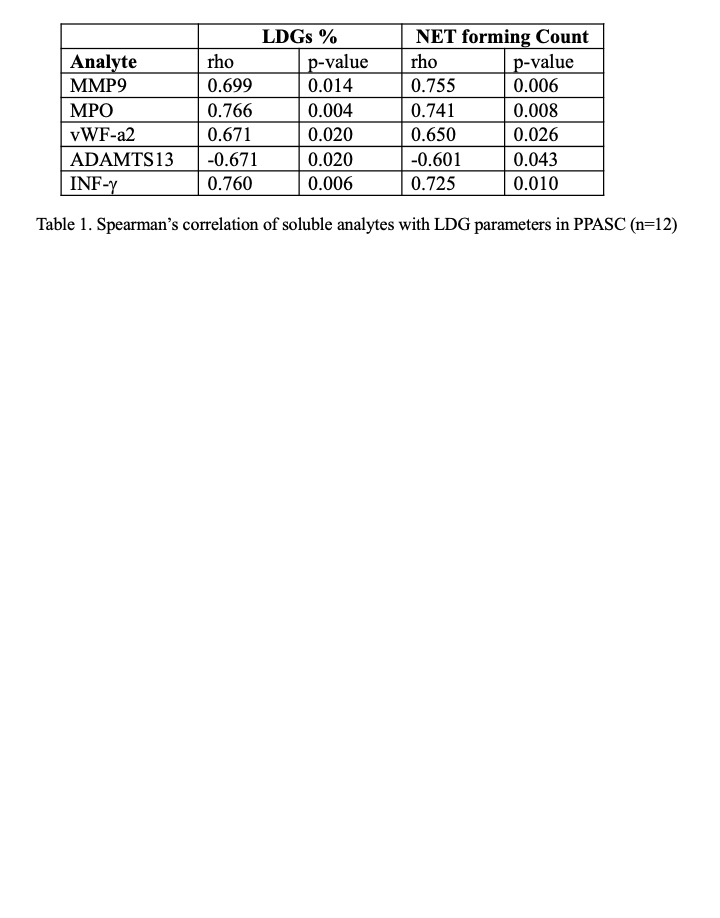
The median age of participants was 57, 55, and 54.5 years for the NP, NRS, and PPASC groups respectively. Months post-infection did not differ between NRS (5 [IQR;1.5-9.5]) and PPASC (6 [IQR:4-14]). Compared with NP, TF and ADAMTS13 levels were statistically decreased in PPASC, and PPASC individuals tended to have higher MPO and vWF-a2 levels. C2a levels were statistically higher in both PPASC and NRS than in the NP, while C5a and C9 expressions were comparable between groups. Further correlation analysis of LDG parameters with soluble factors in PPASC showed that the percentages of LDGs and NET-forming counts were positively correlated with MMP9, MPO, IFN-γ, and vWF-a2 expression, but negatively correlated with ADAMTS13 expression (Table 1). Interestingly, C9 levels were positively associated with the percentages of NET-forming LDGs, vWF-a2, and C5a in PPASC, but these associations were not shown in NRS.
Conclusions:
The associations between LDG parameters and markers for coagulation and neutrophil activation in PPASC suggest that neutrophils and their derived NETs contribute to thrombotic risk in PPASC. Further studies are necessary to understand the role of sC5b-C9 complex in PPASC.