Background:
Modified vaccinia Ankara-Bavarian Nordik (MVA-BN) was licensed for Mpox. Recent data estimated single dose effectiveness around 78%, whereas its ability to induce neutralising antibodies (nAbs) has been measured as relatively low. Whether historical smallpox vaccination (HiSXV) or HIV infection may impact MVA-BN response remains to be determined.
Methods:
Blood samples collected from participants (pts) eligible for pre-exposure Mpox vaccination at the time of receiving the first dose (in non-primed) or single dose (in primed) of MVA-BN vaccine (T1) and one month later (T2). MPXV-specific IgG were measured by in-house immunofluorescence assay, using 1:20 as screening dilution; MPXV-specific nAbs by 50% plaque reduction neutralization test (PRNT50, starting dilution 1:10); IFN-γ-producing specific T cells to MVA-BN vaccine, by ELISpot assay. Probability of nAb response in primed vs non-primed at T2 was estimated in pts who had a titre < 10 at T1. McNemar test used to evaluate the overall response, while proportion becoming responders at T2 by exposure groups was compared by logistic regression. Average Treatment Effect (ATE) of the difference over T1-T2 by HiSXV was estimated after weighting for age using a linear predictor. Whether the effect of HiSXV on MVA-BN response may vary by HIV infection status was tested by including an interaction parameter in the models.
Results:
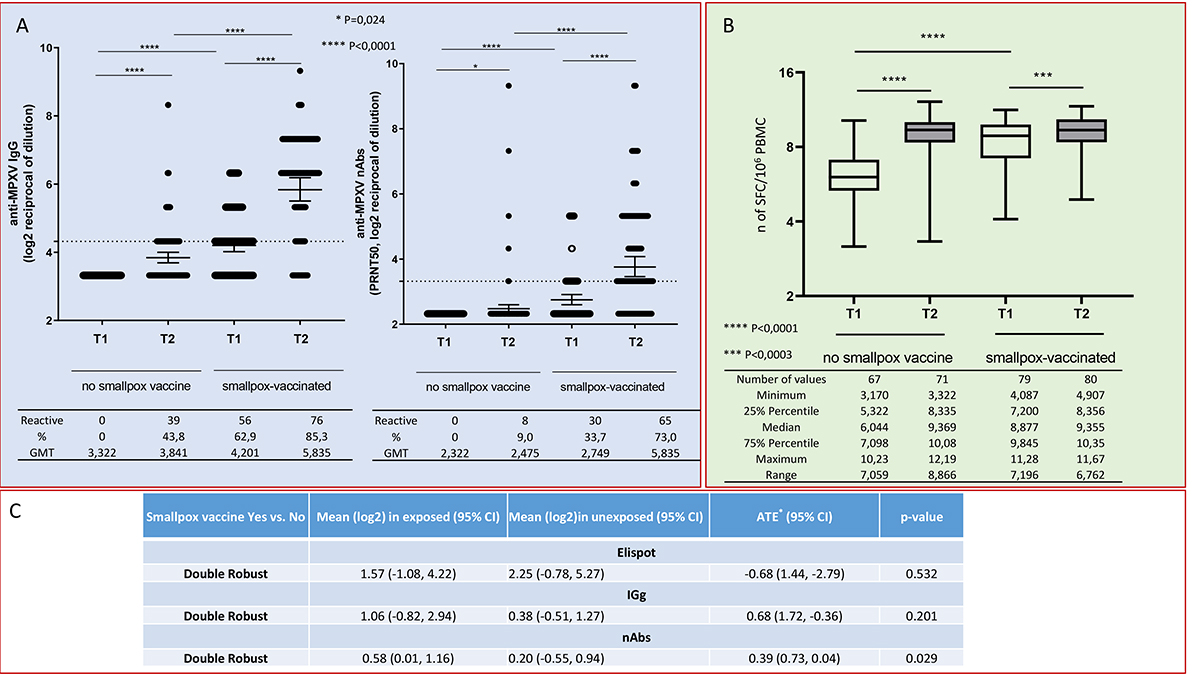
Among the 180 persons self-identified as GBTMSM, 90 (50%) were historically smallpox vaccinated. Median age was 47 years (IQR 38-54). Among the 86 (48%) PLWH, 81% had a CD4 count of more than 500 cells/mm3. A significant increase in T-cell and nAb response over T1-T2 was observed (Fig.1A-B) and 46 of the 157 who were nAbs non responders at T1 became responders at T2 (McNemar p < 0.001). In this subset, the chance of achieving nAb response at T2 was higher in primed vs non-primed [OR=12.2 95% CI (3.4-44.0) after controlling for age]. Results were similar when comparing nAbs in ATE with a mean difference of 0.39 log2 (p=0.03). There was no evidence for a difference in T-cell response according to HiSXV (Fig.1C). There was no evidence that the effect of HiSXV on MVA-BN response varies by HIV status [OR in HIV-neg 18.3 vs HIV-pos 10.7, interaction p=0.54].
Conclusions:
The first/single dose of MVA-BN triggers a humoral and cellular response with nAbs response greater in primed vs. non-primed participants independently of age. No evidence that HiSXV effect on nAbs response to MVA-BN differed by HIV status.
Figure 1. IgG, nAbs and T-cel response after first dose of MVA-BN A. Titers of MPXV-specific IgG and neutralising antibodies. IgG were measured by in-house immunofluorescence assay, using 1:20 as screening dilution; MPXV-specific neutralising antibodies (nAbs) by 50% plaque reduction neutralization test (PRNT50) starting dilution 1:10. Intra-group comparisons were performed with paired t-test; inter-group comparisons with unpaired t-test. B. Frequency of T cells responding to MVA-BN vaccine expressed as the number of SFC/106 PBMC was tested by interferon-γ ELISpot assay. Intra-group comparisons were performed with by Wilcoxon test; inter-group comparisons by Mann-Whitney test. C. Potential average change at time T2 post vaccine and Average treatment effect (ATE) from fitting a linear regression model (log2 scale), weighted for age.