Background:
People with HIV are at increased risk for depression, though the underlying mechanisms for this are unclear. In the general population, depression is associated with peripheral and central inflammation. Since HIV infection may elicit (neuro)inflammation, we hypothesised that (neuro)inflammatory biomarkers would mediate the association between HIV and depression.
Methods:
People with and without HIV in the COmorBidity in Relation to AIDS (COBRA) cohort were included. Using logistic regression, we investigated the possible mediating roles of (neuro)inflammatory biomarkers (neuroimaging, blood, and CSF) on the relationship between HIV status and Any Depression (Patient Health Questionnaire [PHQ-9] scores > 4). We considered changes in the Odds Ratio for Any Depression (OR, adjusted for age, sex, ethnicity, and years of education), before and after adjusting for each biomarker separately. All analyses accounted for varying sample sizes. Biomarkers resulting in >10% reduction in OR were considered potential mediators.
Results:
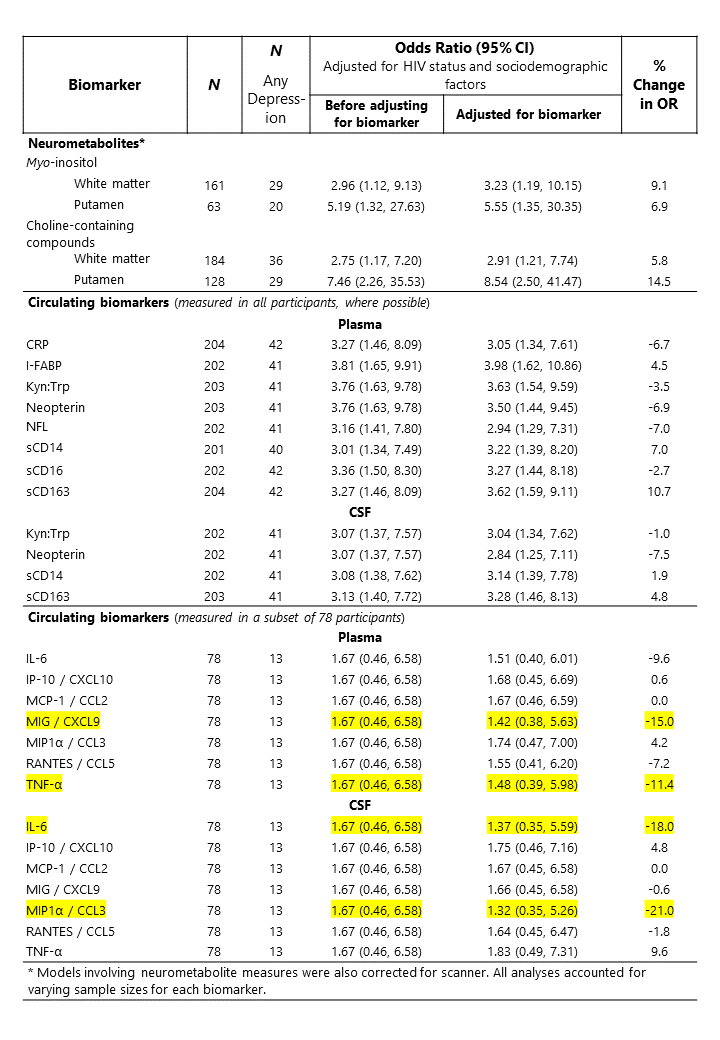
We included 204 participants (125 with HIV, 79 without HIV, median [interquartile range (IQR)] age 57 years [51-62], 93% male, 92% White) with PHQ-9 score and at least one biomarker available. Both groups had similar baseline characteristics. All people with HIV were on antiretroviral therapy and had HIV-RNA viral load < 200 copies/mL. The prevalence of Any Depression was significantly higher amongst participants with HIV than those without HIV (26.4% vs 11.4%, p = 0.02). The OR (95% confidence interval) for Any Depression in the full sample (N = 204), adjusted for sociodemographic factors but before adjusting for biomarkers, was 3.27 (1.46, 8.09). Of the biomarkers analysed, plasma MIG (-15.0%), plasma TNF-α (-11.4%), CSF MIP1-α (-21.0%), and CSF IL-6 (-18.0%) met our criteria for >10% reduction in OR associated with HIV status for Any Depression.
Conclusions:
In this sample, MIG and TNF-α in plasma, and MIP1-α and IL-6 in CSF mediated the association between HIV status and depression. As these biomarkers are hallmarks of inflammation (IL-6, TNF-α) and chemotaxis (MIP1-α, MIG), our results implicate different processes constituting (neuro)inflammation in the risk for depression in people with HIV. We did not observe notable attenuation by the neuroimaging biomarkers, suggesting that this mediation may be peripherally driven. Given the lack of gender and ethnic diversity in this cohort, larger and more diverse datasets are needed to extend these findings.
Table 1. OR (with 95% CI) for the association between HIV status and Any Depression, before and after adjustment for each biomarker fitted separately, and percentage change in OR from each model.