Background:
Dolutegravir (DTG)- and, to a lesser extent, efavirenz (EFV)- based antiretroviral treatment (ART) regimens are commonly used by pregnant persons living with HIV in high burden HIV settings, increasingly with initiation prior to conception. Little is known about the impact of in utero exposure to DTG- or EFV-based ART on child neurodevelopmental (ND) outcomes, although some prior data have raised concerns for EFV exposure.
Methods:
We prospectively enrolled 3 cohorts of 2-year-old children: HIV-exposed/uninfected (HEU)/DTG-exposed, HEU/EFV-exposed, and HIV-unexposed/uninfected (HUU), from March 2021-May 2023. DTG or EFV were taken in combination with TDF/FTC or 3TC. Child ND status was assessed using the Bayley (BSID-III), BRIEF-P-SF, and CREDI (Short; Social-Emotional). ND outcomes were compared between DTG- and EFV-exposed groups, and between HEU and HUU groups, using GEE models to account for twins, and adjusting for enrollment site, child sex/age at testing, maternal age/education/marital status/income, food insecurity (and for DTG vs EFV comparisons, breastfeeding and timing of first in utero ART exposure). Children were classified ‘at risk’ if they scored ≥1SD below the mean or were unable to complete the BSID-III.
Results:
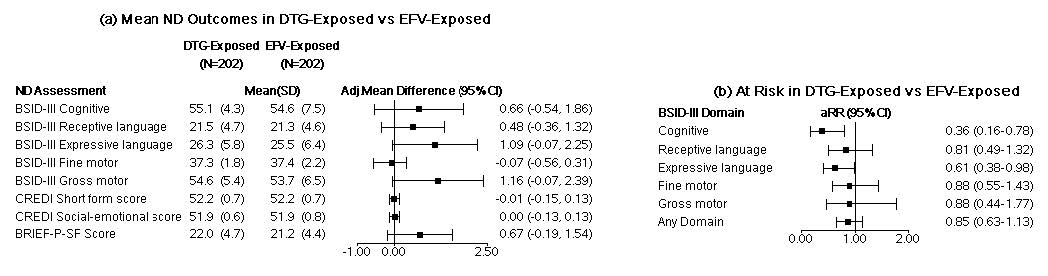
A total of 564 children (202 HEU/EFV, 202 HEU/DTG, 160 HUU; Mage=25.7 months; 49% female) participated. Means were similar across ART-exposure groups in unadjusted and adjusted models (Figure). Adjusted relative risk (aRR) of ‘at risk’ classification was lower in children who were DTG-exposed than EFV-exposed on BSID-III Cognitive (4.5% vs. 8.4% aRR=0.36 (95%CI:0.16, 0.78)) and Expressive Language (10.9% vs 17.3%, 0.61 (0.38, 0.98)) domains. Children HEU (EFV+DTG) were more likely than children HUU to be classified ‘at risk’ on BSID-III Expressive Language (14.1% vs 7.5%, aRR=1.89 (1.00, 3.60)). Children HEU were rated as having slightly better executive function skills on the BRIEF-P-SF. Inferences were similar in sensitivity analyses controlling for preterm birth status.
Conclusions:
Two-year ND outcomes among HEU and HUU children in Botswana were mostly comparable. However, consistent with prior studies, HEU status was associated with higher risk of adverse language outcomes. Among children HEU, those exposed in utero to EFV-ART were at higher risk of adverse cognitive and expressive language outcomes than DTG-ART-exposed. Longer-term ND follow-up is needed to examine the possibility of increased ND burden as HEU-/ART-exposed children enter school-age.