Background:
Dolutegravir (DTG) has improved viral efficacy and tolerance compared to efavirenz (EFV). Early data suggested a potential neural tube defect (NTD) safety signal in infants of women receiving DTG at conception. While recent evidence no longer finds an association and WHO recommends DTG-ART as preferred treatment, continued surveillance is needed to more definitively refute the signal among women of reproductive potential.
Methods:
We evaluated birth outcomes of women delivering in 5 Government hospitals in 4 regions of Eswatini in September 2021-June 2022. Routine data on pregnancy history and HIV/ART status was collected from paper and electronic clinic records. Women of live or stillborn infants with birth defects were consented for interviews capturing detailed history and exposure data and photographs of newborns’ birth defects. Blinded interview data and photographs were reviewed by a medical geneticist for confirmatory defect diagnosis. We aimed to describe rates and 95% confidence intervals (CI) for birth defects among infants by maternal HIV and ART status. Eswatini population NTD rate was unknown but estimated as 0.1%.
Results:
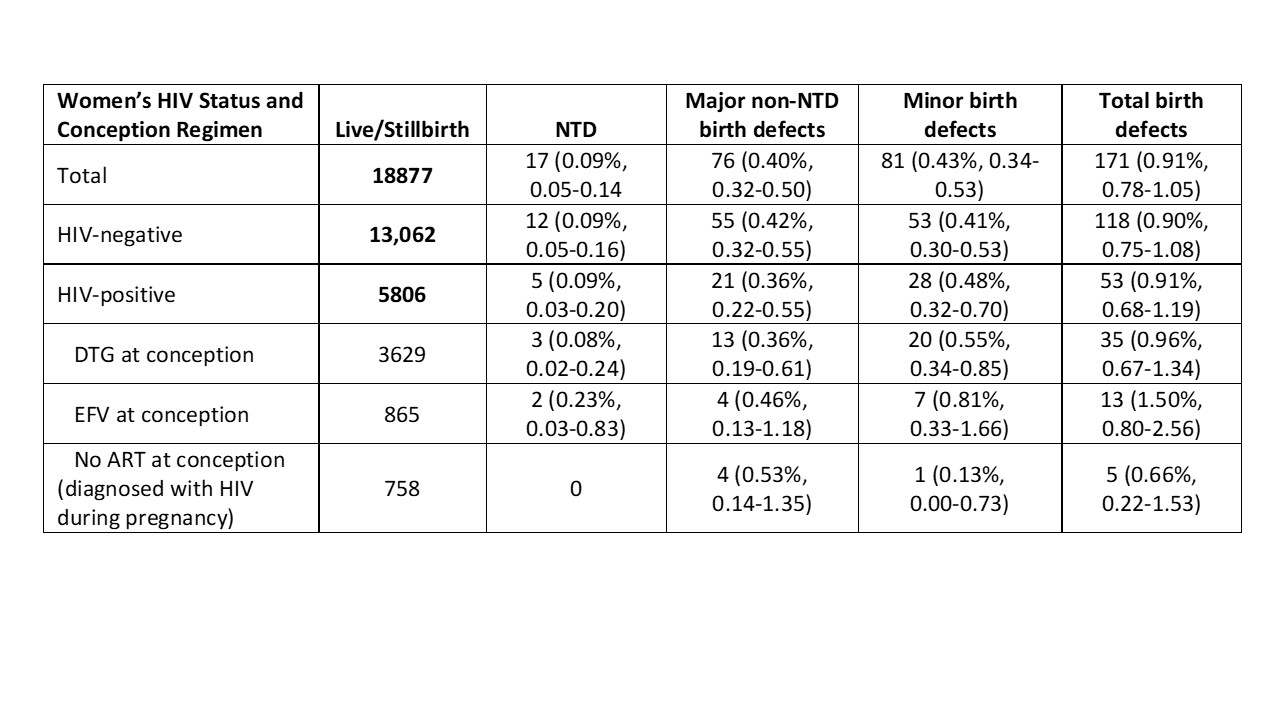
Among 18,877 women enrolled with live (18,398) or stillbirths (479), 13,062 were HIV-negative, 5,806 HIV-positive and 9 were missing HIV status. Of HIV+ women, 3,629 (62.5%) were on DTG at conception, 865 (14.9%) EFV at conception, 758 (13.1%) not receiving ART at conception, 58 (1.0%) were on non-DTG/EFV ART, and 496 (8.5%) were missing regimen and/or timing information. Overall, 171 surface defects were identified (0.91%, 95% CI: 0.78-1.05); NTD comprised 9.9% of defects. NTD prevalence was 0.08% (0.02-0.24), 0.09% (0.05-0.16), and 0.23% (0.03-0.83) for women on DTG at conception, HIV-negative women and women on EFV at conception respectively. 10/17 NTDs (58.8%) were myelomeningocele/meningocele. The most common non-NTD major defect was varus foot malformation (30.3%, 23). Nearly all minor defects were polydactyly, postaxial hand or other/unspecified (97.5%, 79). Non-NTD major and minor defects were similar in HIV+ women on DTG at conception and HIV-negative women (major 0.36% and 0.42%; minor 0.55% and 0.41%, respectively).
Conclusions:
There were similar rates of NTD and non-NTD defects between women on DTG at conception and HIV-negative women, which does not support an association of NTD with DTG at conception. The NTD rate among women on EFV at conception was higher but there were fewer EFV-exposed births and the rate had wide CIs.
Birth defects by HIV and ART status, rate and 95% CI