Background:
Black cisgender and transgender women are disproportionally impacted by HIV in the United States. Having high-risk behaviors related to HIV but not receiving HIV testing could lead to delayed diagnosis and treatment in this population. We investigated the trend of HIV testing and associated sociodemographic characteristics among Black cisgender and transgender women at risk for HIV.
Methods:
We analyzed data from the 2016-2020 Behavioral Risk Factor Surveillance System. Respondents who self-identified as Black, cisgender or transgender women, and reported high-risk behaviors were included. Variables examined in the analysis included ever been tested for HIV, age, education level, income, healthcare coverage, and geographic region. Unweighted counts and weighted percentages were used to describe study population’s characteristics. Annual percent change (APC) and p-value were calculated to examine the trend of ever having been tested for HIV over 5 years, using the Joinpoint trend analysis software. The associations between sociodemographic characteristics and ever having HIV testing were assessed using multivariable logistic regression, controlling for explanatory variables with a p<0.05. Adjusted odds ratio (aOR) and 95% confidence intervals (95% CI) were reported.
Results:
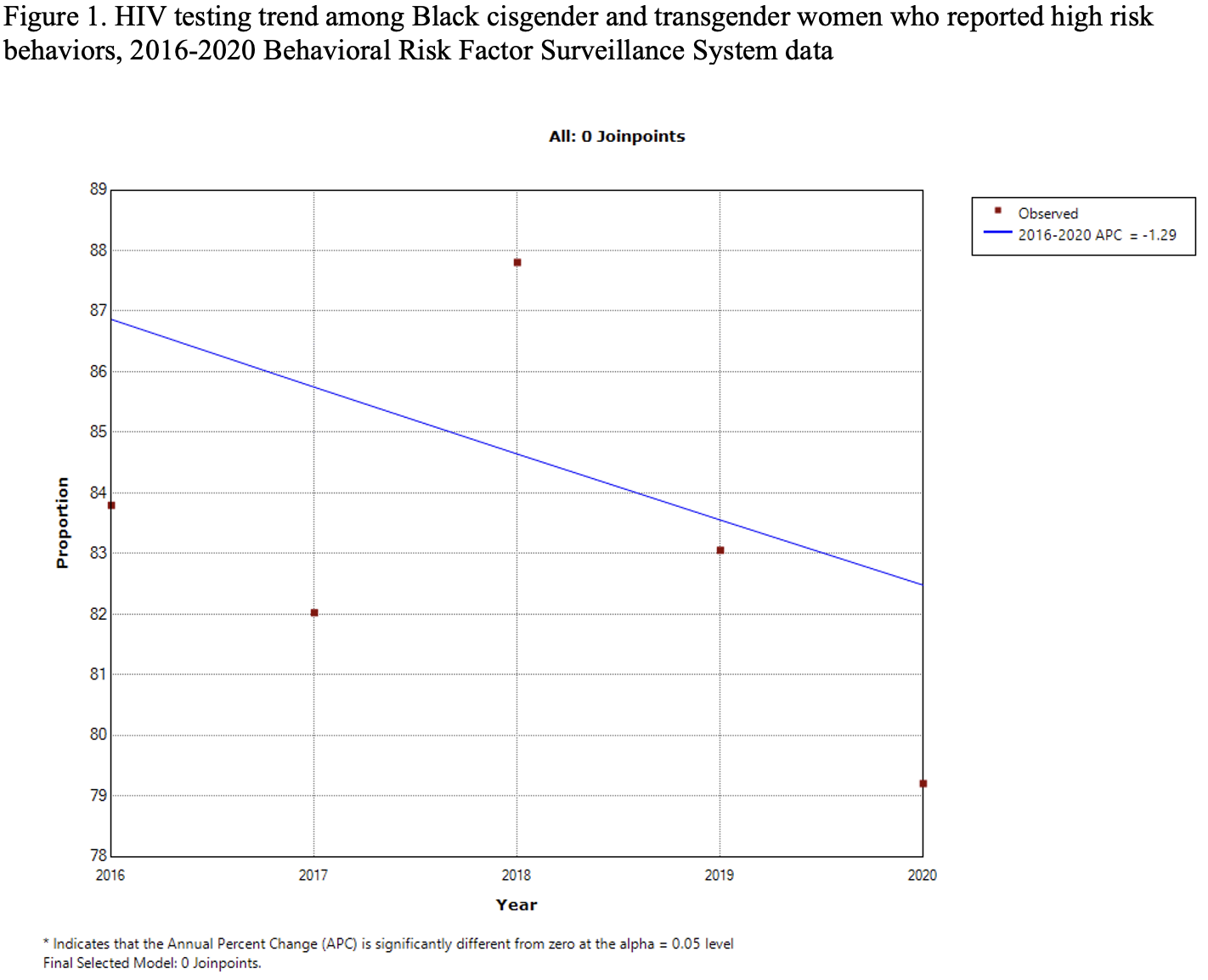
Among 3,509 (weighted n= 4,129,231) Black cisgender and transgender women (35 were excluded due to missing HIV testing status), 2,837 (83.1%) had ever been tested for HIV, and 647 (16.9%) had not. We observed a slight decrease in the percentages of HIV testing over 5 years, from 83.8% in 2016 to 79.2% in 2020 (APC = -1.29, p=0.5420). Black cisgender and transgender women aged 18-34 years (aOR: 0.47, 95% CI: 0.33-0.65) or ≥55 years (aOR: 0.18, 95% CI: 0.11-0.31) were less likely than women aged 35-54 years to get tested for HIV. Additionally, Black cisgender and transgender women with less than high school (aOR: 0.61, 95% CI: 0.38-0.99) or some post-high school (aOR: 0.63, 95% CI: 0.46-0.86) education were less likely to get tested for HIV compared to those with at least a college degree.
Conclusions:
In this nationally representative sample of Black cisgender and transgender women, more than one in 6 with high-risk behaviors had not been tested for HIV, and this trend remained stable over the 5-year period. To address the missed opportunities in HIV testing, HIV prevention programs might consider targeting 18-34 years old and ≥55 years Black women and those with a lower level of education.