Background:
HIV causes a chronic infection that it is not cleared by the normal immune response, in part due to an ineffective early antibody response. Other groups have shown that early in infection, people with HIV-1 (PWH) develop anti-gp41 antibodies that cross-react with commensal bacteria but do not neutralize HIV, and that this same phenomenon occurs after vaccination. Here, we investigate if the baseline antibody response prior to HIV vaccination is comprised of antibodies targeting commensal bacterial that weakly target HIV, and if these antibodies are preferentially activated after subsequent infection.
Methods:
To test this hypothesis, PBMC samples from a SIV/HIV DNA vaccine (SIV gag (p55), HIV env (gp160), and gp140 trimeric protein) and simian-human immunodeficiency virus (SHIV) challenge study in Rhesus Macaques (RhM; n=8) were collected prior to vaccination (week -7) and stained using an 11-color B cell panel. HIV-1 gp140-specific B cells from these SHIV-naïve RhM were sorted and nested-PCR was performed using specific primers for IgG, IgM, IgA heavy chains, and Kappa and Lambda light chains. PCR products were sequenced and compared to germline using IMGT/V-QUEST. Selected sequences were cloned as IgG1 and tested for function.
Results:
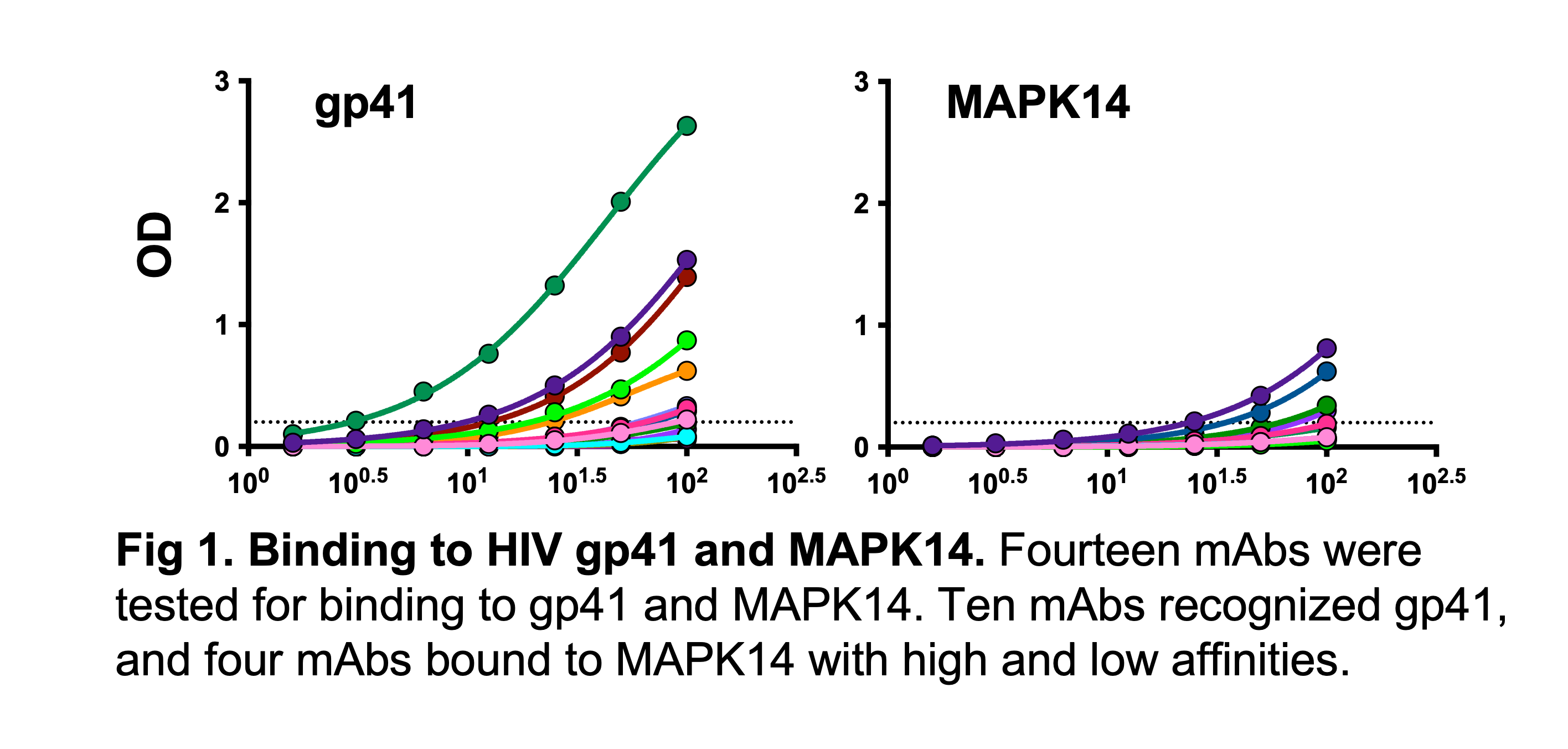
A total of 120 cells were sorted (ranging from 1-44 cells per RhM). 95 heavy chains were amplified, and 70 had productive ORF sequences. 56 out of 70 were IgM, seven were IgA, and seven were IgG sequences. Analyzing light chains, a total of 110 were amplified and 63 had productive ORF sequences. 42 out 63 were Kappa and 21 were Lambda sequences. From these, 35 had productive heavy and light chain sequences. Fourteen cells that exhibited intermediate and high gp140 binding during cell sorting were selected for cloning. Monoclonal antibodies (mAbs) were generated and tested for binding to gp41, gp120, and gp140 proteins. Ten mAbs recognized gp41, two mAbs bound to gp120, and five recognized gp140. A total of four mAbs bound to MAPK14 with high and low affinities, the two with high affinity also bound to LPS (Fig 1). This data shows that these mAbs not only cross-react with bacteria but also bind to different cellular components suggesting that these are polyreactive antibodies.
Conclusions:
Here, we show that B cells can recognize HIV without previous vaccination or infection, and they are mostly naïve (IgM+). Future directions include investigating if these clones are expanded after vaccination and/or SHIV infection trough deep sequencing.