Background:
Chemoprophylaxis is a critical tool for many infectious diseases, and in COVID-19 may have particular benefit for vulnerable patients that do not maximally benefit from vaccination. Nafamostat inhibits TMPRSS2, which catalyses a critical cell entry pathway for SARS-CoV-2. This study sought to assess efficacy of intranasal nafamostat against airborne transmission of SARS-CoV-2 in Syrian Golden hamsters.
Methods:
Male hamsters were intranasally administered water or 5 mg/kg nafamostat in water twice daily for 5 days (sentinels). One day after treatment initiation, sentinels were co-housed with an untreated hamster that was intranasally inoculated with 1 x 10^4 PFU of Wuhan SARS-CoV-2 (donor). Sentinels were separated from the donor by a perforated divider, allowing airflow between zones but not contact. Hamsters were weighed and throat-swabbed throughout. At day 4, all animals were culled, and lung and nasal turbinates were harvested. N-RNA was quantified relative to 18S-RNA by qPCR. A 2-way ANOVA with Bonferroni correction was applied to compare weight changes in the nafamostat group to those in controls. An unpaired t-test was used to compare viral RNA in lung and nasal turbinate between groups.
Results:
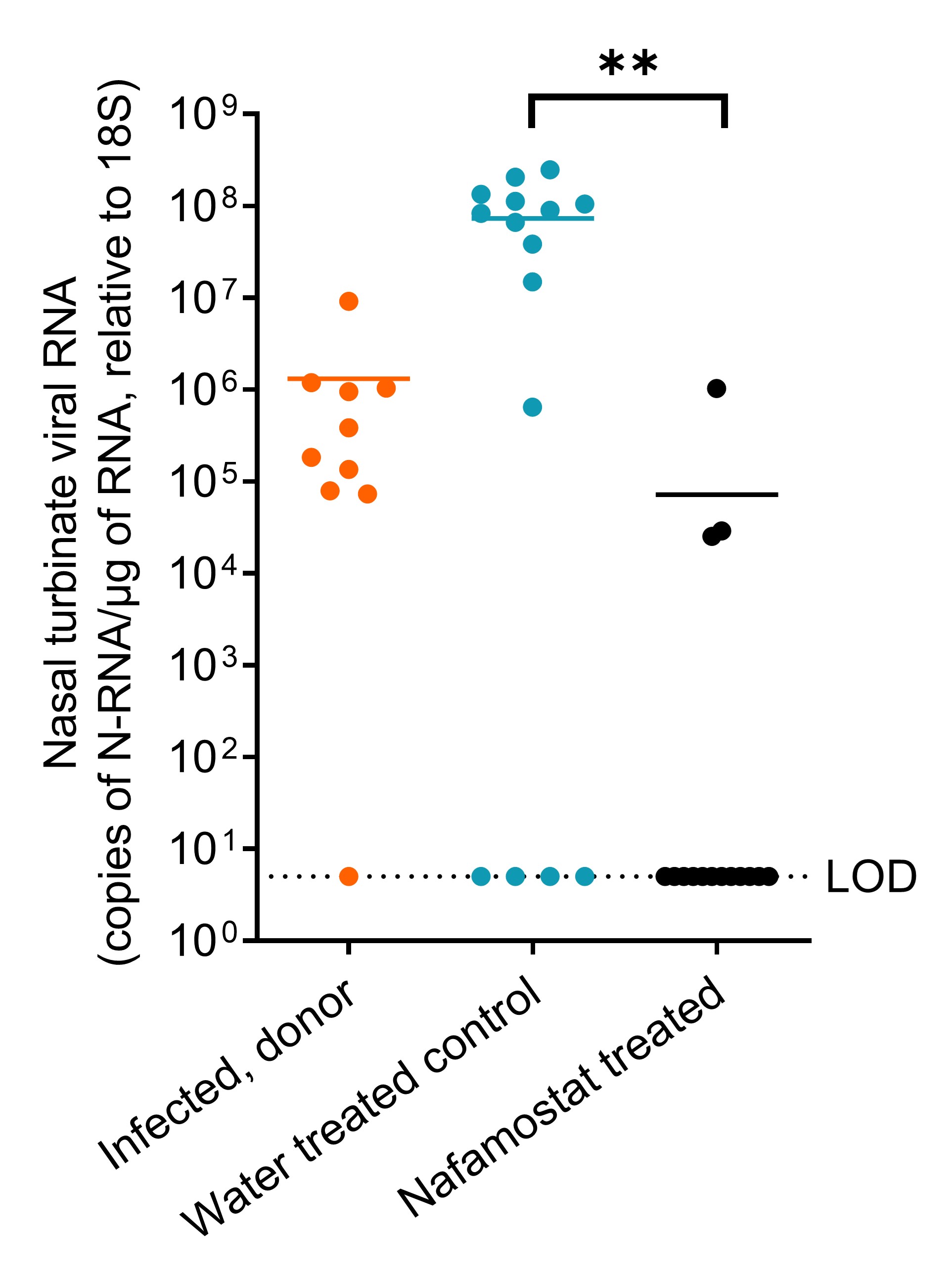
SARS-CoV-2 viral RNA was significantly lower in the nasal turbinates of nafamostat-treated hamsters compared to water-treated controls (P = 0.012; Figure 1). Within the lung, SARS-CoV-2 RNA was undetectable in the nafamostat-treated hamsters, but was detectable in the water-treated controls. Viral RNA was undetectable in the swabs of the nafamostat-treated hamsters at all timepoints, but was quantifiable in the water-treated control group from day 3. Body weight of the nafamostat-treated hamsters was significantly lower (P = < 0.001) than in the water-treated animals throughout. SARS-CoV-2 viral RNA was detectable in the donor hamsters lung, nasal turbinate and swab samples confirming validity of the experiment.
Conclusions:
This study demonstrated a protective effect of intranasal nafamostat against airborne SARS-CoV-2 transmission in Syrian golden hamsters. A phase IIa study of intravenously administered nafamostat yielded no evidence of clinical efficacy in hospitalised patients, but further investigation of intranasally administered nafamostat in a prophylactic setting may be warranted.
Figure 1: SARS-CoV-2 viral RNA concentration quantified from the nasal turbinates of the donor, nafamostat or water treated hamsters.