Background:
The long-term natural history of anal high-grade squamous intraepithelial lesions (HSIL) is incompletely characterized. We aimed to evaluate the effects of readily available patient characteristics on the risk of developing IAC in a longitudinal cohort of people with HIV (PWH)
Methods:
Retrospective inception cohort analysis of PWH between 2006-2021. Patients were eligible if they were at least 18 years of age, underwent ≥ 1 anal cytology screening as part of routine care, and provided informed consent. Validation of IAC was conducted through review of surgical pathology reports. We estimated the risk of developing IAC using Kaplan-Meier analysis and inverse probability of screening weighted (ipw) Cox proportional hazards modeling. Covariates included sociodemographics, HIV risk factors, smoking, antiretrovirals (ART), anal cytology, CD4 and HIV viral load (VL) results. Time-at-risk began on the date of the initial anal cytology and was censored on the date of initial diagnosis of IAC, the last clinic visit, or the end of the study period (31 Dec 2021), whichever occurred first
Results:
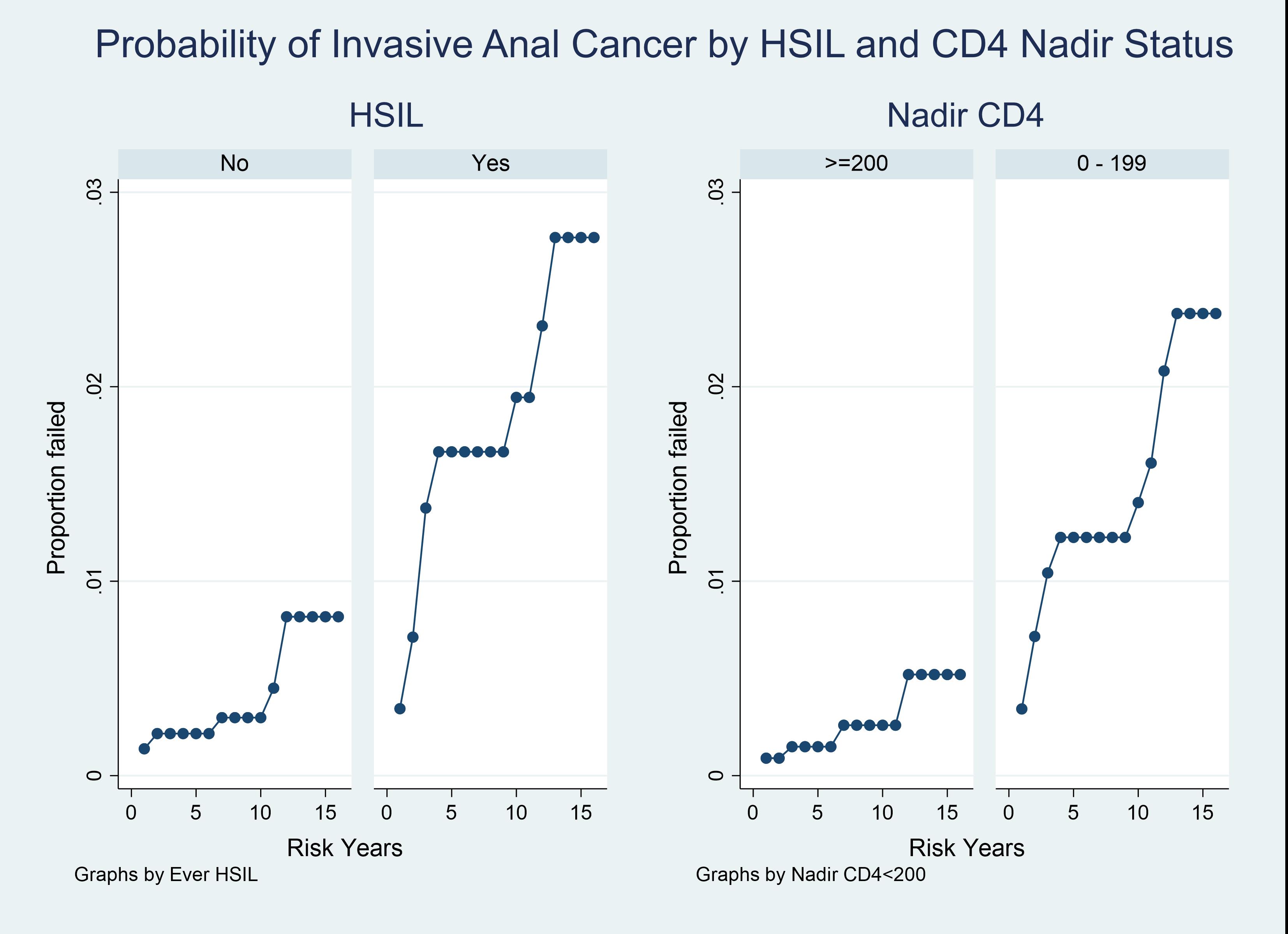
The cohort included 3,967 PWH followed for a median of 5.5 years (up to 13.8 years), and 26 developed incident IAC during follow-up. PWH had a median of 2 anal cytologies. Patient characteristics included: median age 44, 10% females, 36% non-white, 78% men who had sex with men and 33% smokers. Most were on ART (91%). Those with VL < 400 copies/ml at the beginning and end of follow-up were 68% and 89%, respectively. PWH had a median nadir CD4 count of 267 cells/mm3 (IQR: 102, 454) and 39% had a CD4 count nadir < 200. At the first cytology test, 12 % had HSIL, while cumulatively 23% developed HSIL during follow-up. In weighted Cox models, independent predictors of developing IAC were having ever HSIL (HR:3.92, 95% CI:1.76-8.75, P=0.001) and nadir CD4 < 200 (HR:4.56, 95% CI: 1.54-12.8145, p=0.004). Neither age, sex, race, smoking status, VL or HIV risk factor predicted the IAC development, Harrell's C = 0.77. Comparing those with HSIL to those with less than HSIL, 5-year predicted probabilities of IAC were 1.67% and 0.22%, respectively. Comparing those with nadir CD4< 200 to those ≥200, 5-year IAC probabilities were 1.23% and 0.15% (Figure)
Conclusions:
In this 15-year longitudinal cohort, HSIL and nadir CD4 count were independent predictors of IAC. Unbiased estimates of the natural history of IAC observed in inception cohorts should inform shared decision-making discussions regarding anal cancer screening
PREDICTED PROBABILITY OF INVASIVE ANAL CANCER BY HSIL AND NADIR CD4 CELL COUNT STATUS