Background:
Mycobacterium tuberculosis (Mtb) can enhance immune responses against unrelated pathogens. Mtb is the most common co-infection in people living with HIV (PWH), and the impact of active Mtb disease on HIV-1 immune responses has not been examined.
Methods:
Neutralization and antibody dependent cellular cytotoxicity (ADCC) were compared among plasma samples from PWH and Mtb disease (PWH/Active Mtb) and PWH/No Mtb both prior to any treatment and after antiretroviral treatment (ART) and completion of Mtb therapy. Single genome amplification, flow cytometry and luminex-based assays were used to examine HIV-1 envelope sequences, antibody, and cytokine levels respectively. Wilcoxon-rank sum, Kruskal Wallis, and Student t-tests were used to compared different groups and multivariate linear regression analysis was used to account for baseline demographic differences.
Results:
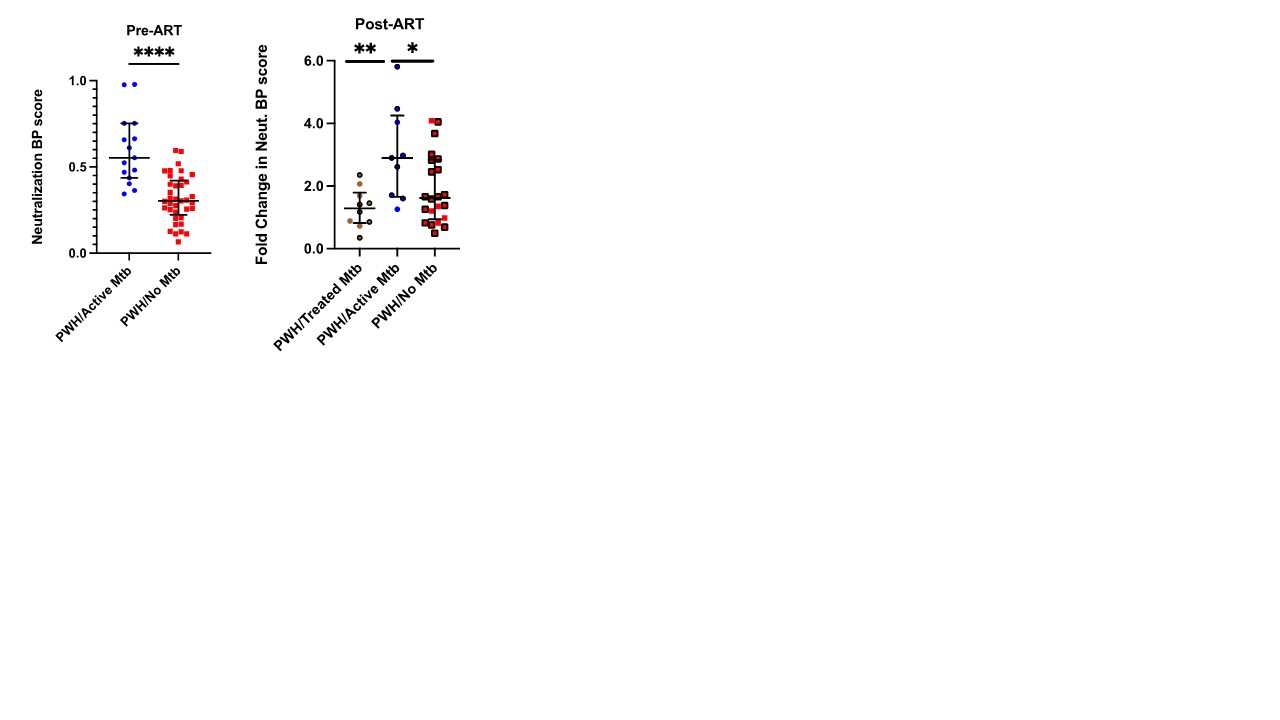
HIV-1 neutralizing antibodies (nAbs) were broader and more potent in PWH/Active Mtb (n = 15) as compared to PWH/No Mtb (n = 37, p < 0.0001) even after accounting for pre-treatment plasma virus level and CD4 counts. NAb breadth and potency significantly increased among the PWH who developed active Mtb after ART initiation (PWH/Active Mtb + ART, n = 9) as compared to the PWH/Treated Mtb + ART (n = 10) and PWH/No Mtb + ART (n = 22, p = 0.01). ADCC was higher in PWH/Active Mtb + ART as compared to PWH/Treated Mtb + ART and PWH/No Mtb + ART (p = 0.02), but ADCC was not different among PWH/Active Mtb and PWH/No Mtb prior to ART initiation. Before ART, PWH/Active Mtb as compared to PWH/No Mtb had unique HIV-1 envelope sequence motifs associated with neutralization resistance implying differences in humoral immune selection pressure. The Mtb-linked antibody augmentation associated with elevated plasma levels of interleukin-6, a proliferation-inducing ligand (APRIL), and B-cell activating factor (BAFF), but not other cytokines important for B cell development and maintenance. Active Mtb co-infection did not associate with non-specific elevation of all antibodies or cross-reactive responses.
Conclusions:
Mtb disease enhances HIV-1 antibody responses primarily as a bystander effect on pathways important for antibody production. The Mtb enhanced humoral responses do not associate with increased virus levels or envelope antigen diversity. Understanding pathways perturbed by Mtb disease can provide unique insights for inducing optimal HIV-1 antibody responses.
Neutralization breadth and potency prior to (left) and post ART initiation (right)