Background:
HIV infection has become a chronic condition, due to antiretroviral treatment. Adolescents and young adults with perinatal acquired HIV (PHIV) are at risk of developing premature senescence and aging-associated illness. The assessment of aging biomarkers and their relation with the HIV reservoir becomes a priority to characterize and monitor these patients.
Methods:
41 PHIV adolescents/young adults (age 16 – 30 years) under antiretroviral therapy and with undetectable viremia for at least 10 years, and 23 aged-matched healthy controls were enrolled in this study. The immune aging profile (activated, senescent, exhausted and regulatory T and B cells) was studied by flow cytometry. Relative telomere length and HIV-DNA in PBMC were measured by real time PCR and ddPCR, respectively. Circulating denervation biomarkers NCAM-1 (Neural Cell Adhesion Molecule-1) and CAF (C-terminal Agrin Fragment), associated with aging and sarcopenia, were assessed by ELISA. Statistical analyses were performed using RStudio software and data were adjusted by age.
Results:
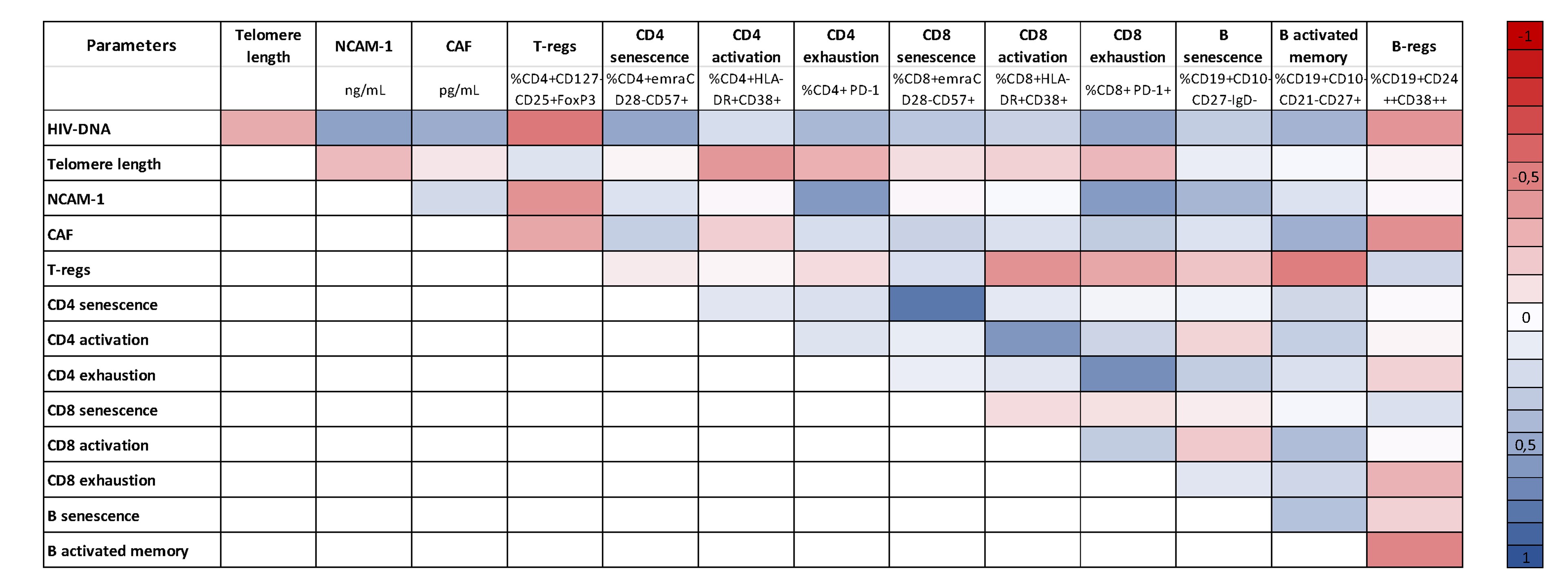
Compared to healthy controls, PHIV subjects had significantly higher levels of immune senescence [%CD4emraCD28-CD57+: 8.14 (5.26-18.18) vs 3.73 (2.16-4.93), p< 0.000, % CD8emraCD28-CD57+: 6.86 (4.00-12.50) vs 3.45 (2.44-6.25), p= 0.003; %CD19+CD10-CD27-IgD-: 10.49 (8.36-14.62) vs 9.20 (4.81-11.82), p= 0.050], exhaustion [%CD4+PD-1+: 11.45 (7.81-13.58) vs 6.58 (5.58-9.52), p< 0.000; %CD8+PD-1+: 11.90 (8.20-13.85) vs 6.75 (4.46-7.36), p< 0.000] and denervation biomarkers [NCAM-1: 364.6 (284.7-575.0) vs 282.5 (241.0-374.2) ng/mL, p= 0.006; CAF: 2282.8 (1989.2-2865.8) vs 2119.5 (1662.9-2356.5) pg/mL, p=0.048]. HIV-DNA positively correlated with immune senescent, activated and exhausted T and B cells, and inversely correlated with regulatory T and B cells and telomere length. Notably, HIV-DNA was also significantly correlated with denervation biomarkers (Table).
Conclusions:
These findings provide evidence for premature aging in PHIV adolescents and young adults, and reinforce the relationship between the HIV reservoir and immune senescence. In addition, these findings demonstrate for the first time that the HIV reservoir positively correlates with circulating denervation biomarkers, thus adding new tools for minimally invasive monitoring of biological aging in this population over time.
Spearman correlation plot. Colour scale represents Spearman’s correlation coefficient. Blue and red correspond to positive and negative coefficient, respectively