Immune reconstitution inflammatory syndrome (IRIS) is an aberrant inflammatory complication observed in HIV+ individuals following the initiation of antiretroviral therapy (ART) frequently associated with mycobacterial co-infections. IRIS is characterized by dysregulated antigen specific CD4+ T cell responses against the opportunistic pathogen. T cell activation is dependent on metabolic reprogramming and the central cell metabolism pathway, mammalian target of rapamycin (mTOR), can regulate T cell effector function. We hypothesized that mTOR activation is associated with the robust antigen specific CD4+ T cell responses in IRIS and the mTOR pathway could be targeted for therapeutic measures.
Cryopreserved PBMCs at the IRIS event or equivalent time point after ART from 6 HIV+ patients with mycobacterial-IRIS (mycobacterium tuberculosis [MTB], M. avium complex [MAC], and M. marinum) and 6 HIV+ patients with mycobacterial infection (MTB and MAC) who did not develop IRIS were stimulated for 16 hours with mycobacterial antigen (PPD and heat inactivated MAC). mTORC1 inhibitor rapamycin (20-500ng/mL) was added at the beginning of stimulation. Intracellular IFN-? and mTOR downstream target phosphorylated S6 (pS6) were detected using flow cytometry after stimulation.
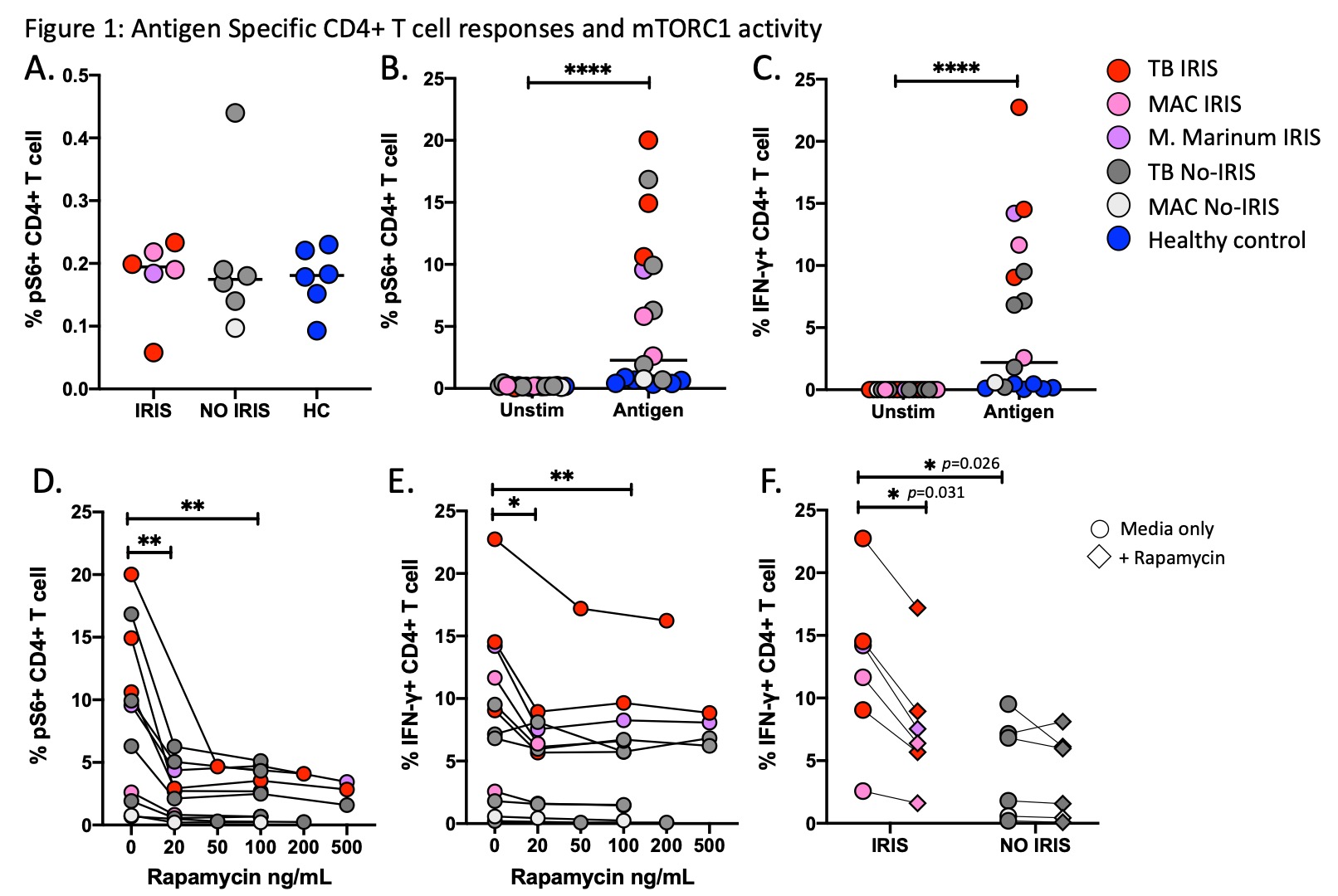
Under unstimulated condition, pS6 expression in CD4+ T cells was low with no difference between IRIS, no-IRIS, and healthy control groups (Figure 1A). Following mycobacterial antigen stimulation, IFN-? production and pS6 level were significantly increased (p<0.0001) in CD4+ T cells in HIV+ patients with mycobacterial co-infection (Figure 1B, C). Rapamycin reduced pS6 expression and IFN-? production in CD4+ T cells in a concentration independent manner (Figure 1D, E). When comparing IRIS with no-IRIS groups, IFN-? producing CD4+ T cells in all IRIS patients were significantly decreased (p=0.031) in the presence of low concentrations of rapamycin at 20-50ng/mL (Figure 1F) reaching plateau at higher concentrations. The effect of rapamycin on IFN-? production in CD4+ T cells after stimulation was not statistically significant in HIV+ no-IRIS patients (Figure 1F).
Increased mTOR activity was observed in CD4+ T cell following antigen stimulation in HIV+ patients with mycobacterial co-infection. Rapamycin can successfully reduce pS6 levels and IFN-? production in CD4+ T cells from patients with IRIS following antigen stimulation, which highlights the potential of mTOR pathway as a therapeutic target for IRIS.