Background:
mRNA vaccines elicit a durable humoral response to SARS-CoV-2 in adults, whereas evidence in children is lacking. This study aimed to evaluate the early and long-term immunological response after the BNT162b2 vaccine in children with or without a previous SARS-CoV-2 infection.
Methods:
In a multicenter, prospective, observational study we profiled the immune response to the BNT162b2 vaccine in children aged 5-11 years attending the Pediatric Departments at the University of Padua and Bambino Gesù Children’s Hospital in Rome (Italy). Forty-four healthy children (HC), 20 immune compromised (IC), and 18 children who previously developed MIS-C (MIS-C) were included in the study. Blood samples were collected pre-, 1, and 6 months after a 2-doses vaccination schedule. Neutralizing antibodies (NAbs) and anti-S-RBD IgG titers were analyzed through Plaque Reduction Neutralization Test (PRNT) and chemiluminescent immune-enzymatic assay (CLIA), respectively. B and T cell phenotypes were analyzed by flow cytometry. Geometric mean titers (GMTs) and 95% confidence intervals and median and interquartile range (IQR) of variables were evaluated according to pre-existing confirmed COVID-19.
Results:
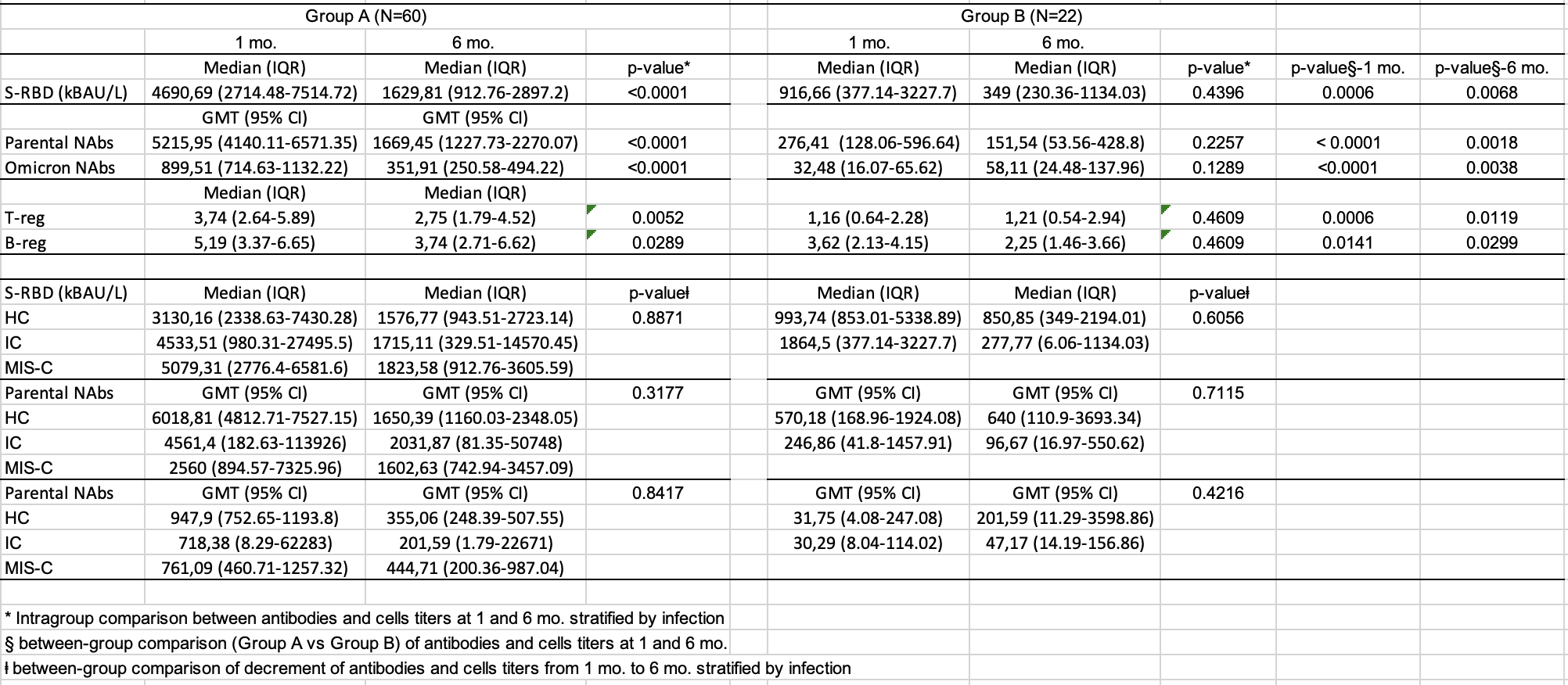
Eighty-two children were studied; 60 with a molecular-documented previous COVID-19 (Group A) and 22 without previous infection defined as the absence of antigen-specific antibodies before the vaccination (Group B). Overall, in Group A we observed higher NAbs GMTs, anti-S-RBD titers, and T- and B-reg cells than in Group A, at both 1 and 6 mo after vaccination (table); Nabs against the parental virus resulted to be greater in Group A than in Group B by a factor of 18 and 11, at 1 and 6 mo after vaccination, respectively. Both Groups recorded a decrease in antibody titers of approximately 50-70% between 1 and 6 months. A significant difference for Omicron NAbs (p=0.02) and anti-S-RBD (p=0.07) titers decay was observed between Group A and B; in contrast, Parental NAbs titers appeared to have similar trends in the 2 groups (p=0.47). Comparable antibody titers at 1 and 6 mo. (p=0.37) were detected across the three categories of HC, IC, and MIS-C (table).
Conclusions:
mRNA vaccination triggers a higher humoral response in children with a previous history of COVID-19, regardless of the immune deficiency or previous MIS-C, at least up to 6 mo, providing insight into boosting preexisting immunity with mRNA vaccines.
Table. Humoral and cell response comparison between groups A and B, overall, and stratified according to HC, IC, and MIS-C.