Background:
The HIV care continuum emphasizes that PWH should engage in lifelong care and treatment to achieve viral suppression (VS), yet progress along the continuum is non-linear for many PWH. We sought to characterize states of engagement in care and identify potential factors associated with disengagement among a longitudinal cohort of PWH receiving care at 14 HIV clinics in Washington DC enrolled in the DC Cohort.
Methods:
DC Cohort participants ≥18 years who enrolled from 1/1/2011 to 6/30/2021 were included. Longitudinal care engagement was determined using discrete multistate modelling using 6 mutually exclusive states (engaged, short, medium-, long-term disengaged, transferred, died) based on care engagement (i.e., having ≥1 HIV visit, CD4 or VL in a 200-day interval). Multinomial logistic regression for repeated measures was used to identify predictors of transitioning between different care engagement states including demographics, HIV indicators, substance use and the modified Quan Charlson Comorbidity Index (QCCI).
Results:
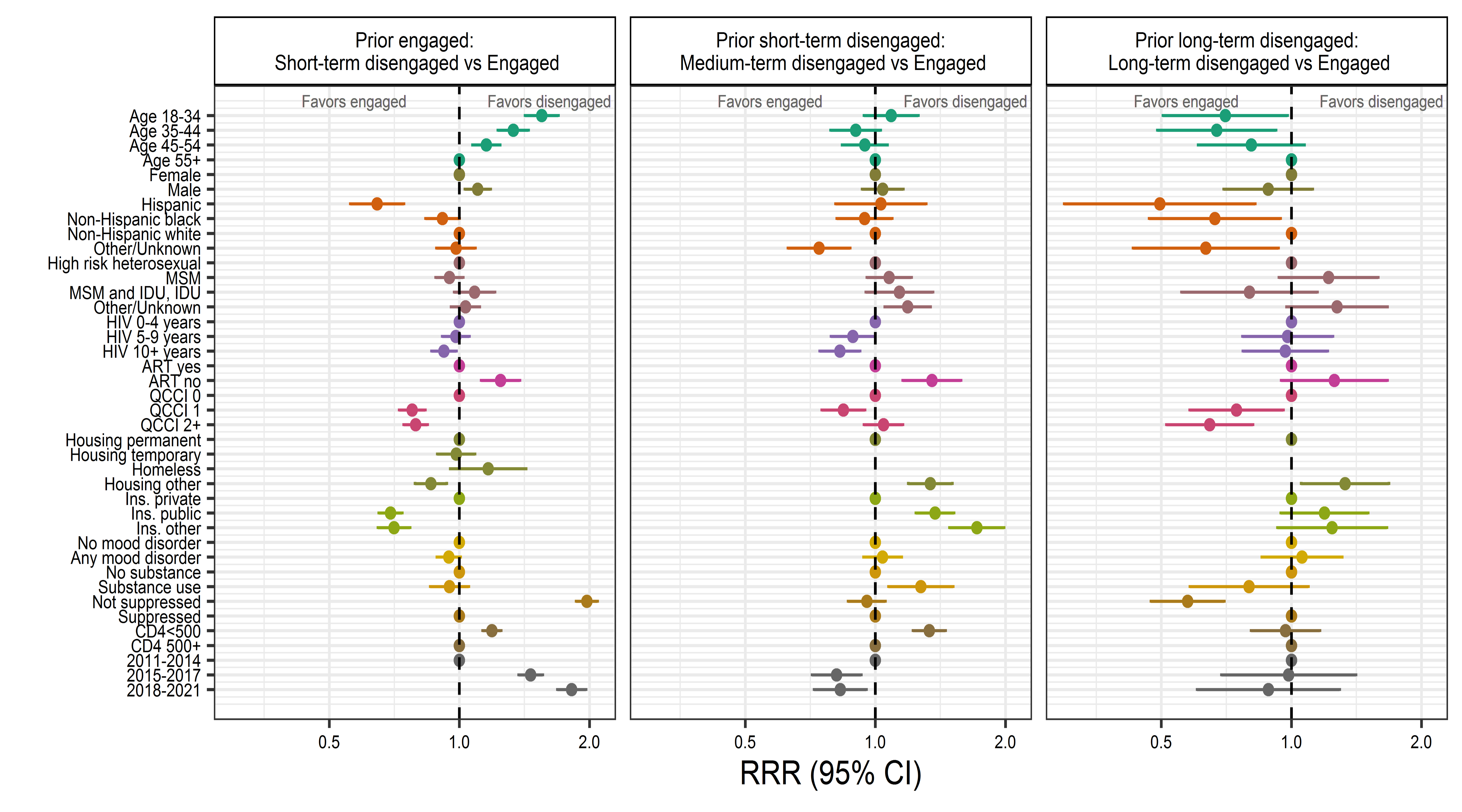
Among 11,064 PWH (median age 47 years, 72% male, 63% NH Black, 48% ≥10 years since HIV diagnosis, 75% VS), the probability of remaining engaged was 85%, the probability of disengagement was 14%. After one 200-day period of disengagement (short-term disengagement), the probability of re-engagement was 55%, 21% after two periods (medium-term disengagement), and 4% after ≥3 periods of disengagement (long-term disengagement). During the observation period 14% of PWH transferred their care; 4% died. Factors associated with short-term disengagement compared to those who remained engaged included younger age, race/ethnicity, male, not on ART at baseline, a QCCI score of 0, private insurance, not VS and CD4 < 500 cells/µL (p-values < 0.05). Medium-term disengagement was associated with younger age, not being on ART, lack of permanent/stable housing, any substance use, public insurance, and CD4 < 500 cells/µL (p-values < 0.05). Predictors of long-term disengagement included increasing age, being NH White, not being on ART, lower QCCI score, lack of permanent/stable housing, and being VS (p-values < 0.05)(Figure).
Conclusions:
Among a cohort of PWH who linked to care, we found the probability of re-engaging in care decreased with each additional 6-month interval and factors associated with disengagement varied based on the duration out of care. Identifying PWH at risk of early disengagement may minimize the cyclic nature of care and improve long term HIV care continuum outcomes.
RRR (95% CI) for the multinomial regression for the transitions from engaged in care to short-term disengaged vs remaining in care (left panel), from short-term disengaged to medium-term disengaged vs returning to care (center panel), or from long-term disengaged to remaining in long-term disengaged vs returning to care (right panel)