Background:
Dolutegravir (DTG) is an integrase strand transfer inhibitor (INSTI) approved for once-daily doing in INSTI-naive adults and children living with HIV. For adults with INSTI resistance (INSTI-r) based on certain substitutions or clinical suspicion, current recommendations are to double the standard 50 mg dose of DTG giving it twice daily (BID). However, dosing recommendations for children with INSTI-r have not been assessed. Our objective was to generate model-based population pharmacokinetic (PopPK) data to inform DTG BID dosing in 1st generation INSTI-r (raltegravir or elvitegravir) children (age ≥4 weeks and weight ≥3 kg), extrapolating efficacy and safety from adults to pediatric population based on drug exposures, in accordance with FDA and EMA guidance.
Methods:
A PopPK model was developed using data from IMPAACT P1093 (NCT01302847) and PENTA ODYSSEY (NCT02259127) to predict exposures from BID dosing of DTG in pediatric patients. Clinical trial simulations were performed to evaluate predicted drug levels with different dosing strategies. Exposure metrics (AUC0-24, C24 and Cmax) were calculated for each dose within each weight band. The target PK exposures (C12h geometric mean >1.97 µg/mL & AUC0-12h >32.2 µg*h/mL) for pediatrics were selected based on this adult data. DTG Cmax exposures were also evaluated for safety, with reference to existing adult and pediatric data.
Results:
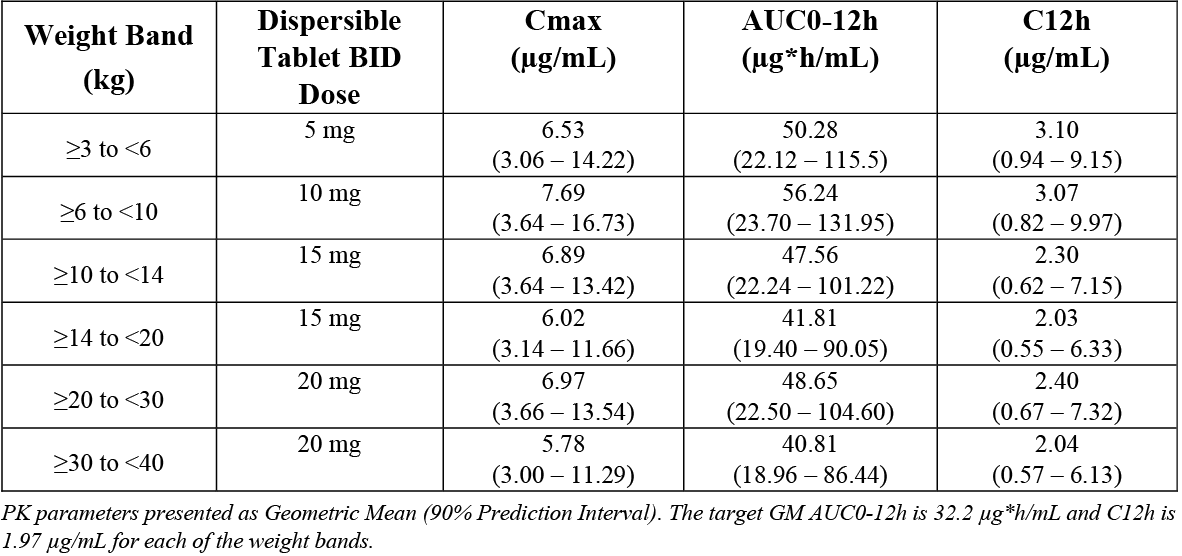
The BID dosing using the dose approved for once-daily dosing in INSTI-naive children exceeded Cmax exposures in several weight-bands compared to existing adult and pediatric data. Among the several dosing strategies evaluated, the proposed BID dosing (Table 1) yielded predicted exposures within each weight band that were comparable to the pre-defined adult exposures. These proposed doses are expected to provide similar efficacy as observed in adults with 50 mg BID dosing.
Conclusions:
The proposed BID dosing for children is predicted to achieve similar drug exposures to those in adults. While clinical PK data would form an ideal basis for dosing, recruitment of children with 1st generation INSTI-r is exceedingly challenging. These modeled data inform DTG dose selection for pediatric patients with 1st generation INSTI-r (raltegravir and elvitegravir). It is important to note that this dosing differs from guidance in adults (double standard dosing) and that BID dosing of DTG is not expected to be effective against viral resistance to DTG or bictegravir.
Table 1. Dolutegravir Model-Based BID Dosing Regimen in 1st Generation INSTI-r Pediatric Subjects