Background:
Mitochondrial genetic variability is associated with diabetes mellitus (DM) risk among people with HIV (PWH). However, it is unclear to what extent this association is driven by antiretroviral (ART) exposure.
Methods:
We included men without DM who had fasting glucose (FG) data available at baseline from the Multicenter AIDS Cohort Study (MACS). DM was defined by fasting glucose ≥ 126 mg/dL, the use of DM medication, a DM diagnosis, or hemoglobin A1c ≥ 6.5%. Self-reported time-varying exposure to mitochondrial-toxic ART (D-drug; stavudine, zalcitabine, and didanosine) were obtained at 6-monthly visits. Haplogroups were inferred from genotyping data using HaploGrep. We used multivariable Cox regression to examine the race-stratified association between common European (UK, JT) or African haplogroups (L2, L3) and hazard of DM over time. We further examine the association with and without D-drug exposure, as well as with a statistical interaction term. Models were controlled for principal components of genetic ancestry, age, BMI, HCV or HBV infection, and smoking (never, ever, vs. current).
Results:
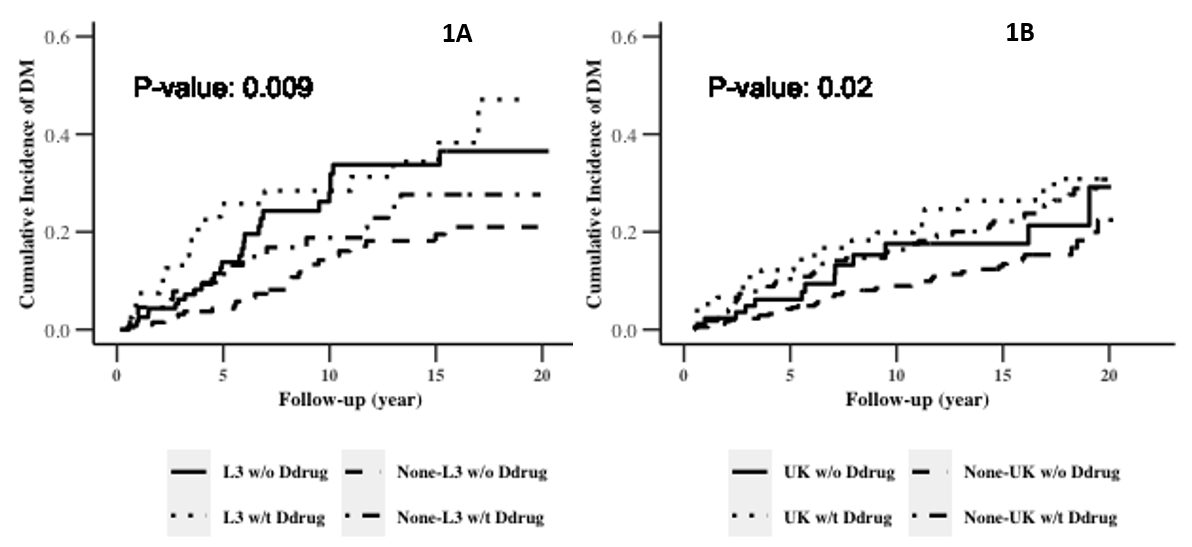
Of 2598 men (1249 PWH and 1349 people without HIV [PWoH]), 667 were Black, 1616 were White, and median age at baseline was 44 years [IQR: 37, 50]. Among PWH of African origin, Haplogroup L3 was associated with increased hazard of incident DM (HR: 1.92, 95% CI 1.2, 3.1), independent of covariates and D-drug exposures. D-drug exposure was independently associated with incident DM (HR: 2.8, 95%CI 1.5, 5.3). Men with haplogroup L3 and exposure to D-drugs took the shortest time to develop DM (median: 3.5 years), while men without L3 and D-drug exposures took the longest time to develop DM (median: 7 years; Figure 1A). No association between European haplogroup (UK or JT) and DM risk was observed. However, PWH with European haplogroup UK and exposure to D-drug had a significantly shorter time to incident DM, compared to other groups (Figure 1B). Mitochondrial haplogroups were not associated with incident DM among PWoH.
Conclusions:
A common mitochondrial haplogroup L3 increases the risk of incident DM in African-ancestry men with HIV. This association was accentuated by exposure to mitochondrial-toxic ART, but was seen in all men having this haplogroup.
Figure 1. Time to incident diabetes mellitus by mitochondrial haplogroups and D-drug antiretroviral therapy exposures in the Multicenter AIDS Cohort Study (MACS)