Background:
Mitochondrial (mt) dysfunction has been described in acute severe SARS-CoV2 infection. It remains unclear whether the disturbances in mt are also present in post-acute sequelae of COVID-19 (PASC).
Methods:
We analyzed cross-sectional data from participants without history of COVID and SARS-CoV2 antibody negative (COVID-), with documented prior COVID and full recovery (COVID+ PASC-), and with prior COVID with PASC as defined by the CDC (COVID+PASC+). Mt respiration was measured from peripheral blood mononuclear cells utilizing the Seahorse XFe96 analyzer. Generalized linear regression was used to compare estimates of mt and non-mt respirations, and unadjusted odds ratios using multinomial logistic regression to assess if mt respiration were associated with PASC.
Results:
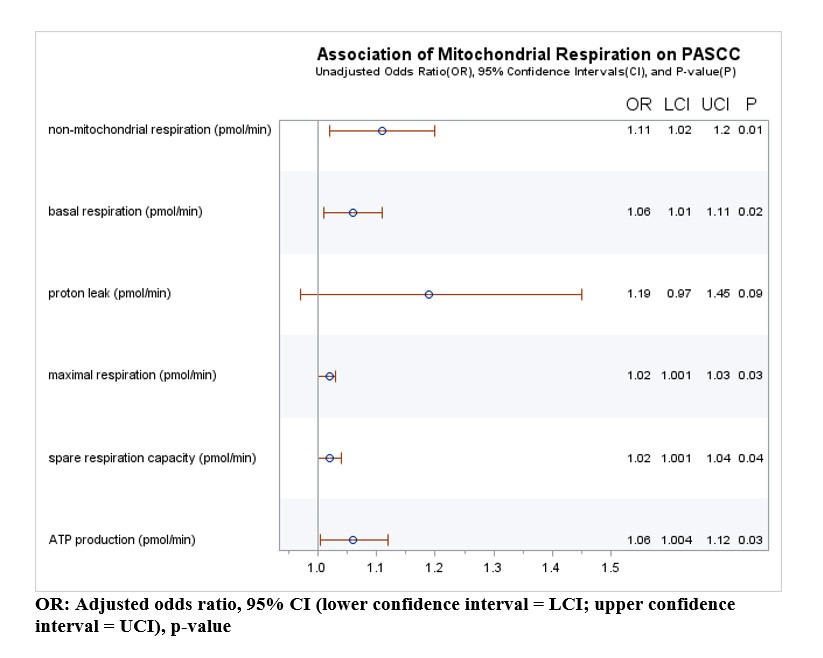
For this analysis, 59 participants were enrolled, 71.19% (n=42) had a confirmed COVID-19 diagnosis. The overall mean age was 47.47 ± 14.86 years, 69.49% (n=41) were females and 33.90% (n=20) were non-white race. There was no difference in demographics between participants with and without COVID (p≥0.72). Amongst all COVID+ participants, 19% (n=11) had hypertension and 8% (n=5) had diabetes. Among all COVID+, the median time between COVID diagnosis and study evaluation was 210 (IQR: 119, 453) days, and 50% (n=21) of COVID+ experienced persistent symptoms consistent with PASC. PASC participants had the highest observed values in non-mt respiration (21.57 ± 10.77 pmol/min), basal respiration (38.95 ± 17.58 pmol/min), proton leak (10.41 ± 3.1), maximal respiration (103.91 ± 58.63 pmol/min), spare respiratory capacity (64.96 ± 41.82 pmol/min), and ATP production (28.55 ±14.85 pmol/min). Basal respiration, ATP production, maximal respiration, and non-mt respiration were highest in PASC compared to COVID- (p≤0.02). There was marginal evidence (p=0.05) of a mean difference (8.09 pmol/min) in ATP production between COVID+PASC+ and COVID+PASC-, without differences in proton leak (p=0.23) or spare respiration capacity (p=0.07). Every unit increase in non-mt respiration, basal respiration, maximal respiration, and ATP production increased the predicted odds of PASC by 10.99, 5.6, 1.6 and 6.2%, respectively (Figure).
Conclusions:
Individuals with PASC are consuming more oxygen and producing more ATP in the PBMCs compared to controls. There also appears to be increased PBMC ATP production between PASC and COVID+. We hypothesize that this may reflect a crucial pathogenic mechanism in PASC that may be associated with ongoing inflammation.
Figure : Association of mitochondrial respiration on PASC-