Natural control of viral replication in the absence of antiretroviral therapy (ART) occurs in a small fraction of HIV+ individuals. Elite controllers (EC) efficiently control blood viral load under 50 cp/ml while viremic controllers (VC) maintain viral load under 2,000 copies/ml without ART. Distinct miRNA expression has been associated with cell populations in these patients. Hence, we explored the miRNome of CD4 T cells to identify a miRNA signature related to HIV infection control.
We performed miRNA-Seq in forty-four samples of CD4 T cells from EC (n=10), VC (n=10), HIV-negative individuals (HIV-; n=4), and typical progressors (TP) before (NT-TP; n=10) and after ART administration (ART-TP; n=10). Viral load was monitored for at least more than one year. Reads were aligned to miRBase v21 with Chimira and miRDeep2 and differential expression analysis was carried out between groups (FDR-adjusted q-value<0.1). Target genes were predicted using miRNet and filtered with NCBI's HIV-host protein interactome, checking for experimentally validated miRNA-gene interactions in DIANA-Tarbase 8.0 and miRTarBase v8.
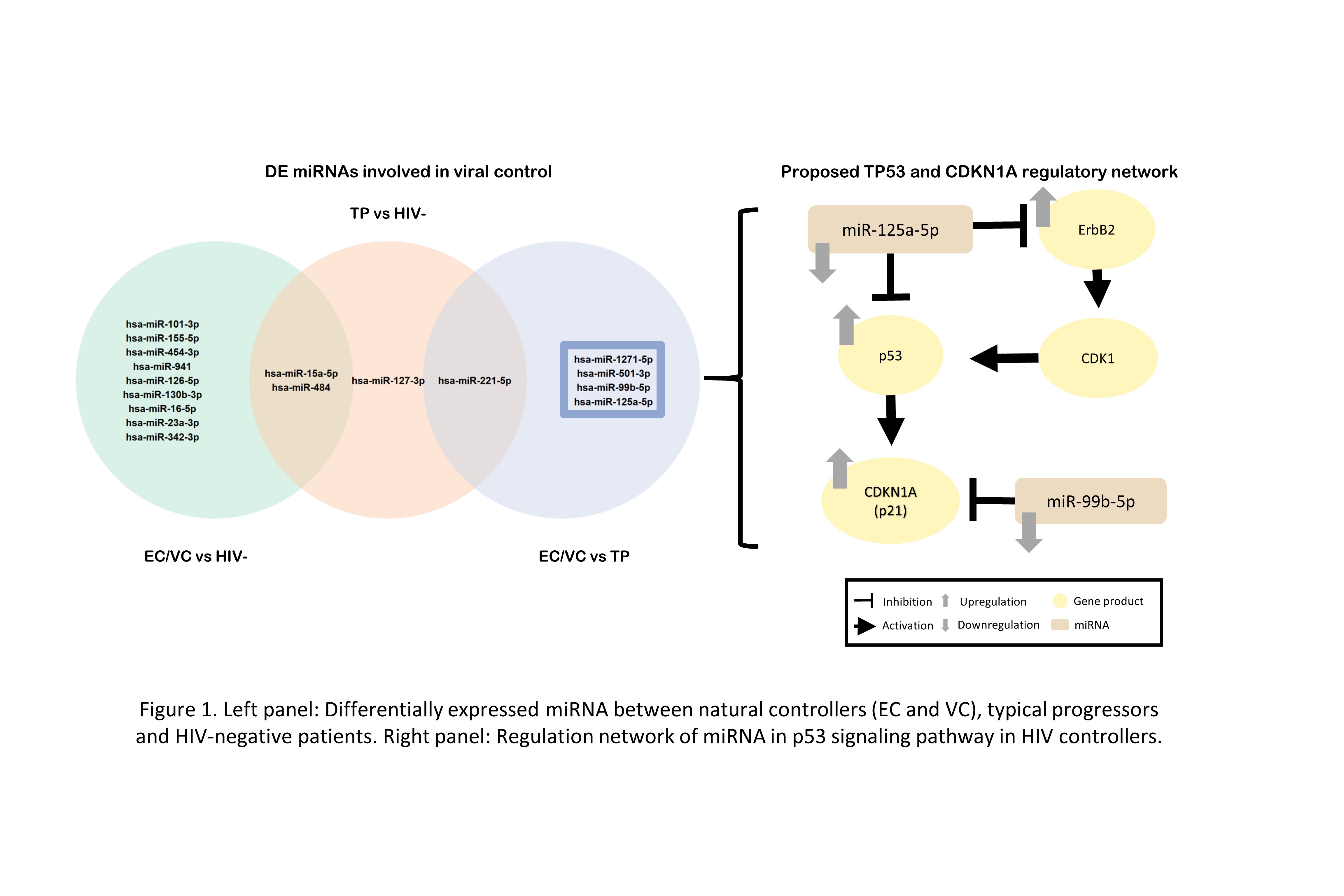
We found four downregulated miRNA in EC/VC vs TP (Fig.1): miR-1271-5p (log2 fold change (LFC)=-1.318), miR-501-3p (LFC=-1.043), miR-99b-5p (LFC=-0.855), and miR-125a-5p (LFC=-0.665), that likely regulate 822 host genes. Pathways potentially affected by the downregulation of these miRNA include ErbB and p53 signaling routes (q<5x10⁻⁴). Within these routes, miR-125a targets ErbB2, and TP53, and miR-99b targets CDKN1A. In addition, EC presents an upregulation of let-7c-5p vs NT-TP (FC=0.861; q<0.1), vs ART-TP (LFC=0.921; p<0.05), and vs TP (LFC=0.606; p<0.05), including TNPO3 and IL-10 as experimentally validated targets of this miRNA. Moreover, miR-221-5p, miR-192-5p, miR-484, miR-501-3p, and let-7f-5p (q<0.1) were downregulated in EC vs NT-TP and HIV- vs NT-TP comparisons.
We observe a specific signature of four downregulated miRNA in ECs’ and VCs’ CD4 T cells compared to TPs. These miRNAs regulating the expression of ErbB2, p53, and CDKN1A may produce the activation of the p53 signaling route, fostering cell cycle arrest and a pro-apoptotic state, as well as the CDKN1A-mediated HIV restriction. The upregulation of let-7c-5p reveals a specific mechanism in ECs, which may modulate pre-integration complex nuclear transport and site-directed integration through TNPO3. Besides, similar miRNA signatures have been found in ECs and HIV-.