Background:
Majority of studies investigating associations between maternal antiretroviral therapy (ART) and preterm delivery (PTD) are observational and subject to bias, which may contribute to heterogeneity in findings. We investigated the impact of participant selection, data source and data quality on observed associations between maternal ART and PTD.
Methods:
Data from 3 related data sources from the same underlying population over same time-period (January 2017-July 2018) in Western Cape Province (South Africa) were compared. 1) Province-wide routine electronic health data on pregnant women (records linked across health services by the Provincial Health Data Centre (PHDC)); 2) facility-based pregnancy exposure registry (PER) (based on digitisation of patient-held booklet recording pregnancy-related clinical information); and 3) a purposely sampled cohort study (questionnaire-based data collection and clinical records abstraction). Data availability, detail and quality of baseline characteristics varied by data source. Associations between maternal ART and PTD were examined separately to assess impact of data source on the association. We compared PTD by HIV status (HIV+ vs HIV-) and ART status (initiation preconception vs during pregnancy).
Results:
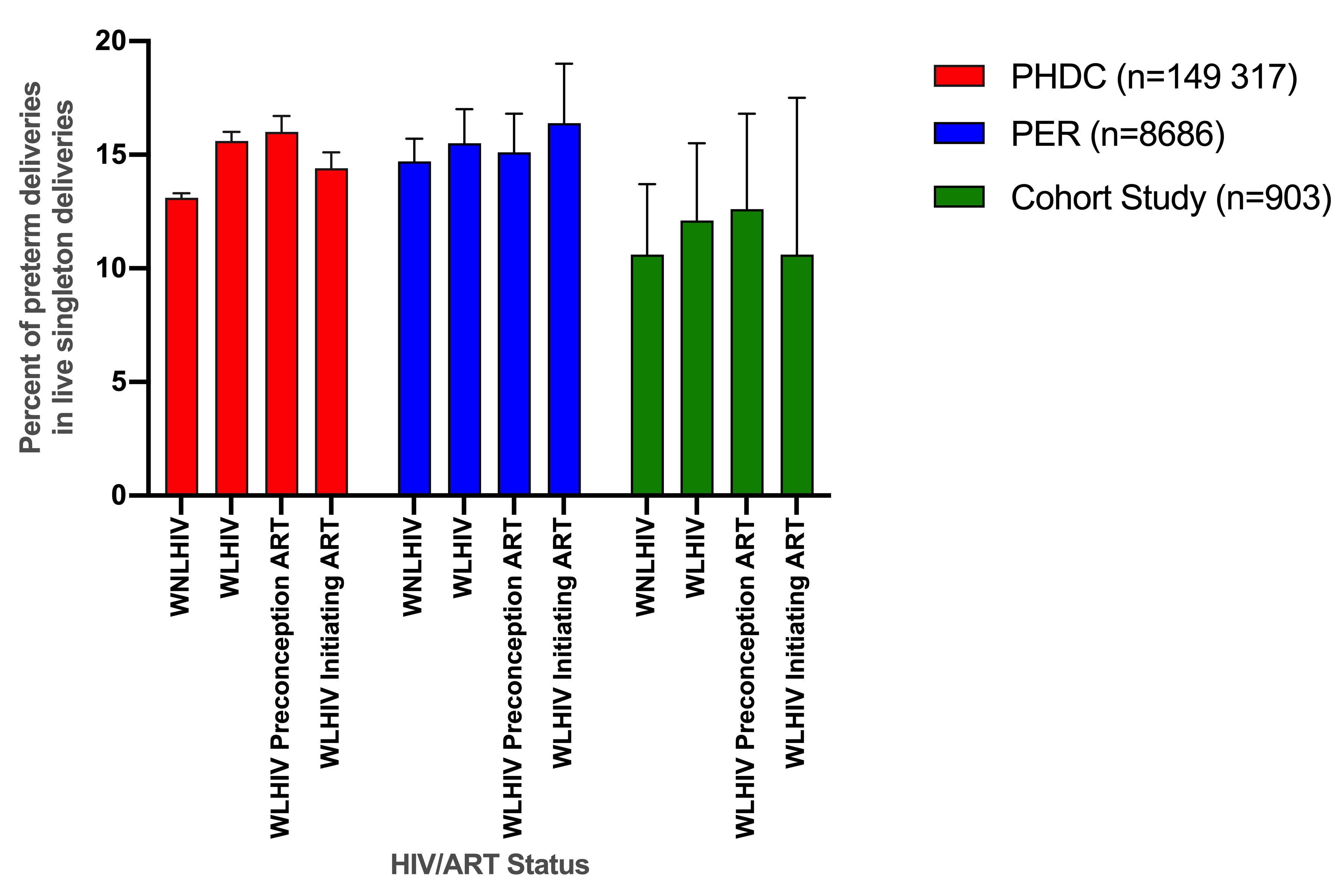
Median age (27y) was similar across data sources, however proportions of primigravid and HIV+ women differed: PHDC (n=183593), 53% primigravid, 19% HIV+ of whom 56% on ART preconception; PER (n=9476) 25% primigravid, 32% HIV+ of whom 66% on ART preconception; and cohort study (n=989) 21% primigravid, 48% HIV+ of whom 70% on ART preconception (82% TDF+FTC+EFV, 7% PI-based regimens). Among women with live singleton births, PTD deliveries differed by HIV/ART status in PHDC (population-level); differences were less pronounced in PER and cohort study (Figure). Increased PTD risk in HIV+ women (ARR1.15, 95% CI1.11-1.18) and women on preconception ART (ARR1.08, 95% CI1.01-1.14) was only observed in PHDC. Data availability and quality did not impact association estimates, however statistically significant differences by HIV/ART status were only detectable in the larger PHDC population.
Conclusions:
With improvements in birth outcomes due to increased coverage of safer ART regimens, sample size considerations will be important to detect differences in obstetric outcomes by HIV status. Inclusion of both population level data and purposely sampled studies will remain important to leverage the benefits of both data sources.
Preterm delivery by HIV/ART Status