Background:
People with HIV who develop cancer have a higher risk of dying from their cancer compared with immunocompetent cancer patients in the general population. However, no prior study has assessed HIV disease markers in relation to cancer-specific mortality among cancer patients with HIV.
Methods:
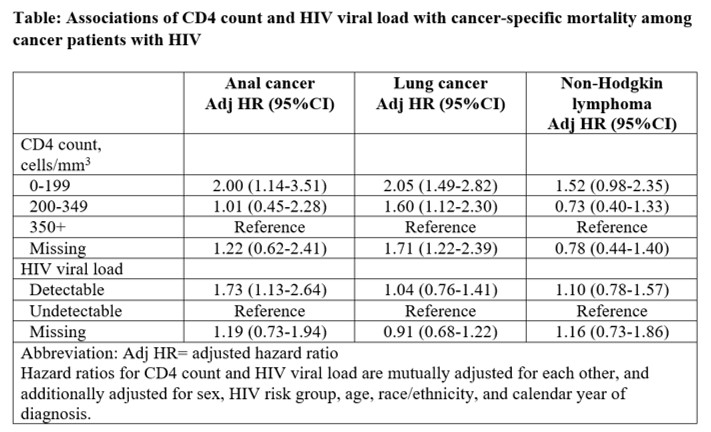
We used data from the HIV/AIDS Cancer Match Study, a linkage of US state HIV and cancer registries. We selected individuals with HIV who developed 3 common cancers during 2005-2018: anal cancer (Nf765), lung cancer (Nf682), or non-Hodgkin lymphoma (NHL, Nf1173). We identified the most recent CD4 count and HIV viral load (VL) within the 6 months after cancer diagnosis. Deaths from these cancers were identified from death certificates. We used Cox proportional hazards models to assess adjusted associations of CD4 count and HIV VL with cancer-specific mortality (see Table).
Results:
Among individuals with HIV diagnosed with anal cancer, lung cancer, or NHL, a total of 134, 334, and 171 patients, respectively, died from their cancer. For anal cancer and lung cancer, individuals with CD4 counts below 200 cells/mm3 had significantly increased cancer-specific mortality (adjusted hazard ratio [HR] 2.00, 95%CI 1.14-3.51, and 2.05, 1.49-2.82, respectively, compared to individuals with CD4 350+ cells/mm3; Table). For anal cancer, patients with detectable HIV VL also had elevated cancer-specific mortality (adjusted HR 1.73, 95%CI 1.13-2.64). The association between CD4 and cancer-specific mortality was borderline for NHL (adjusted HR 1.52, 95%CI 0.98-2.35 for CD4 counts 0-199 vs. 350+ cells/mm3; Table).
Conclusions:
Among patients with anal cancer, lung cancer, or NHL living with HIV, a low CD4 count at the time of diagnosis was associated with an increased risk of individuals subsequently dying from their cancer. These results are preliminary, and additional analyses need to be performed that further adjust for cancer stage at diagnosis and cancer treatment. Nonetheless, our findings support that immunity plays a crucial role in the control of certain malignancies and preventing relapse and death. Optimizing antiretroviral therapy to suppress HIV replication and restore immune function should be an important component of cancer treatment.