Background:
Viremic Non-Progressors (VNPs) is a rare subgroup of HIV+ individuals who maintain high CD4 counts despite high viremia in the absence of antiretroviral treatment (ART), resembling SIV infection in natural hosts. The mechanisms underlying this phenotype are unclear; however, the VNP phenotype has been associated with lower expression of Interferon (IFN)-stimulated genes across multiple immune cells. Elevated IFN responses can alter host metabolism to impact immune homeostasis. However, the potential link between IFN responses, host metabolic alterations, and immune homeostasis in VNPs is unknown.
Methods:
We retrospectively selected plasma samples from 16 VNPs and 29 HIV progressors with similar viral load (VL; median log VL >4) but different CD4 decay rates (median annual CD4 loss < 10% and >10%, respectively) before ART initiation. Plasma samples from six HIV-1 seronegative individuals (HIV-) were included as a reference. Soluble plasma markers of inflammation and microbial translocation were measured using ELISA and multiplex cytokine arrays. Untargeted plasma metabolomic analysis was performed by mass spectrometry. Metabolic pathway analysis was performed using MetaboAnalyst 5.0.
Results:
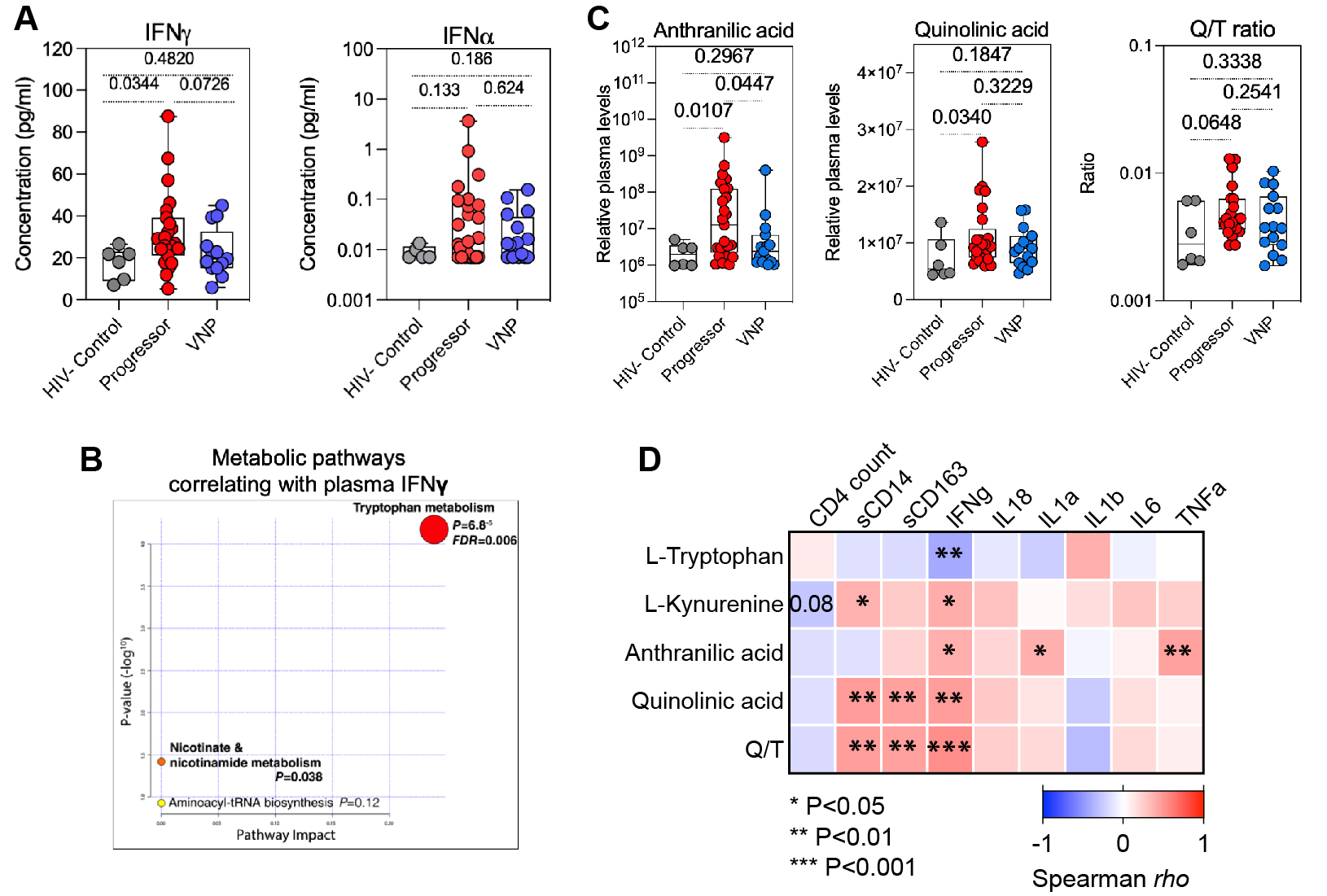
Plasma levels of the proinflammatory type II IFN (IFNγ) were similar in VNPs and HIV-, but increased in Progressors (P< 0.05; Fig. 1A). However, no difference in the levels of the antiviral type I IFN (IFNα) was observed among the three groups. Levels of plasma IFNγ were strongly associated with an upregulation of tryptophan (Trp) catabolism and nicotinamide metabolism pathways (FDR=0.006 and P=0.038, respectively, Fig. 1B). Consistently, levels of metabolites within the Trp catabolism pathway (including anthranilic acid, quinolinic acid (Q), and the ratio of Q/Trp), with established immunomodulatory roles, were increased in Progressors, but not in VNPs, compared to HIV- controls (Fig. 1C). Finally, high Trp catabolism correlated with high levels of proinflammatory cytokines and low CD4 counts (Fig. 1D).
Conclusions:
Increased Trp catabolism, as observed in HIV Progressors, is known to restrain CD4 T-cell function and decrease T cell survival. Conversely, unaltered Trp metabolic profile was linked to immune preservation in VNPs. Additional investigations are warranted to examine the mechanistic links between this pathway and the desirable phenotype of VNPs. Unraveling these mechanisms may guide the development of novel therapeutic strategies to maintain immune homeostasis during HIV infection.
Figure 1