Background:
The World Health Organization defines HIV viral load (VL) suppression as <1,000 copies/mL (c/mL). However, low-level HIV viremia (LLV) has been associated with drug resistance mutations and virologic failure. Limited data are available on population-based prevalence of LLV in low and middle-income settings, especially following the expansion of dolutegravir-containing regimens.
Methods:
We examined temporal trends in prevalence of LLV, defined as HIV RNA >50 and <999 c/mL, among persons with HIV (PWH) aged 15y+ who reported ≥12 months of ART use, by analyzing data from five African countries (Eswatini, Lesotho, Malawi, Uganda and Zimbabwe) which conducted two sequential, nationally representative population-based HIV impact assessments (PHIA1 [2015-19] and PHIA2 [2020-21]). VL values of 'target not detected', <20, <40 and <50 c/mL were all categorized as '<50 c/mL'. Dolutegravir was qualitatively measured in PHIA 2 blood samples using analytic methods. Weighted prevalence and distribution of LLV by demographic characteristics and use of dolutegravir were assessed.
Results:
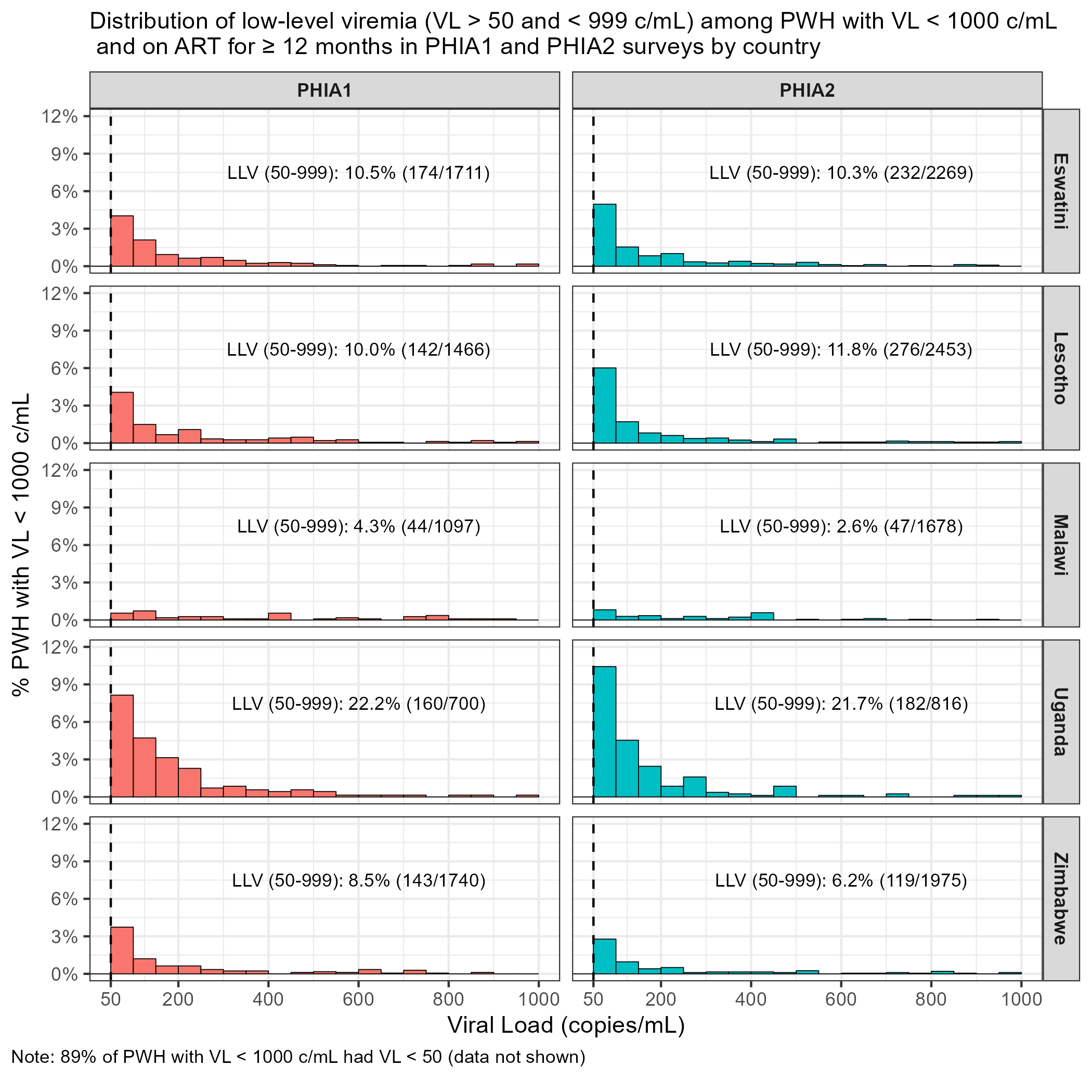
Among 185,552 individuals enrolled across the 10 surveys, 27,202 were PWHIV. Of these, 17,347 (58%) reported ≥12 months of ART use; of these, 15,978 (91%) had VL <1,000 c/mL. Among those with VL <1,000 c/mL, 14,386 (89.2%) had VL < 50 c/mL and 1,519 (10.8%) had LLV. LLV varied by survey from 2.6% to 22.2% but was largely stable over time in each country. LLV was similar among younger (age <30 y) adults vs older adults (13.1% [95% confidence intervals (CI):10.8, 15.8] vs 10.5% [9.7, 11.3]). Four of five countries had a similar distribution of LLV (Figure). Overall, 70.4% of the 1,519 individuals with LLV had values >50 and < 200 c/mL, with little variation by country or survey year. In the PHIA2 surveys, across all five countries, LLV was similar among those with and without detectable dolutegravir (10.3% [8.8, 12.0] and 10.5% [9.0, 12.3]). LLV was significantly less common, however, among those with vs without dolutegravir in Eswatini (9.2% [7.9, 10.8] vs 18.1% [13.4, 24.0]) and Malawi (1.9% [1.2, 2.9] vs 7.4% [4.6, 11.6])
Conclusions:
The population-based prevalence of LLV among PWH who have been on ART ≥12 months, based on two sequential, nationally representative general population surveys in five African countries, was stable and relatively low at approximately 10%. Most of the LLV values were under 200 c/mL, suggesting the risk of drug resistance and ongoing HIV transmission due to LLV are likely to be minimal.