Background:
Living with HIV is associated bone density deficits, increasing fracture risk. We investigated the effect of HIV on bone density accrual over one year and inflammatory biomarkers relevant to osteoclast formation in peripubertal children and adolescents with and without perinatal HIV.
Methods:
From 2018 to 2020, clinically healthy children with HIV (CWH) on antiretroviral treatment (ART) for at least 2 years, aged 8-16 years, were recruited from HIV clinics as were children of similar ages without HIV (CWOH) from nearby schools in Harare, Zimbabwe. Dual X-ray absorptiometry was performed at baseline and at 12months quantifying height-adjusted total-body less-head bone mineral content for lean mass (TBLH-BMC) and size-adjusted lumbar spine bone mineral apparent density (LS-BMAD) Z-scores. Change in Z-scores accounted for follow-up time. Baseline plasma levels for CRP, sCD14, TNFα, IL-6, IL-17α, IL-18, IL-10 and IFNλ were measured using Luminex. Bone outcome measurements were univariately plotted with age, with linear regression used to compare longitudinal changes in bone density by HIV status, adjusting for age, pubertal stage and baseline bone density. Principal components analysis was used to group inflammatory biomarkers. Linear regression models were used to compare these components by HIV status adjusting for age and pubertal stage.
Results:
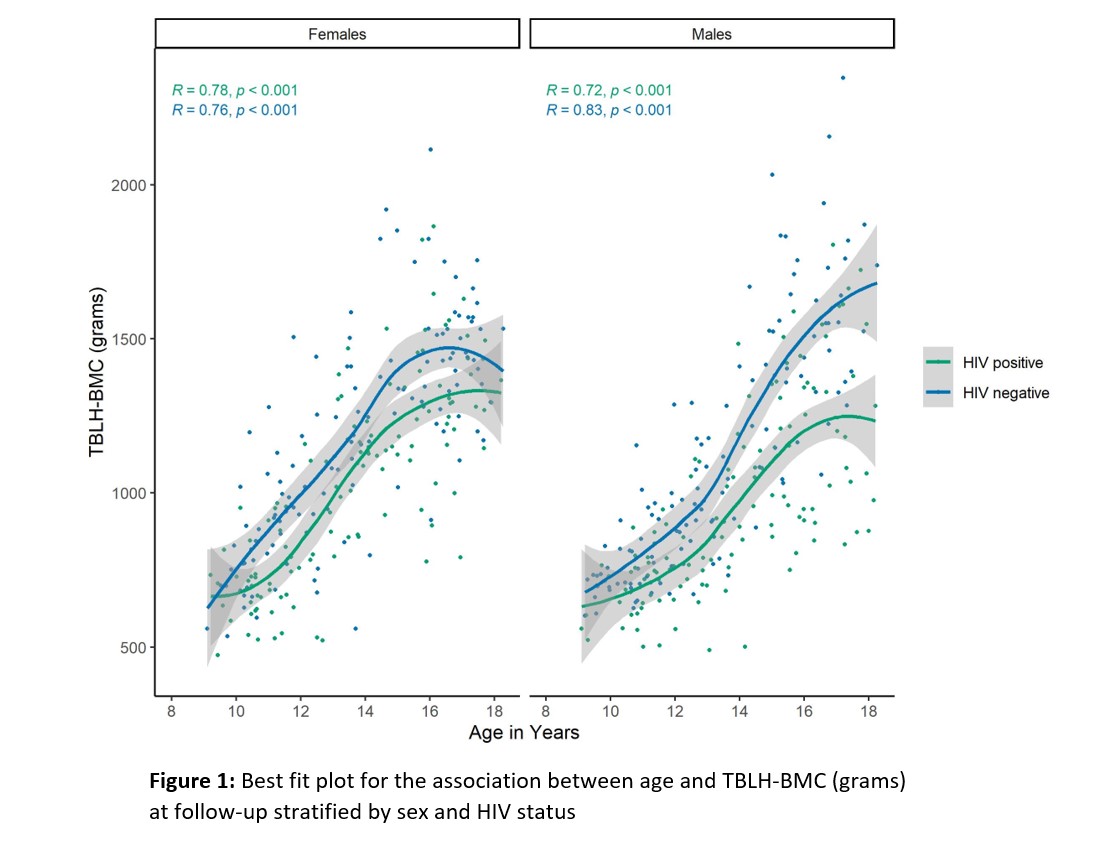
There were 275 CWH (mean±SD 12.6±2.5 years old, 134[49.6%] girls) and 283 CWOH (12.7±2.5 years old, 149[50.4%] girls) at baseline. No deaths were reported, but 19% were lost to follow-up. ART regimens included either a non-nucleoside reverse-transcriptase or protease inhibitor; 211 (70%) and 89 (29%) respectively. HIV was associated with impaired gains in bone density, particularly among males (Figure 1). While females with and without HIV had similar bone density gains, males living with HIV gained less LS-BMAD (adjusted mean difference[95%CI] -0.14[-0.25 to -0.02], p=0.02) and TBLH-BMC (-0.19[-0.33 to -0.04], p<0.015) compared to males without HIV. Living with HIV was associated with higher levels of a component representing IL-18, CRP, sCD14 and TNFα for females (βcoefficient[95% CI] 0.63[0.27 to 0.98], p=0.001) and males (0.80[0.45 to 1.15], p<0.001).
Conclusions:
Children living with HIV on ART have impaired bone density accrual and increased inflammation. Further investigation is ongoing into the effect of higher inflammation on peak bone mass among this population.