Background:
We previously have shown in a clinical trial that PWH who had achieved virologic and immunologic responses with ART and were randomized to receive three double-dose (40-µg) HBV vaccine (Engerix) achieved a significantly higher seroresponse rate (anti-HBs antibody titer ≥10 mIU/ml) and high-titer (≥100 mIU/ml) seroresponse rate than PWH who received three standard-dose (20-µg) HBV vaccine. Factors associated with loss of seroprotection during follow-up were investigated.
Methods:
PWH who were born after 1986 and achieved seroresponses at Wk 28 following HBV revaccination in the trial were included in the follow-up. Loss of seroresponse was defined as testing negative for HBsAg and anti-HBc with anti-HBs titer <10 mIU/ml. The clinical characteristics at revaccination and during follow-up were analyzed, including age, sex, smoking status, CD4 count, plasma HIV RNA, and pre-vaccination anti-HBs titer.
Results:
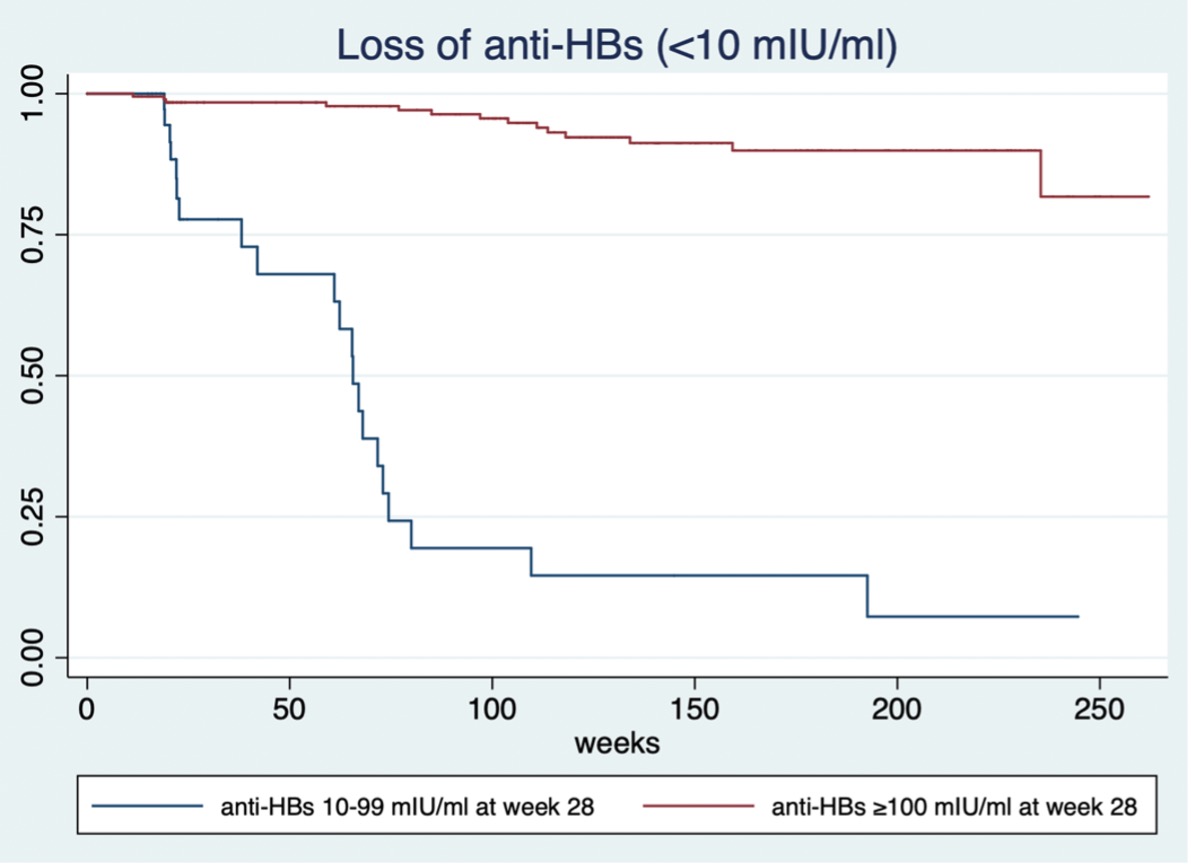
228 seroresponders (mean age, 28.5 years; median CD4, 599 cells/mm3) after HBV revaccination were included, 112 receiving standard-dose and 116 double-dose HBV vaccine. The baseline characteristics were balanced between the two groups. The median follow-up time was 2.48 and 2.04 years for PWH receiving standard-dose and PWH receiving double-dose HBV vaccine, respectively. During the follow-up, more PWH in the standard-dose group lost seroprotection than those in the double-dose group (22.3% vs 11.2%, p=0.024). Loss of high-titer seroresponse was more common for the standard-dose group than the double-dose group (43.4% vs 19.8%, p<0.001). Factors associated with loss of seroresponse during follow-up were older age (aHR, 1.14 [95% CI, 1.03-1.27]; p=0.016), lower pre-revaccination anti-HBs titer (<2.5 mIU/ml, aHR 13.23 [95% CI, 3.15-55.47], p<0.001), and HBV vaccine dose (double-dose, aHR 0.42 [95% CI, 0.21-0.90], p=0.024). People failing to achieve high-titer responses (10-99 mIU/ml) at Wk 28 were more likely to lose seroprotection during follow-up (HR 27.9 [13.7-57.0], p<0.001) with a median time to lose anti-HBs titers being 1.26 years when compared with people achieved high-titer responses (≥100 mIU/ml) at Wk 28.
Conclusions:
Three double-dose HBV revaccination leads to more sustained seroprotection than standard-dose revaccination in PWH. For PWH who fail to achieve high-titer seroresponse after revaccination, annual follow-up of anti-HBs titers is recommended to detect the loss of seroprotection for HBV revaccination to be administered timely.