Background:
In perinatal HIV infection, early ART initiation is now recommended but questions remain regarding infant immune responses to HIV as well as the impact of HIV on early immune development.
Methods:
We conducted a longitudinal study in HIV exposed infected (HEI,n=33) and uninfected (HEU,n=35) infants from Maputo, Mozambique (TARA cohort). Although ART was prescribed at diagnosis (1-2mo), adherence was inconsistent with only 6/33 achieving suppression within 5 mo of starting ART and maintaining plasma virus load (VL) < 200 copies/ml for 2 yrs. T cell phenotypes were assessed at ages 1-2 mo. (entry, Pre-ART), 5, 10, and 18 mo. Expression of markers of activation and immune regulation (CCR5, CD127, CD25, CD28, CD31, CD38, CXCR5, HLA-DR, PD-1, TIGIT) were measured on CD4 and CD8 T cell subsets by flow cytometry. Median VL in HEI at entry was 5.7 logs (range 2.5-7 logs). Spearman correlation was performed to find associations between T cell phenotypic data and VL.
Results:
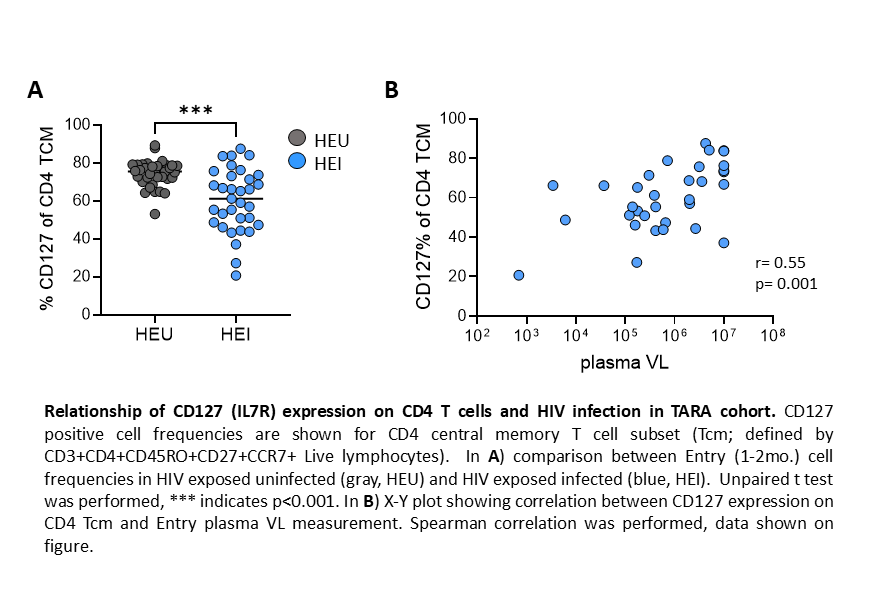
Compared to HEU at entry, higher frequencies of cells expressing activation markers, HLA-DR, PD-1, CD38, and CD25 and lower frequencies of CD28 and CD127 (IL-7R) were noted in CD8 and CD4 T cells of HEI. At entry, CD127+ CD4 T central memory cells correlated positively with VL (r=0.53, p=0.002) and CXCR5+ CD4 T cells correlated negatively with VL (r=-0.54, p=0.001). Dynamic changes in surface receptor expression were evident from 1 to 18 mo. in HEU and HEI infants, with CXCR5, PD-1, and TIGIT increasing and CD127 and CD38 decreasing with age in CD4 and CD8 T cells. Thus, to identify age-independent immunological correlates of VL in HEI at different timepoints longitudinally, we excluded T cell parameters that showed significant correlations (p< 0.05) with all three of the following: age in HEU, age in HEI, and VL in HEI leaving 62/382 parameters (16%); of these, co-expression of HLA-DR and CD38 on CD8 T cells was a strong positive indicator of plasma VL levels (r=0.44, p< 0.0001).
Conclusions:
Our results point to a role for IL7/IL7R signaling in early response to HIV infection in infants and suggests that the magnitude of IL-7 receptor downregulation on memory CD4 T cells in response to IL-7 levels could be a correlate of viral control. Further, we report the T cell developmental changes directly attributed to HIV burden and provide a strategy for identifying age-independent correlates of viral control in infants that may be important to guide the design of immune-based interventions, including vaccines, in early life.
Relationship of CD127 (IL7R) expression on CD4 T cells and Virus Load in Infants