Background:
Infection with SARS-CoV-2 triggers reprogramming through global transcriptomic changes that drive the development of Coronavirus disease 2019 (COVID-19). Although the expression and functions of protein-coding transcripts have been widely studied in SARS-CoV-2 infection, most of the transcriptome consists of non-protein-coding RNAs (ncRNAs). Long noncoding RNAs (lncRNAs), which constitute a large proportion of the transcriptome, regulate immune responses and play prominent roles in health and disease. However, the impact of lncRNAs on SARS-CoV-2 infection is poorly understood. Our study will provide fundamental insights into the role of lncRNAs in SARS-CoV-2 infection.
Methods:
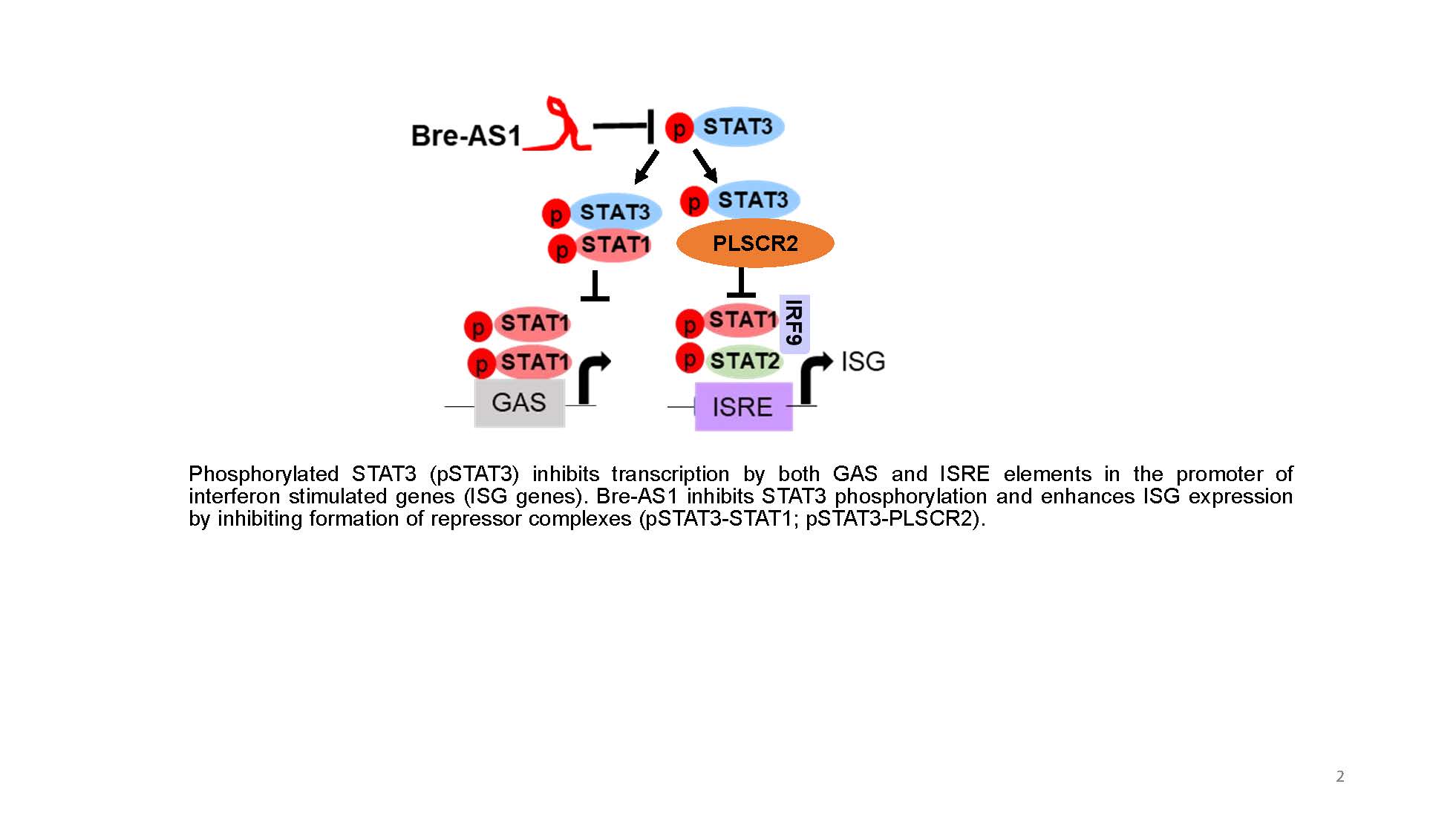
We hypothesized that SARS-CoV-2-induced lncRNAs are critical regulators of viral replication and immune response. To test our hypothesis, we identified lncRNAs with significant differential expression in SARS-CoV-2 infected vs. uninfected cells across two cell types (A549-hACE2 and Calu) from published transcriptome data. We silenced the expression of the top lncRNA Bre- AS1 (BA) a human lung epithelial cell model (A549 cells stably expressing hACE2 and hTMPRSS2, A549AT) using lncRNA-specific ASO (lncsi) or negative control (NC) and compared viral replication in lncsi vs. NC cells. BA-silencing (BA-si) increased SARS-CoV-2 replication. and inhibited the expression of antiviral interferon-stimulated genes (ISG). (Tyr 705) pSTAT3 forms suppressor molecular complexes (pSTAT3-pSTAT1 or pSTAT3-PLSCR2) that inhibit ISG transcription. Using molecular methods such as gene-silencing, immunoprecipitation, western blot, and measuring promoter activity, we further show that Bre-AS1 inhibits the phosphorylation of STAT3 and enhances ISG transcription.
Results:
Our data show that cellular lncRNA, Bre-AS1 enhances antiviral interferon-stimulated genes (ISG) expression and inhibits replication of SARS-CoV-2. Our data show that Bre-AS1 inhibits the (Tyr705) phosphorylation of STAT3 that forms ISG repressor complexes (pSTAT3-pSTAT1 or pSTAT3-PLSCR2) and thus enhances ISG transcription.
Conclusions:
Cellular lncRNA Bre-AS1 enhances expression of antiviral interferon-stimulated genes and inhibits the replication of SARS-CoV-2. Our data show that cellular lncRNAs could play significant roles in immune response and viral propagation. Thus, unraveling the mechanisms of lncRNA-mediated regulation of virus replication and immune response may lead to identifying new, highly selective therapeutic targets
Bre-AS1 inhibits STAT3 phosphorylation and enhances ISG transcription