Background:
The SARS-CoV-2 pandemic called attention to an urgent need for fast and versatile vaccine development platforms to combat infectious RNA viruses. However, there is a continuous need for new, innovative tools to study viruses with large RNA genomes that have a pathogenic potential for human disease.
Methods:
We developed the novel vaccine concept of ‘single-cycle infection viruses’ (SCV) and completed the proof-of-concept for SARS-CoV-2 in the Syrian hamster model. ‘CLEVER’ (Cloning-free and Exchangeable system for Virus Engineering and Rescue), a DNA-based strategy for rapidly generating RNA viruses directly from PCR products, enabled the specific deletion of individual viral genes in a single step. We generated and profiled replication-deficient SARS-CoV-2 variants, for which the missing function could efficiently be complemented in trans. Animals were intranasally prime/boost vaccinated, challenged with wild-type SARS-CoV-2, and assessed for protection against viral infection, transmission, and pathogenesis. Moreover, primary human T cells were utilized to assess the potency in eliciting a specific T-cell response by our SCV candidate.
Results:
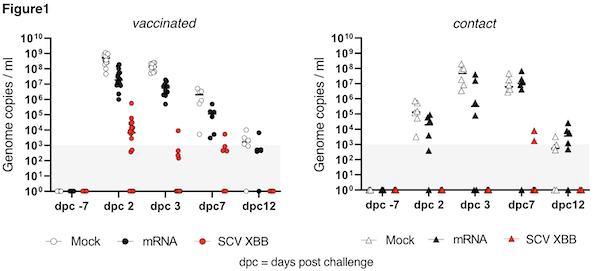
Several SCV candidates were produced and tested for functionality, stability, and safety (single-cycle properties) in vitro. After intranasal vaccination, animals tolerated the vaccine very well and experienced no weight loss, even when high doses were applied, validating excellent in vivo safety. All animals were fully protected against an autologous challenge with a high dose of infectious SARS-CoV-2 virus. With the specific deletion of three immune-modulatory viral genes sterilizing immunity was achieved, preventing any viral spread to unvaccinated contact animals. Superior immune function was further shown by specific memory T cell responses in primary PBMCs from SARS-CoV-2 pre-exposed individuals. The SC vaccine effectively prevented viral infection with reduced inflammatory cytokine levels and pathology in the lung. In a direct comparison with the most recent bivalent mRNA vaccine superior immunity was confirmed for omicron-adapted SCV: full protection of vaccinated animals, no sign of viral replication and pathology in the contact animals, achieving again sterilizing immunity (Fig.1).
Conclusions:
SCVs can induce broad protection and even sterilizing immunity against viruses, as demonstrated for SARS-CoV-2. We will use the concept to build a vaccine platform targeting other RNA viruses of concern, like Dengue or Chikungunya.