Background:
The addition of costimulatory signalling domains to the CAR construct has dramatically increased the functional capacity of CAR-T cells to kill cancer cells. We hypothesized that we could augment the functional anti-HIV activity and persistence of cytotoxic CD8 T cells (CTLs) engineered to express HIV-specific TCRs used as an adoptive therapy to provide a functional HIV cure by incorporating the intracellular activation domain of costimulatory signalling domains into the TCR construct, termed TCR-costim.
Methods:
As a proof-of-concept, we constructed a lentiviral vector (LV) encoding chimeric α and β TCR chains containing the well described HIV-1 Gag epitope SL9 human variable TCR region fused to the murine constant region, to prevent TCR mispairing with the endogenous TCR. We added the signal transduction domain of either the CD28 or 41BB to the α and/or β TCR chains. Jurkat/MA-NFAT-luciferase reporter (Jurma) cells were transduced with the LV to evaluate SL9-TCR activation by quantification of the luciferase reporter. SL9-TCR expression in CTLs from seronegative donors was determined by tetramer staining; and their cytotoxic activity, activation, and IFNγ and TNFα production by flow cytometry.
Results:
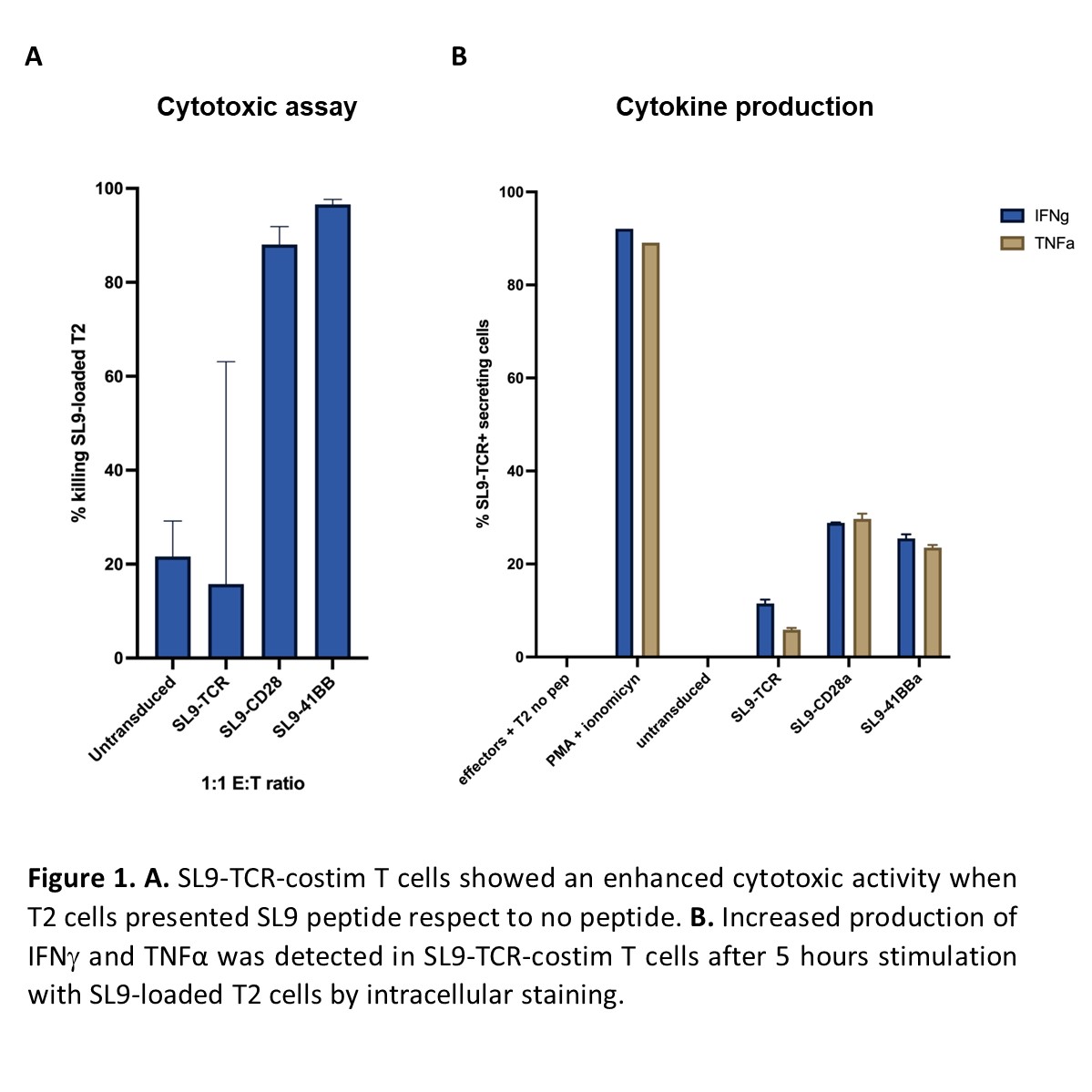
In Jurma cells transduced with the different SL9-TCR LV constructs, TCR was highly expressed (95-99%). Jurkat/Ma transduced with the SL9-CD28 LV displayed 1.47 or 2.2-fold greater TCR activation than SL9-TCR or SL9-41BB, respectively, after coculturing with SL9-loaded T2 cells. Donor CD8 T cells were effectively transduced (15-30%) with all LV contructs and SL9-TCR expression reached 80% of the transduced cells. SL9 reactivity was demonstrated by increased LAG3 and CD25 expression in SL9-TCR, SL9-CD28 and SL9-41BB CTLs incubated with SL9-loaded T2 cells but not with T2 cells alone. Of great interest was the increased cytotoxic activity (figure 1A) and IFNγ and TNFα production of SL9-CD28 and SL9-41BB CTLs as compared with SL9-TCR CTLs (figure 1B).
Conclusions:
Incorporating costimulatory signalling domains with the TCR construct (TCR-costim) provides an increased downstream activation of the TCR and an improved functional activity of CTLs. Because TCRs require recognition of far fewer HIV peptides than CARs to activate their effector functions, adoptive therapy with TCR-costim CTLs may overcome CAR-T cell limitations in recognizing and killing latent HIV infected cells which produce low levels of HIV proteins, and provide the sustained CTLs response required for a functional HIV cure.