Background:
Late HIV diagnosis is one of the main drivers of ongoing HIV transmission. We aimed to evaluate the evolution of late HIV diagnosis in CoRIS, a Spanish multicenter prospective HIV cohort, between 2012 and 2022, and assess the impact of a wide formative intervention at primary care centers assigned to Ramón y Cajal Hospital (RyC) in Madrid, Spain.
Methods:
In 2017, we conducted two training sessions to encourage HIV screening among primary care providers in 20 primary care centers assigned to RyC. 454 out of a total of 630 (72%) primary care providers attended the sessions. We compared the rates of late HIV diagnosis (CD4 <350 cells/µL and/or AIDS-defining illness, excluding documented recent infection) and advanced HIV disease (CD4<200/µL or AIDS-defining illness) between the centers with intervention (intervention group) and the remaining centers included in CoRIS (control group) before (2012-2017) and after (2017-2022) the intervention. Association measures (adjusted odds ratio [AOR]) were obtained using a logistic regression. Covariates included age, sex, geographical origin, mode of transmission, and educational level.
Results:
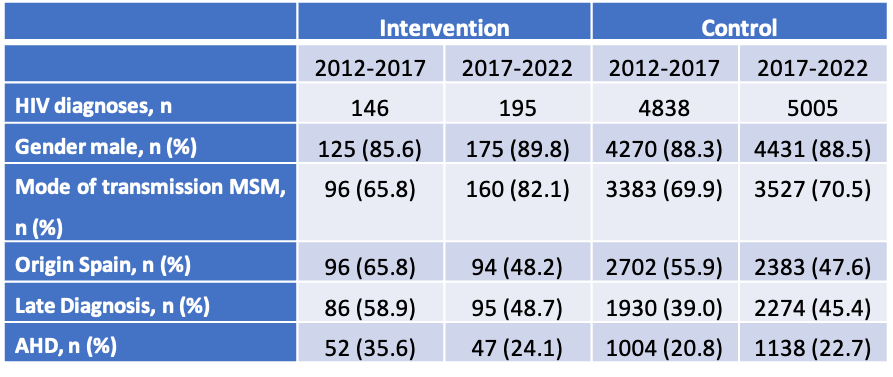
A total of 10,184 patients newly diagnosed with HIV were included, 341 of whom belonged to centers with intervention. 88.4% were male, the mean age at diagnosis was 36.45 years, 70.4% were men who had sex with men (MSM) and 51.8% were Spanish (Table 1). In the control group, late diagnosis significantly increased between both periods (39.0% before, 45.4% after; AOR 1.22 [95%CI 1.13–1.33], p<0.001). In contrast, the intervention group showed a non-significant decrease in late HIV diagnosis rates between both periods (58.9% before, 48.7% after; AOR 0.70 [95%CI 0.45–1.09], p=0.121). Notably, the intervention had a significant effect on reducing late diagnoses when comparing both groups (p = 0.017). When examining the proportion of advanced HIV disease, we noted an increase in the control group from 20.8% before the intervention to 22.7% after (AOR 1.10, [95%CI 1.00-1.22], p=0.061), compared to a non-significant reduction in the intervention group (35.6% vs. 24.1%; AOR 0.66 [95%CI 0.40-1.08], p=0.095). Importantly, the intervention had a significant effect on reducing advanced HIV disease when comparing both groups (p=0.044).
Conclusions:
A training intervention regarding HIV screening delivered to a majority of primary care providers in a health area significantly reduced the proportion of late and advanced HIV diagnoses compared to a nationwide control group.