Background:
Little is known about HIV trends among female sex workers (FSW) in Africa. We analysed data from a national-scale collaboration to explore trends in HIV prevalence and HIV incidence among FSW in Zimbabwe between 2011 and 2023, complemented by mathematical modelling.
Methods:
Between 2011-2023 we collected data on HIV infection from 13,918 women aged 18-39 in multiple respondent driven sampling surveys (RDS) in Zimbabwe, including 13 towns where surveys were repeated in 2017 and 2021, and 2 cities where surveys were repeated in 2017 and, the most recently available data, from 2023. In 2021, we analysed 306 dried blood spot samples with a recent infection algorithm (LAg avidity+Viral load). Using RDS-II weighting we explored HIV prevalence trends. We estimated HIV incidence pooled for 2011-2017 (since patterns were similar across years), and for 2021-2023, based on HIV prevalence rises with age (‘prevalence to incidence method’). In 2021, we also estimated HIV incidence using recent infections (‘RITA method’, MDRI 130 days, false recency 0.2%). In addition, the HIV synthesis model was calibrated to data from Zimbabwe.
Results:
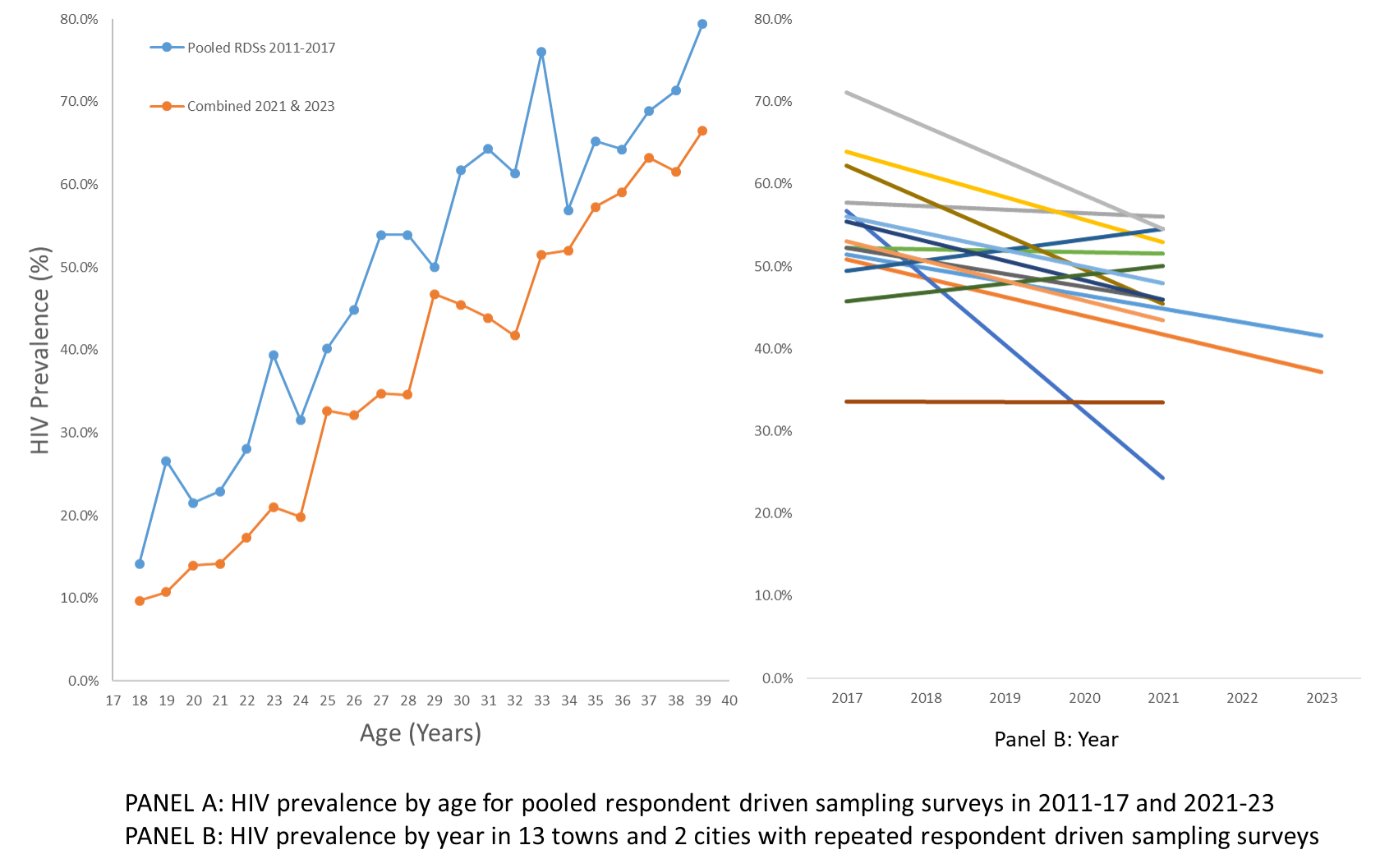
HIV prevalence in 2021-23 was 16.9% lower than in previous surveys pooled (2011-2017, 4314/7964, RDS-II prevalence 54.2%; 2021-23, 2220/5954, 37.3%, Figure Panel A). HIV prevalence fell in 11/13 towns and in both cities with repeated surveys, between 2017 and 2021/2023, by an average of 8.5% (Figure Panel B). HIV incidence (‘prevalence to incidence method’) was similar in both 2011-2017 and 2021-23, estimated at 4.4/100pyar. HIV incidence in 2021 (‘RITA method’) was estimated at 1.9/100pyar (17 recent infections, 1396 long term positive, 2107 HIV negative samples). Modelled HIV incidence was higher than the empirical estimates, but fell from 12.1/100pyar (2015) to 4.5/10 pyar (2021).
Conclusions:
Using population-based sampling we show a large reduction in HIV prevalence over time among FSW in Zimbabwe. Trends in incidence are harder to estimate, but incidence may be declining, partly driven by improved treatment coverage among men. PHIA data suggest that the proportion of males aged 15-49 living with HIV who had suppressed viral load increased from 48.9% (2015/16) to 68.1% (2020). HIV incidence remains unacceptably high among FSW. Persistence and innovation in HIV prevention for FSW are needed.