Background:
The determinants of functional cure of hepatitis B virus (HBV) infection during antiviral therapy are poorly understood. Hepatitis B core-related antigen (HBcrAg) and circulating HBV RNA correlate with intrahepatic covalently closed circular DNA (cccDNA) levels and cccDNA transcriptional activity. Both markers may help identify persons who eventually experience functional HBV cure on therapy. We aimed to compare long-term kinetics of circulating HBV RNA and HBcrAg levels among persons living with HIV (PLWH) and HBV treated with tenofovir in the Swiss HIV Cohort Study.
Methods:
We matched 29 participants with to 29 participants without functional HBV cure based on age, sex, pre-treatment with lamivudine and CD4+ T-cell count. We modeled HBV RNA and HBcrAg levels over time using linear regression with time as a function of fractional polynomials, and compared HBV RNA and HBcrAg levels during tenofovir therapy in participants with and without functional HBV cure. We defined functional HBV cure as the first occurrence of a quantitative hepatitis B surface antigen < 0.05 IU/ml.
Results:
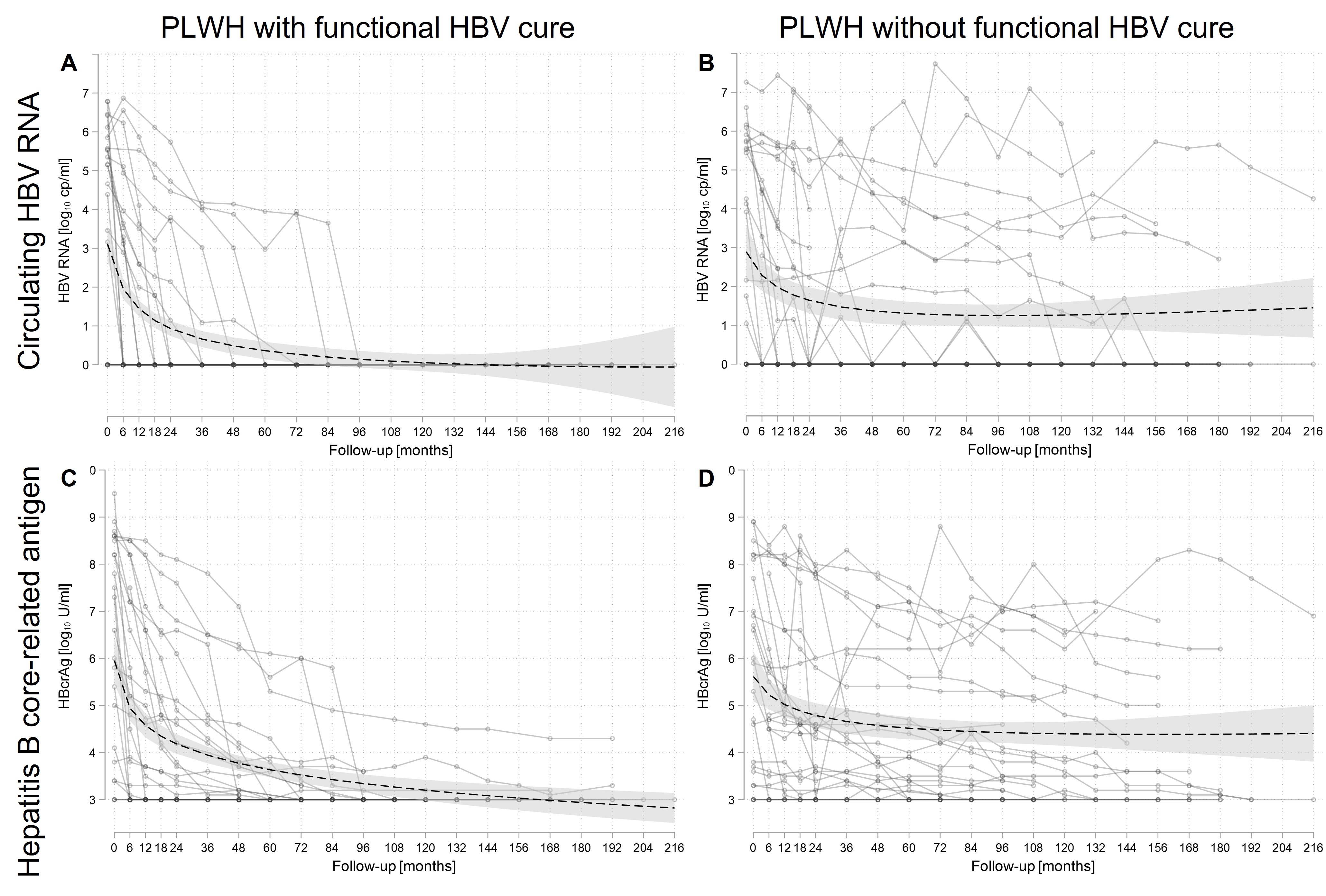
Median follow-up time was 12 years (interquartile range [IQR] 8-14) with functional HBV cure occurring after a median of 4 years (range 0.5-14). At start of tenofovir, 23/58 (40%) participants had undetectable HBV RNA and 11/58 (19%) had HBcrAg below cut-off. Median levels of HBV RNA and HBcrAg at tenofovir start were similar in those with and without functional HBV cure (HBV RNA: 5.5 [IQR 4.9-6.3] vs. 5.5 log10 cp/ml [IQR 4.0-6.0], p=0.57; HBcrAg: 7.5 [IQR 5.4-8.6] vs. 6.6 log10 U/ml [IQR 4.6-8.1], p=0.22). Among those with detectable HBV RNA at tenofovir start, 14/17 (82%) with functional HBV cure compared to 10/18 (56%) without cure had an HBV RNA decline of ≥1 log10 cp/ml after one year on tenofovir (p=0.15, Figure 1). In participants with HBcrAg above cut-off at tenofovir start, 14/22 (64%) with functional HBV cure compared to 8/25 (32%) without cure had an HBcrAg decline of ≥1 log10 U/ml (p=0.04) after one year. Five years after tenofovir start, HBV RNA was undetectable among 26/28 (93%) participants with functional HBV cure compared to 17/26 (65%) without cure (p=0.02), and 18/28 (64%) with cure had HBcrAg below cut-off compared to 6/26 (23%) without cure (p=0.003).
Conclusions:
A decline in circulating HBV RNA and HBcrAg levels during tenofovir therapy is more likely in PLWH with functional HBV cure than in those without cure. HBV RNA and HBcrAg may be promising predictive markers of functional HBV cure.
Kinetics of circulating HBV RNA levels in participants with (A) and without (B) functional HBV cure and kinetics of HBcrAg levels in participants with (C) and without (D) functional HBV cure during treatment with tenofovir. Mean levels of HBV RNA and HBcrAg were modeled as fractional polynomials of time (dashed line) with 95% confidence intervals (shaded area) and individual changes of HBV RNA and HBcrAg (circles with connecting solid lines). Cut-off was 10 cp/ml for HBV RNA and 3 log10 U/ml for HBcrAg.