Background:
Internalized HIV stigma (IHS) may have significant impact on people with HIV (PWH). Our prior work suggests associations between IHS and increased HIV viral load are mediated by depression. Herein, we describe longitudinal changes in IHS and associations with mental health and substance use.
Methods:
The CFAR Network of Integrated Clinical Systems (CNICS) is a longitudinal, multisite, cohort of PWH in care who complete tablet-based care assessments. At two different timepoints (T1 and T2) 1 year apart (from 2016-2022), IHS was assessed by 4 Likert scale response questions (low 1-5 high), with mean score and dichotomized score at ≤2 (no stigma) vs >2 used as primary exposures. We estimated adjusted rate ratios (ARR) of the association between IHS, depression, anxiety, and substance use at T1 and T2, adjusting for plausible confounders using conditional logistic regression (CLR) for dichotomized and Poisson regression (PR) for mean IHS score. We also fit autoregressive (AR) models with IHS parameterized as none, decreasing, constant, or increasing stigma (≤2 to >2) from T1 to T2.
Results:
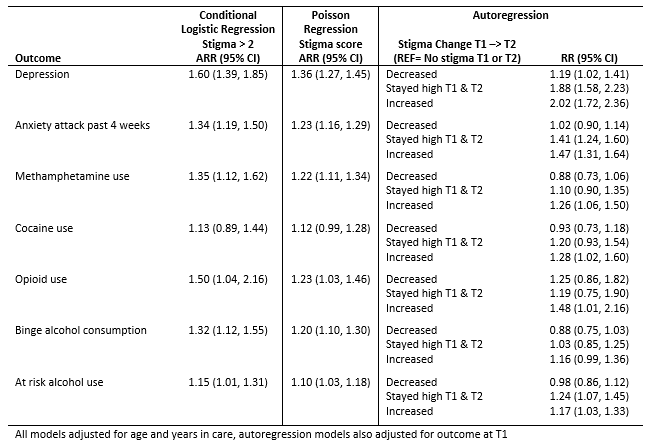
6123 PWH had complete IHS and outcome data at T1 and T2. Mean IHS was 2.01 at T1 and 1.93 at T2, with younger, non-gay identifying, and female PWH reporting higher IHS at T1 and T2 (p < 0.001). From T1 to T2, 2248 (37%) PWH had IHS score ≤ 2 (i.e., no stigma) and 694 (11%) had IHS >2 with no change in IHS, while 1737 (28%) had a decrease and 1444 (24%) had an increase in IHS score. Compared to those with no IHS at T1 and T2, PWH whose IHS changed or stayed high were in care for fewer years and were more likely to report heterosexual or bisexual than gay/lesbian identity (p < 0.01). Those with a decrease in IHS were more likely to be female and younger. Higher IHS was significantly associated with depression and recent anxiety attacks, methamphetamine and opioid use, and binge and at-risk alcohol consumption in CLR and PR (Table). In AR, these associations remained consistent for those reporting an increase in IHS compared to those with no IHS at either T1 or T2. Additionally, IHS >2 at both timepoints was associated with increased risk of depression and anxiety compared to no IHS.
Conclusions:
We observed >30% prevalence of IHS at any timepoint, with consistent and concerning associations between IHS and depression, anxiety and substance use among PWH. There is a need for further causal inference analyses and future studies to support directionality of these associations and inform actionable interventions.
Table: Longitudinal associations between internalized HIV stigma (IHS) and substance use and mental health outcomes in different models (Nf6123 for all models)