The prevalence of potential drug-drug interactions (DDIs) is about 29% in people living with HIV (PLWH) undergoing treatment, which can impact the overall management of therapies. Only a minority of potential DDIs have actually been characterised in clinical studies; many DDIs remain unexplored clinically or cannot be studied due to ethical constraints. In most cases, the evaluation of DDIs is supported only by the individual judgment of the prescriber or expert opinion. Computer modelling tools can support the prediction of potential DDIs, providing a quantitative estimate of DDI magnitude. The aim of this study was to develop a quantitative algorithm for the prediction of enzymatic mediated induction DDIs of antiretrovirals (ARV).
In vitro drug metabolism data for 73 drugs across multiple disease areas were integrated to provide a comprehensive description of the mechanisms underpinning induction DDIs, including: in vitro drug metabolism and pharmacokinetics (DMPK) data, transporter specificity and induction potential of metabolic enzymes. For each DDI substrate an in vitro metabolism metric (IVMM) was calculated through the integration of the fractions metabolised (Fm) by each hepatic enzyme multiplied by the inducer effect (E) for the corresponding enzyme isoform. Rifampicin was selected as a DDI perpetrator and a multiple linear regression model was generated to identify predictors of the DDI magnitude.
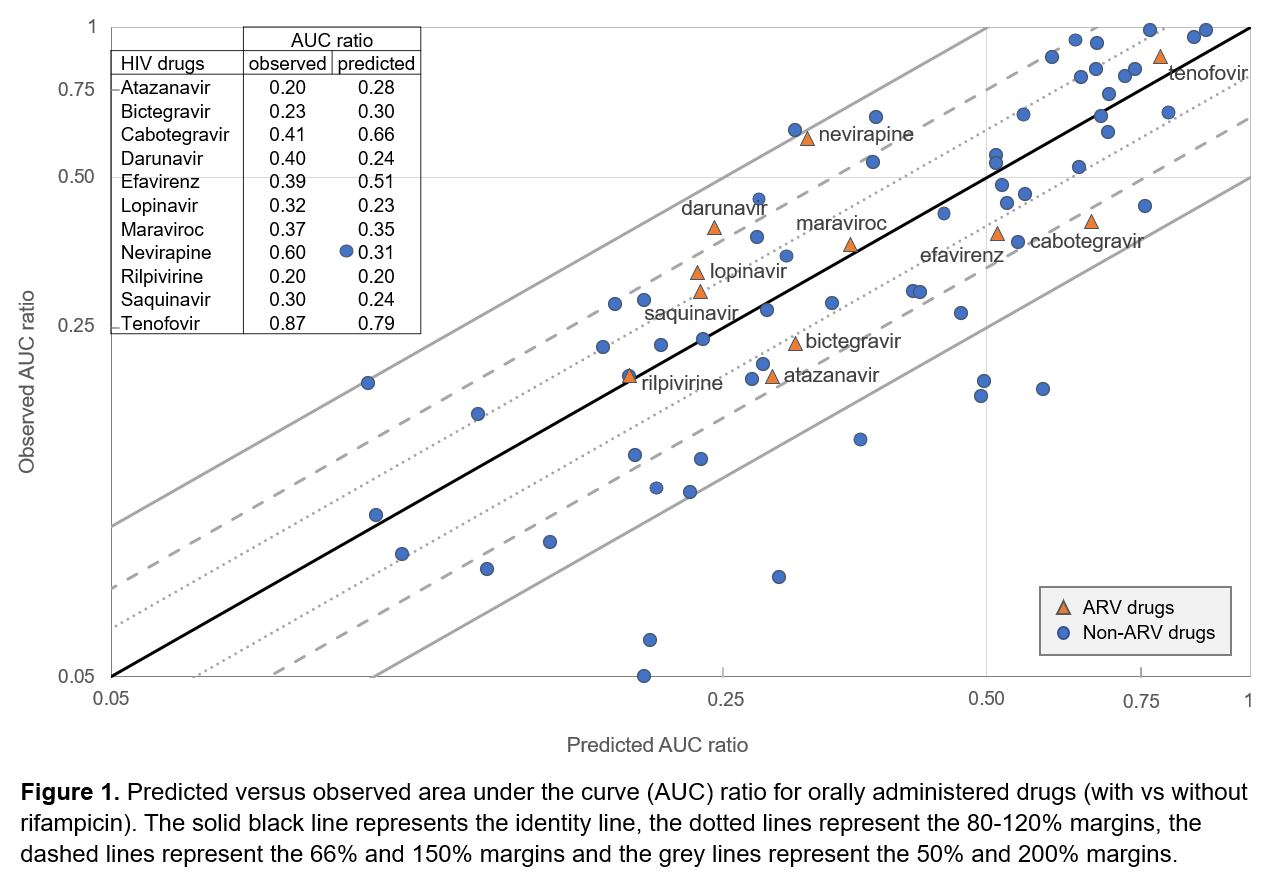
The predicted area under the curve (AUC) ratios (with vs without rifampicin) obtained in our model were in agreement with the AUC ratios observed in clinical studies (Figure 1). Three independent in vitro variables were retained: IVMM, fraction unbound in plasma (Fu) and substrate specificity for OATP1B1 transporter. All ARV (n = 11) DDI predictions were within 2-fold of observed clinical data and yielded a mean absolute error (MAE) of 0.11±0.09. Of all 73 drugs included in the algorithm, 42%, 70% and 88% were within 1.25-fold (0.8-1.25), 1.5-fold (0.66-1.5) and 2-fold (0.5-2) of the clinical data, respectively.
Management of DDIs in PLWH is challenging, especially in an ageing cohort with accumulating multiple comorbidities and polypharmacy. This model provides a fit-for-purpose tool to predict potential DDIs, utilising accessible in vitro data which could prove advantageous in early drug development and potentially help facilitate a more rational design of clinical studies evaluating the risk of toxicity and loss of efficacy associated with DDIs.