Background:
HTLV-1 infection is responsible for two aggressive diseases, leukemia and neuronal inflammation (HAM), in 5-10% of the chronically-infected asymptomatic carriers (AC). However, some infected individuals present minor symptoms that do not meet the criteria for HAM, while not asymptomatic which we named Intermediate syndrome (IS). To determine whether immune responses could discriminate IS from AC and healthy carriers (HC), and could be used as biomarkers of disease progression, in this study, were analyzed the frequency of monocytes (cMono, intMono, and ncMono), dendritic cells (cDCs and pDCs), and NK cells and their cytokine production, before and after stimulation.
Methods:
23 HTLV-1-positive participants being followed up at the Institute of Infectious Diseases “Emilio Ribas” were invited to participate in this study. Whole fresh blood samples were collected from health controls (HC) (n=8), asymptomatic carriers (n=8), and individuals with the intermediate syndrome (n=15), and in vitro stimulated with R848, an agonist of TLR7/8 to evaluate the responsiveness of immune cells. Multi-parameter immunostaining was performed to analyze the cytokine production of different cell subpopulations, here specifically the IFN-α production of pDC. In addition, we quantified the spontaneous IFN-γ production by peripheral blood mononuclear cells (PBMCs) using ELISPOT assay. One-way ANOVA or Kruskal-Wallis statistical analysis was performed using the software GraphPad Prism 8.0 to compare parametric or nonparametric variables.
Results:
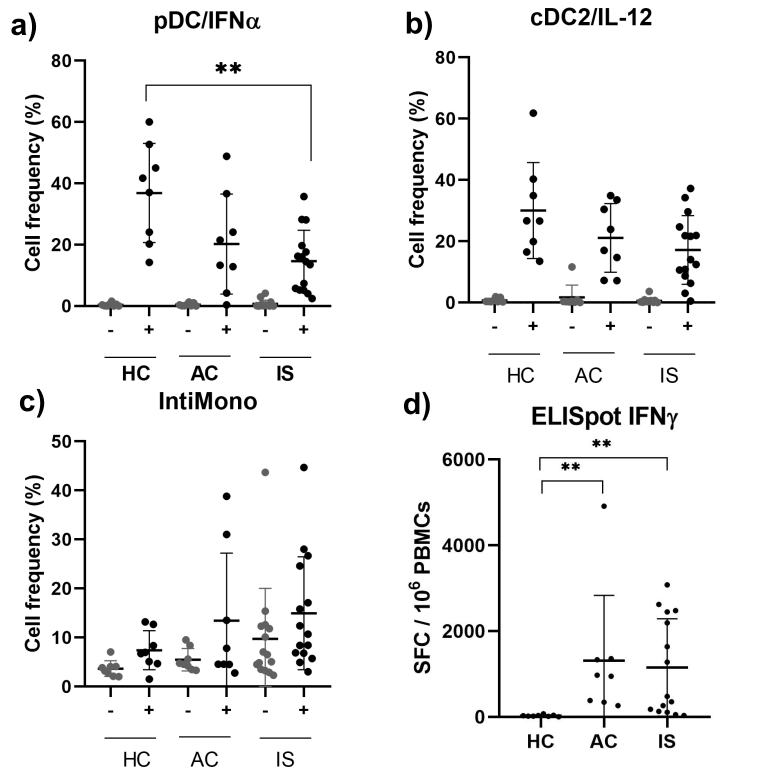
31 volunteers were included (77% women and 23% men), with a median age of 56 years. No statistical difference was seen in the cell subpopulations of the three groups. However, IFN-α production by pDC cells (fig. 1a) was significantly reduced in the IS vs HC group (p=0.002). Moreover, spontaneous IFN-γ production (fig. 1d) was increased in both asymptomatic and IS individuals compared to HC, with a statistical difference of p=0.0013 between HC and AC and of p=0.0011 between HC and IS.
Conclusions:
Changes in innate and adaptive immunity are observed in HTLV-1 infected individuals compared to healthy donors regardless of their disease status. A higher decrease of IFN-α-producing pDC and a higher increase of IFN-γ-producing PBMCs in IS compared to AC might be a signature of disease evolution to HAM.
Main changes observed in the immune response of this study