Background:
While elevated levels of inflammatory biomarkers in people with HIV (PWH) have consistently been linked to a higher risk of severe non-AIDS adverse events (SNAEs), their clinical significance and the relevant inflammatory pathways are not well-established.
Methods:
In this nested case-control study within the Spanish AIDS Research Cohort (CoRIS), from a pool of 18,573 PWH we selected 89 cases who experienced SNAEs after two years of ART (including cardiovascular events, non-AIDS-related cancers, or non-accidental deaths) and had available plasma at month 24 (±6) of suppressive ART. Cases were matched with 89 controls using propensity-score matching. Covariates included age, sex, risk factor for HIV transmission, AIDS history, geographical origin, year 2 CD4/CD8 ratio, baseline HIV RNA, ART regimen, total cholesterol and HDL cholesterol. We measured the expression of 368 inflammatory proteins in plasma using Olink Proteomics’ Proximity Extension Assay and analyzed their functions in Metascape. We used Welch 2-sample t-tests at a confidence level of 0.95 for every protein for a given outcome and corrected for multiple testing by the Benjamini-Hochberg method.
Results:
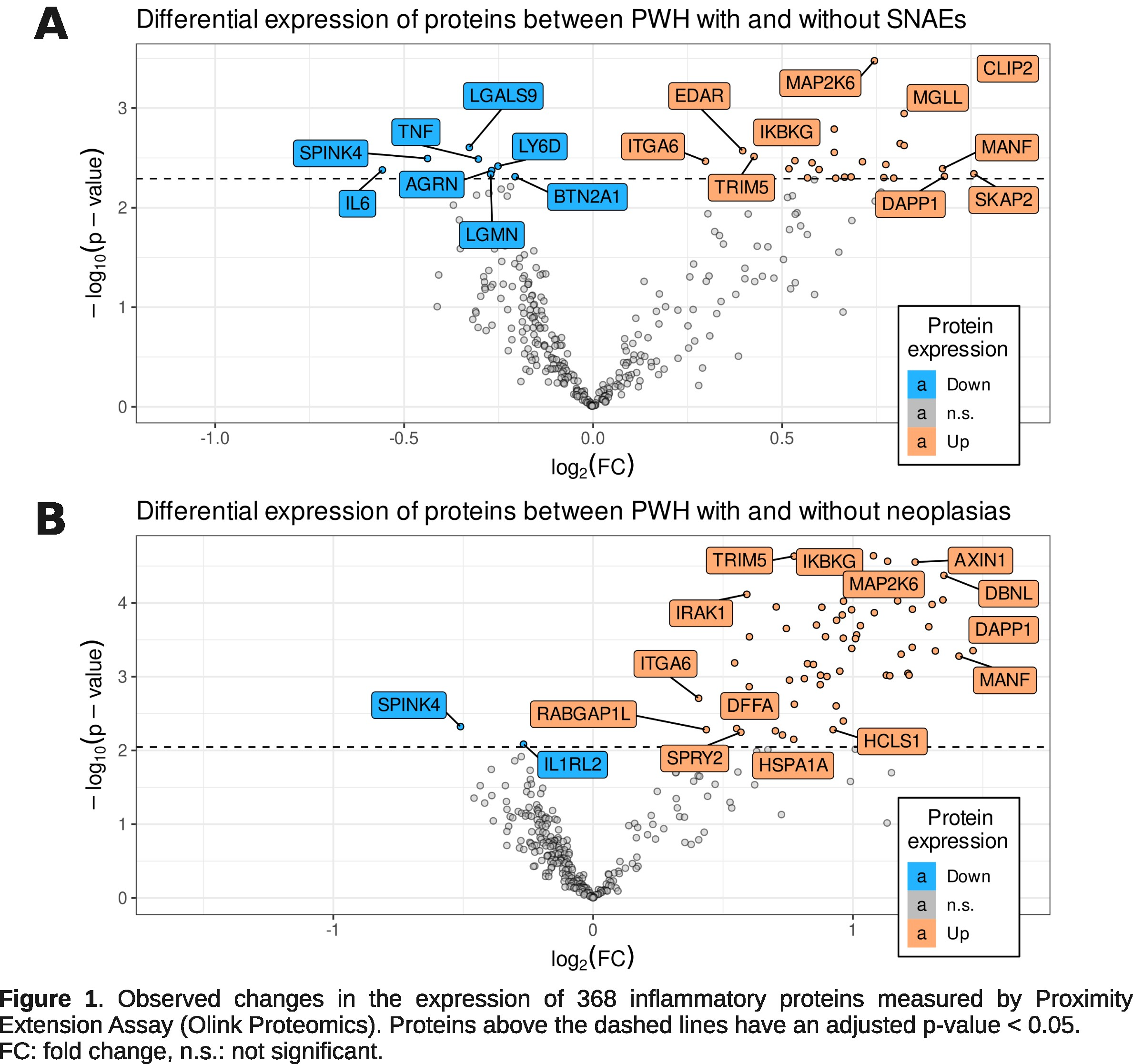
We studied 178 PWH, median age 45 years, 25% women, 49% smokers, median CD4 nadir 208 cells/uL, median CD4 counts at year 2 469 cells/uL. We found significant changes in the expression of inflammatory proteins before month 24 subsequently predicting SNAEs risk. In cases, 25 proteins were upregulated, and 8 were downregulated. The greatest size effect was found for CLIP2, SKAP2, DAPP1, MANF, with approximately two-fold increased expression in cases. A subanalysis on patients with cardiovascular events and non-accidental deaths did not show significant differences in protein expression. In contrast, cases who experienced non-AIDS cancers showed a marked (near 3-fold) upregulation of 59 plasma proteins and downregulation of 2 proteins, being SKAP2, CLIP2, DAPP1 and MANF those more discriminant between groups. Functional analyses indicated that these proteins predicting SNAEs are involved in infection, inflammation signaling pathways, immune response activation, and cancer-related pathways, including NF-KB, PD-L1, and B-cells.
Conclusions:
Our study revealed a specific inflammatory signature predicting SNAEs risk, with distinct inflammatory proteins strongly associated with the onset of non-AIDS cancers. These proteins warrant further exploration as promising biomarkers for SNAEs and as potential therapeutic targets.