Background:
The HIV care continuum provides a comprehensive framework to assess the progress of people with HIV (PWH) from diagnosis to sustained viral suppression.
Methods:
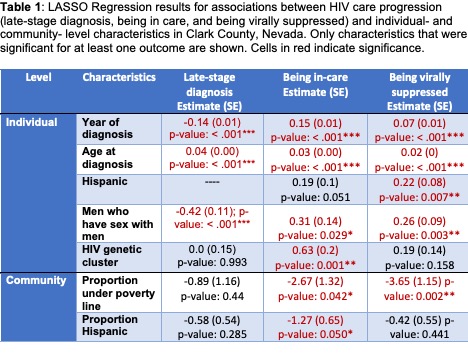
We investigated associations between HIV care progression (being diagnosed, being in care, and being virally suppressed) and individual- and community- level characteristics in Clark County, Nevada. Individual-level characteristics included: age at diagnosis, current age, being MSM or IDU, race, sex, education, income, and being HIV genetically clustered (distance threshold <1.5%). Community-level characteristics included aggregated metrics for education, employment, race, and poverty. We used LASSO (Least Absolute Shrinkage and Selection Operator) regression with a zip code-level random effect to simultaneously conduct model selection and multivariate analyses; model tuning parameter was estimated using cross-validation.
Results:
We identified 5,122 diagnosed PWH in Clark County from 2011 to 2022. Of these individuals, 29% were Black, 36% Hispanic, 86% male, 69% men who have sex with men (MSM), and 56% with a high school education or less. More recent diagnosis year (estimate -0.14; SE 0.01; p-value: <0.001) and being MSM (est. -0.42, SE: 0.11, p-value: <0.001) were inversely associated with late-stage diagnosis, while older diagnosis age was associated with higher probability (est. 0.04, SE: 0.003, p-value: <0.001); no community-level predictors were associated with late-stage diagnosis. Individual-level predictors associated with being in-care include: MSM (est. 0.31, SE: 0.14, p-value: 0.03), being HIV genetically clustered with an another PWH (est. 0.63, SE: 0.20, p-value: 0.001), more recent diagnosis year (est. 0.15, SE: 0.01, p-value: <0.001), and older age at diagnosis (est. 0.03, SE: 0.004, p-value: <0.001). In addition, residing in areas with higher percentages of poverty (est. -2.67, SE: 1.32, p-value: 0.04) and Hispanics (est. -1.27, SE: 0.65, p-value: 0.050) were significantly associated with being out of care. Similar associations with an individual being in-care were identified for an individual being virally suppressed--though some predictors differed; see Table 1 for details.
Conclusions:
Further studies are needed to identify the factors associated with poverty (e.g., access to HIV services) that may contribute to being out of care and virally unsuppressed. This analysis can serve as a basis for proactively identifying and supporting patients at risk of disengaging from HIV care through personalized care plans.