Background:
Syphilis rates have increased in men who sex with men (MSM) in high income countries. Infectious syphilis is associated with HIV acquisition in MSM. Nationally representative syphilis prevalence data from MSM in low-and-middle income settings are lacking. We evaluated changes over 5 years in syphilis and high titer (HT) RPR prevalence across 10 Indian cities.
Methods:
As part of a cluster-randomized trial to evaluate integrated HIV prevention, testing, and treatment services, respondent-driven sampling (RDS) accrued samples of MSM (n=1000/city) in 10 Indian cities between 2012-2013 and again in 2016-2017. Participants underwent serological testing for syphilis (RPR). Additional testing was performed on RPR-positive stored sera to determine titers (high ≥ 1:8, low <1:8). The integrated services intervention did not have a statistically significant effect on syphilis prevalence. We evaluated associations with HT prevalence from 2016-17 using RDS-weighted multivariable multilevel multinomial regression models stratified by HIV status.
Results:
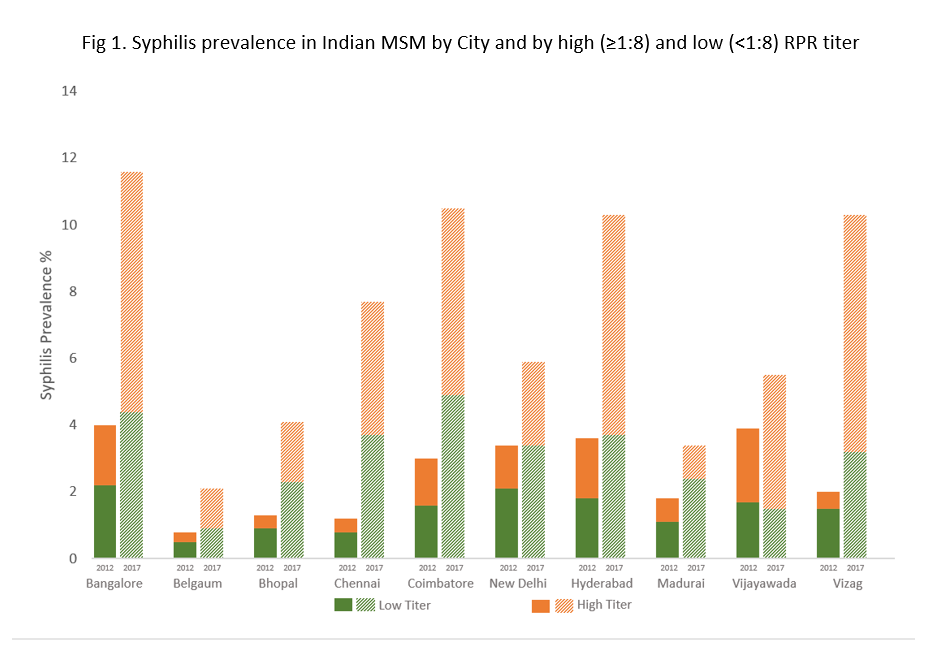
9984 and 9991 MSM were sampled in 2012-2013 and 2016-2017, respectively. During this time, HIV prevalence increased from 7.4% to 15.3% with improvements across the HIV care continuum (33.4% vs 59.1% viral suppression). At the same time, syphilis prevalence increased in all cities; the median prevalence increase from 2013 to 2017 was 4.7% (range: 1.6 – 7.5%) with increase in HT (2.7% [1.2 – 4.8%]) accounting for more of the overall increase than low titer (1.6% [1.3 – 2.2%) (Fig 1). Of 9991 MSM with lab confirmed syphilis, only 3.2% reported a prior diagnosis. Among MSM living with HIV, significant correlates of HT (vs. negative) included being older, HIV viral load >1000 copies/ml, and reporting running out of money in the prior 12 months. Among MSM without HIV, correlates of HT included being older, having prior gonorrhea or chlamydia diagnoses and any STI symptom. Regardless of HIV status, kothi identity (prefer receptive anal sex) and recent condom use with male partners was associated with higher HT prevalence.
Conclusions:
Syphilis prevalence increased within all 10 cities in 5-years. Associations with HT suggests targeted interventions like STI-PEP are needed. Of concern, HT was associated with viremia in men living with HIV suggesting a greater likelihood of HIV transmission to sex partners not on HIV PrEP. Augmented adherence support and early syphilis treatment is required.