Background:
HIV incidence has been declining in sub-Saharan Africa with scale-up of HIV interventions. However, there is limited data on HIV evolutionary trends in African populations with declining epidemics. Here, we evaluated changes in HIV diversity over a twenty-five-year period spanning the introduction and scale-up of HIV prevention and treatment programs in Uganda.
Methods:
We used HIV sequence and survey data from the Rakai Community Cohort Study, a longitudinal population HIV surveillance cohort in southern Uganda. p24 and gp41 consensus sequence data were generated from blood samples of persons living with HIV (PLHIV) in 31 inland semi-urban trading and agrarian communities (1994 to 2018) and four hyperendemic Lake Victoria fishing communities (2011 to 2018) under continuous surveillance. HIV subtype was assigned using the Recombination Identification Program with phylogenetic confirmation. Inter-subtype diversity was estimated using the Shannon diversity index and intra-subtype diversity with the nucleotide diversity and pairwise TN93 genetic distances. Evolutionary dynamics were assessed among demographic and behavioral sub-groups and by migration status.
Results:
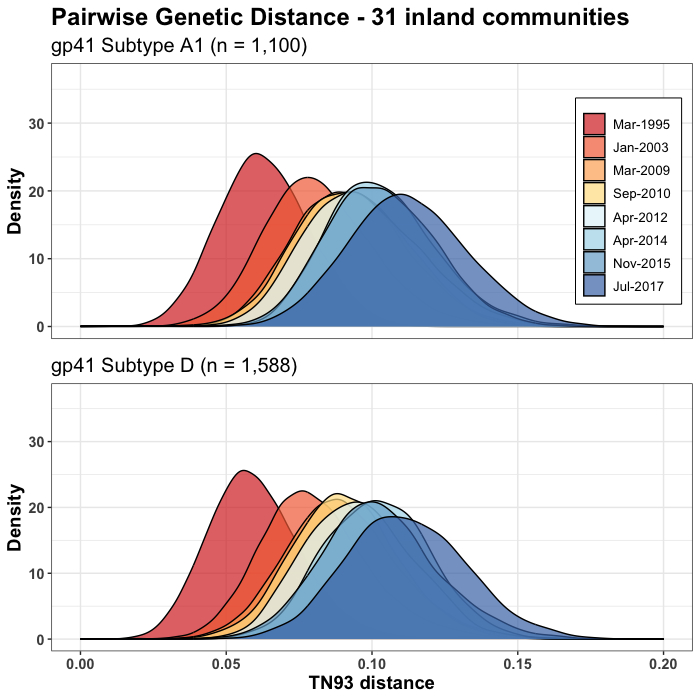
HIV genomic data were available from 4,999 PLHIV, including 3,060 and 1,939 persons residing in inland and fishing communities, respectively, and from 1,484 HIV seroincident cases. In inland communities, subtype A1 viruses proportionately increased in p24 from 17% in 1995 to 32% in 2018 (p<0.001) and in gp41 from 21% in 1995 to 48% in 2018 (p<0.001), while those of subtype D declined in p24 from 80% in 1995 to 45% in 2018 (p<0.001) and in gp41 from 76% in 1995 to 38% in 2018 (p<0.001). In both genes, an increasing proportion of viruses were classified as recombinants (e.g., in p24 from 2.7% in 1994 to 21.4% in 2018 in inland communities). While p24 intra-subtype genetic diversity leveled off after 2014, diversity of gp41 increased through 2018. Inter- and intra-subtype viral diversity generally increased across all population sub-groups, including among individuals with no recent migration history or extra-community sexual partners.
Conclusions:
Although HIV incidence has declined in Uganda, intra and inter-subtype HIV diversity has increased. Continued molecular surveillance may provide a better understanding of the dynamics driving population HIV evolution and yield important insights for epidemic control.