Background:
Despite free and efficacious biomedical HIV prevention, including universal HIV test and treat (UTT) and Pre-Exposure Prophylaxis (PrEP), 200,000 South Africans acquired HIV in 2019. Incidence was highest among adolescents and youth, so strategies to improve HIV prevention are needed.
Methods:
We conducted a 2×2 factorial trial (Isisekelo Sempilo) between March 2020 and August 2022. 2301 eligible 16-29-year-olds, randomly selected from a population surveillance area in rural KwaZulu-Natal, were randomly allocated to four arms: 1) enhanced Standard of Care (SoC): access to study-organized mobile adolescent youth friendly services (AYFS) for differentiated HIV prevention (condoms, UTT, PrEP if eligible); 2) Sexual and Reproductive Health (SRH): baseline self-collected specimens for sexually transmitted infection (STI) testing and referral to AYFS for differentiated HIV prevention integrated with SRH; 3) Peer-support: referral to a peer navigator for needs assessment to tailor health and social support, condom provision and facilitation of AYFS attendance for differentiated HIV prevention; 4) SRH + peer-support. Co-primary outcomes:1) the proportion of individuals with transmissible HIV (HIV viral load >400 copies per ml) measured from dried blood spots (DBS) collected at 12 months; 2) linkage to study AYFS for differentiated HIV prevention and care within 60 days of enrolment. NCT04532307
Results:
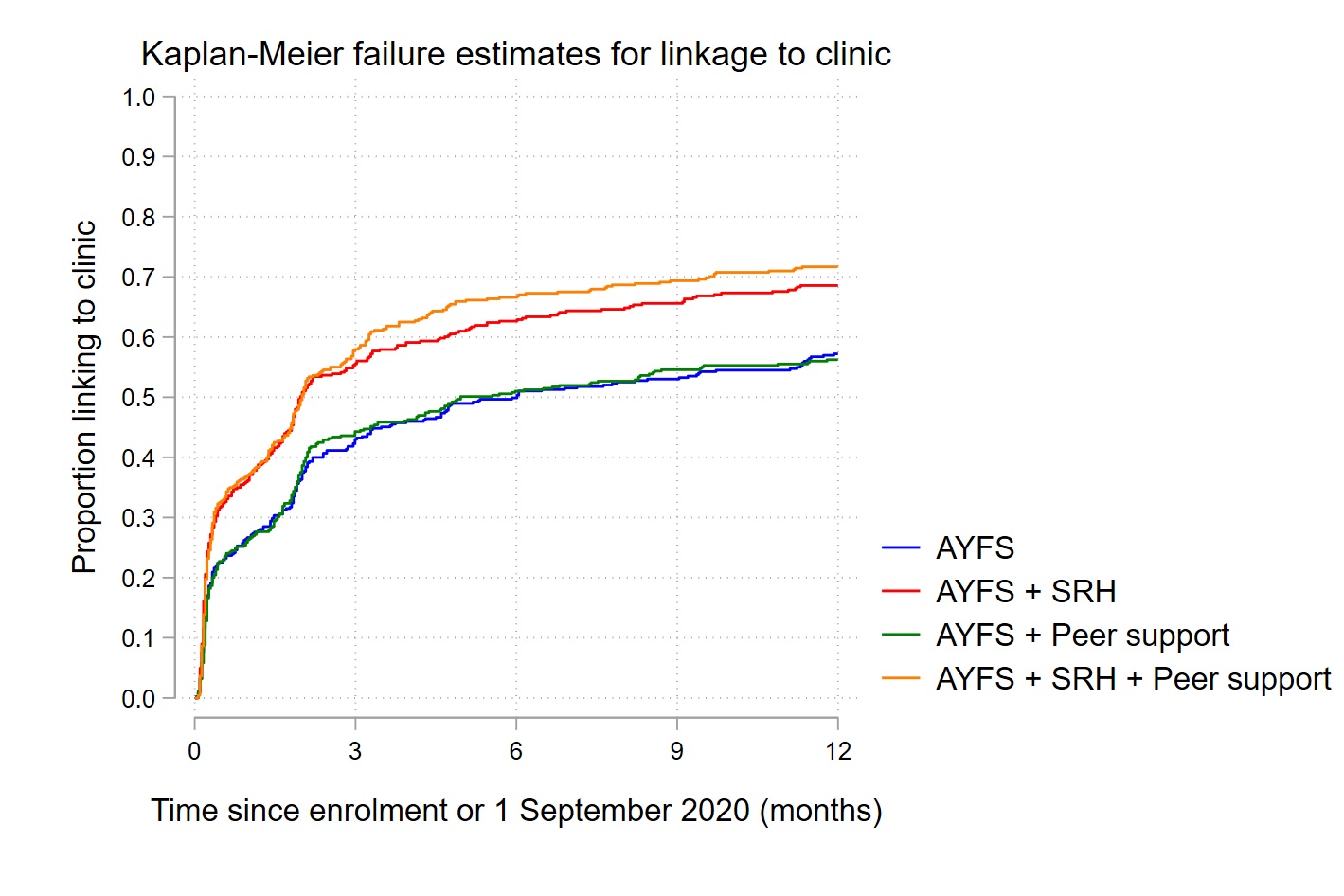
1743 (76%) eligible contacted individuals were enrolled and randomised; 1168 (67%) provided a DBS at 12 months. Baseline characteristics and outcome ascertainment were similar by arm. At 12 months 227 (19%) tested ELISA-positive for HIV, of which 185 (82%) had a HIV viral load < 400 copies/ml. Overall 41 (3.5%) of all who provided DBS had transmissible HIV. After adjustment for age, sex and rural/urban area there was no difference in transmissible HIV by either intervention: SRH: aOR 1.12; 95%CI:0.6-2.11; peer-support aOR 1.03; 95%CI:0.55-1.94. Overall 732 (42.6%) linked to AFYS by 60 days, Those randomised to SRH were significantly more likely to link (aOR 1.61; 95%CI:1.32-1.95) but peer-support had no effect unless combined with SRH.
Conclusions:
In this representative sample of adolescents and youth in rural South Africa, STI testing and SRH (but not peer support) increased uptake of differentiated HIV prevention. While the UNAIDS target of 90:90:90 was exceeded in all arms, neither SRH nor peer support reduced transmissible HIV compared to AYFS.
Time to linkage to AFYS for differentiated HIV prevention, including PrEP/ART amongst n=1743 16-29 year olds