Background:
Tuberculosis (TB) is a leading cause of mortality among people living with HIV and is prevented by isoniazid preventive therapy (IPT). Uptake is low despite guidelines that recommend IPT for all people with HIV (PWH) in high TB prevalence settings, in part due to limited integration into ART services. We tested the efficacy of integrated community-based ART and IPT services on IPT initiation and continuation.
Methods:
The DO ART Study tested integrated IPT and community-based ART in KwaZulu-Natal, South Africa. PWH were randomized 1:1:1 to 1) clinic-based services including standard-of-care IPT; 2) community-based ART and IPT initiation, delivery, quarterly refills, and decentralized monitoring; or 3) hybrid services with clinic ART and IPT initiation and community follow-up. In intervention groups, participants were screened by lay health workers for TB symptoms and contraindications to IPT, and if eligible, were offered IPT 1 month after ART initiation. Quarterly IPT refills were synchronized with ART dispensing. IPT initiation and adherence were assessed through chart review, medication dispensing logs, and quarterly self-report. IPT continuation was defined as refill receipt. A subset of participants had urine tested for isoniazid metabolites at community IPT refill visits to assess concordance with self-reported adherence.
Results:
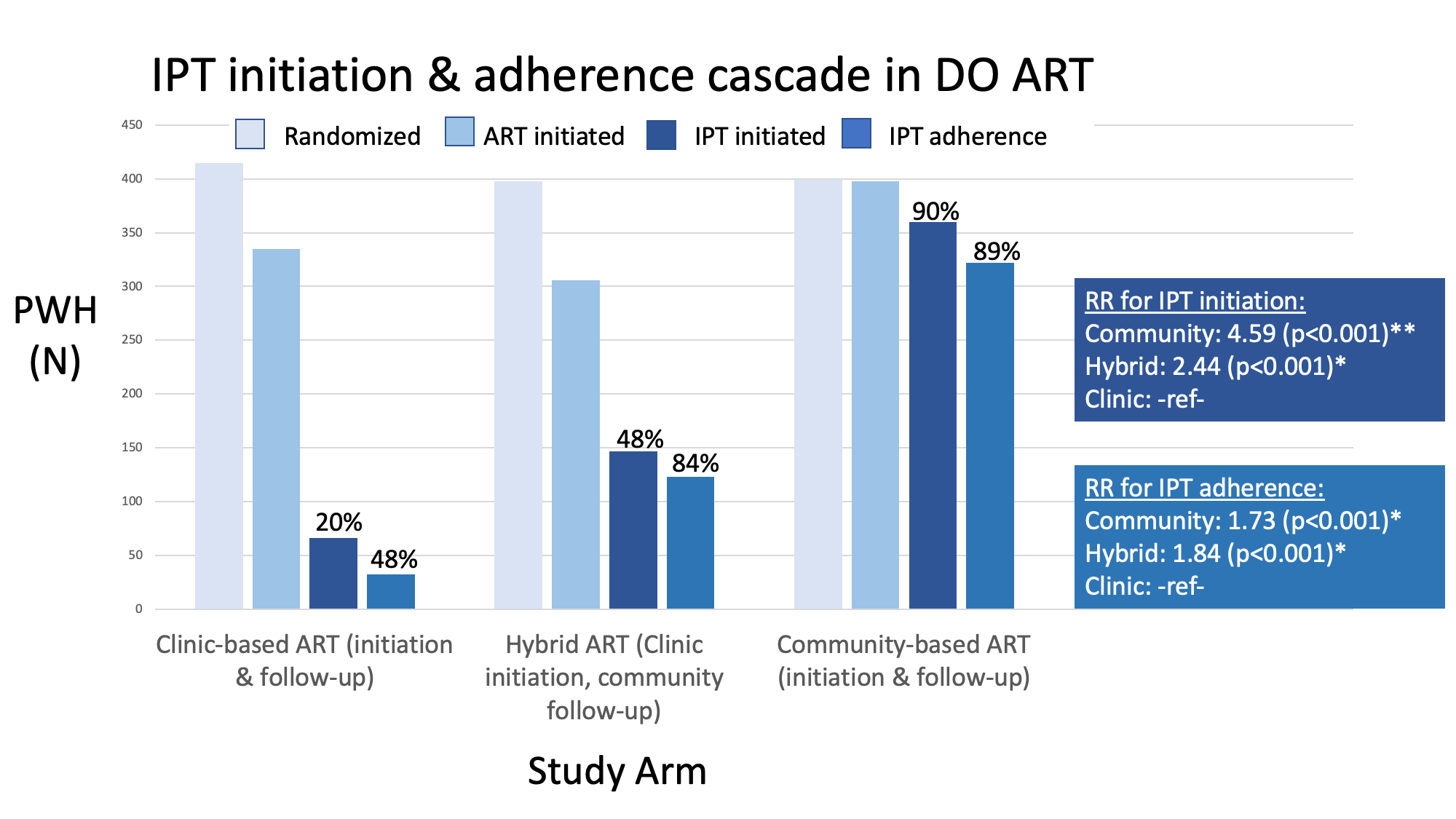
Between 2/2017-3/2019, 1,212 PLWH, including 540 (45%) men, were randomized. Of 1,039 (441, 42% men) who initiated ART, 573 (55%) initiated IPT during 12-months follow-up. Compared to clinic-based IPT uptake of 20%, IPT initiation was 90% in the community-based delivery group (RR=4.59, 95% CI 3.69-5.71 ), and 48% in the hybrid group (RR=2.44, 95% CI 1.91-3.12). Among participants initiating IPT, continuation was similar in the hybrid (84%) (RR=1.84 95% CI 1.43-2.37) and community-based delivery (89%) groups (RR=1.73, 95% CI 1.33-2.34); compared to 48% continuation in the clinic-based group. Gender was not associated with IPT use. Isoniazid metabolites were present in 164/259 (63%) of participants who reported taking IPT.
Conclusions:
Community-based delivery of IPT with ART was associated with more than four-fold higher rate of IPT initiation and two-fold higher continuation than standard clinic-based care in South Africa. High levels of IPT uptake and continuation were achieved through integration into community-based ART delivery, and demonstrated feasibility, adherence, and acceptability. Urine testing can complement self-reported adherence measures.
IPT initiation and adherence cascade in DO ART