Background:
Medicare spending tends to be disproportionately higher among beneficiaries in their last year of life. We currently lack empirical data on how spending differs among Medicare beneficiaries with HIV in the last 12 months of life compared with Medicare beneficiaries with HIV who survive 12 months.
Methods:
Using a 20% yearly sample of Medicare fee-for-service claims data (2016-2018), we identified beneficiaries with HIV aged 65 and older with Part D (prescription) coverage. We examined mean annual Medicare spending among beneficiaries with HIV who survive the calendar year compared with mean spending in the 12 months prior to death among beneficiaries with HIV who died, stratifying results by age group. After 1% winsorization, we calculated mean total spending, as well as mean spending across seven subcategories: direct medical treatment of HIV (excluding drugs); HIV-associated conditions and infections; mental health disorders; other medical spending; total drug spending; spending on antiretroviral therapy (ART); and spending on other drugs.
Results:
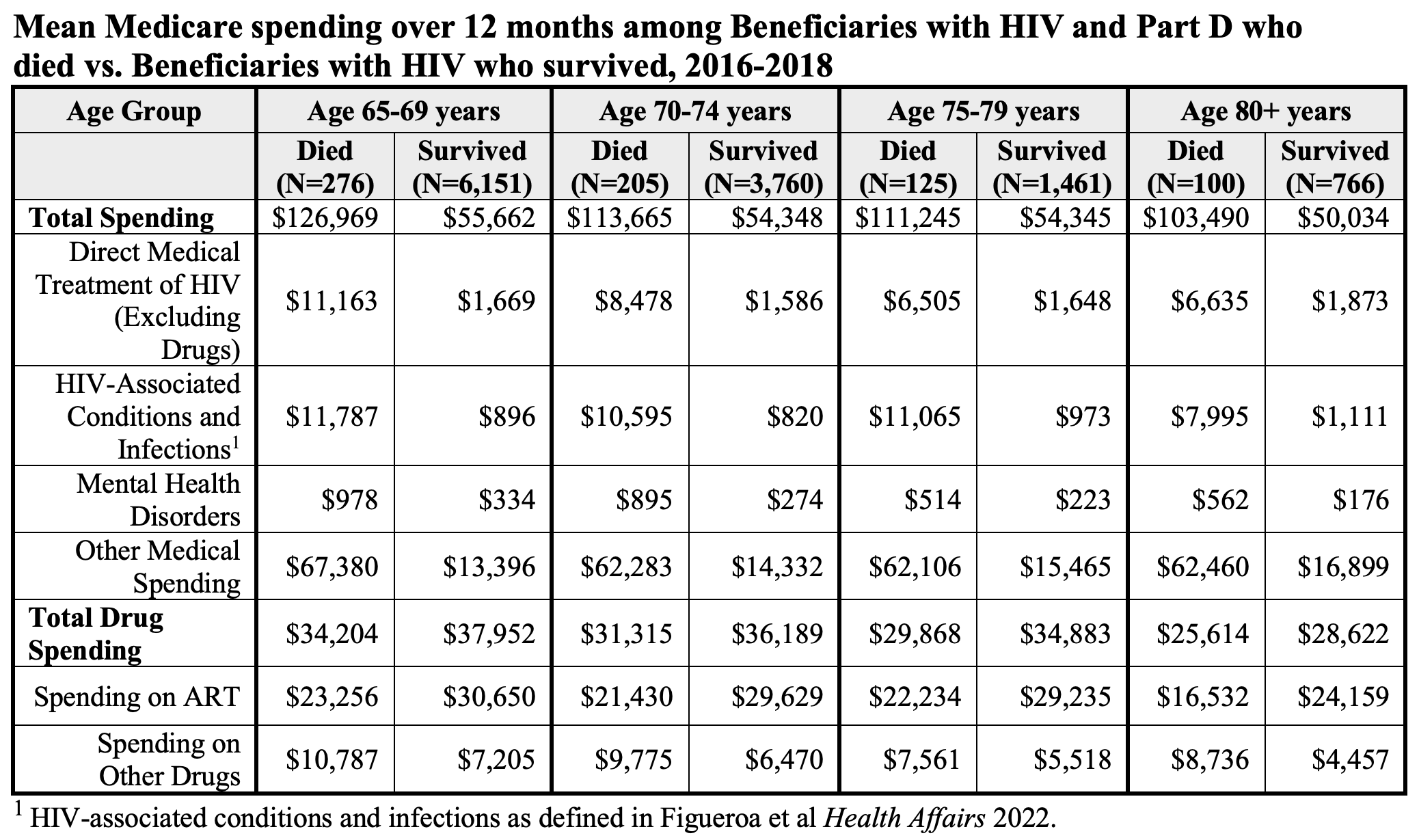
The study sample included 5,601 beneficiaries with HIV who survived the study period, and 706 beneficiaries who died. Mean annual Medicare spending was substantially higher among decedents in the 12 months prior to death compared to people who survived, with the largest difference observed among beneficiaries aged 65-69 ($126,969 vs. $55,662). Mean annual spending was higher among decedents with HIV (compared with survivors) across most subcategories, except total drug spending. Beneficiaries of all age groups who died had lower spending on ART ($23,256-$16,532 vs. $30,650-24,159) with the greatest decrease among older beneficiaries.
Conclusions:
In a national study of older Medicare beneficiaries with HIV and Part D, beneficiaries in their last year of life incurred substantially higher spending compared to survivors, particularly among younger beneficiaries. In contrast, ART spending declined markedly in the last year of life, especially among older beneficiaries, which suggests ART cessation at the end of life. These findings have important implications as the HIV population grows older, and a greater number of people with HIV receive healthcare coverage through the Medicare program at the end of life.