Background:
According to UNAIDS, 40% of new pediatric infections in Mozambique are linked to incident maternal infection during pregnancy or breastfeeding. Since 2021, Mozambique has been implementing a policy of retesting all pregnant and breastfeeding women (PBFW) with unknown HIV status every three months until nine months postpartum. We aim to describe the provincial-level coverage of maternal retesting as after the new policy was introduced and the association of incident maternal infections and positivity rates among HIV exposed infants
Methods:
We analyzed the President’s Emergency Plan for AIDS Relief (PEPFAR) Monitoring, Evaluation, and Reporting data from April 1,2021 to March 31, 2022. We report HIV prevalence at ANC1, the number of pregnant women who had HIV testing performed after first antenatal care visit (ANC1), maternal HIV retesting positivity and coverage (percent tested after ANC1/ HIV negative at ANC1) and early infant diagnosis (EID) positivity at 12 months by province. We assessed the association of maternal incident HIV infection and new pediatric infections, using a Pearson’s correlation coefficient
Results:
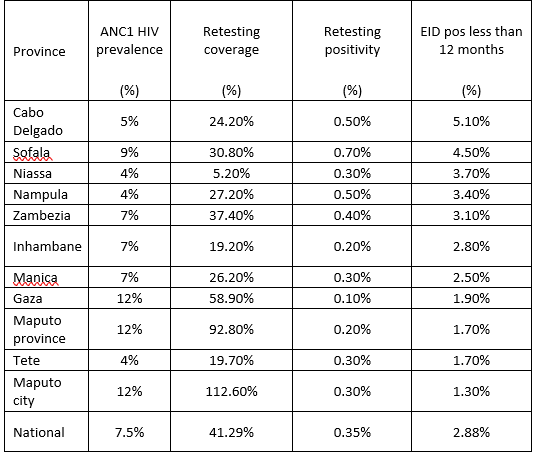
Between April 2021 and March 2022,99.3% (1,883,920/ 1,896,554) of pregnant women attending antenatal care had their HIV status assessed at ANC1. Of these, 116,354 (6.2%) were positive, which included newly positive and known HIV positive. During this time period, 568,601 PBFW were tested after ANC1, achieving a retesting coverage of 32%. Retesting coverage was highest in Maputo City (112.6%), Maputo Province (92.8%) and below 60% in all other provinces. Positivity for HIV exposed infants ranged between 1.3% in Maputo City to 5.1% in Cabo Delgado. There was a significant positive correlation between retesting positivity at provincial level and EID positivity at 12 months (correlation coefficient 0.7, p-value 0.01) and a significant negative correlation between Post ANC1 coverage and 12 months’ EID positivity (correlation: -0.6, p-value 0.04) at provincial level
Conclusions:
Higher provincial HIV positivity among retested PBFW, a measure of incident HIV infections during pregnancy or breastfeeding, was associated with higher HIV positivity among infants in Mozambique. Lower provincial HIV retesting coverage of PBFW was negatively correlated with higher infant HIV positivity suggesting that uptake of maternal retesting may be a proxy for uptake of critical PMTCT services. It is important to invest in preventing incident infections in PBFW through targeted interventions
Table 1 MER indicators by province