Background:
Molecular HIV surveillance (MHS) is routinely used by U.S. public health departments to monitor HIV transmission dynamics within populations and regions. We analyzed MHS data to identify potential drivers of transmission by investigating genetically related infections (transmission clusters).
Methods:
De-identified data were obtained from the epidemiology unit of the Health and Human Services Agency (HHSA) of San Diego County. A baseline HIV genetic network was inferred based on genetic distance of 0.5% (proxy for recent linkage) for all HIV diagnoses from 2006-2016, and links from newly diagnosed people with HIV (PWH) were added to the network from 2017-2023. The presence of a negative HIV test within 6 months of a new HIV diagnosis was used to indicate incident HIV infection. Cox proportional hazards models were used to identify factors associated with the rate of transmission cluster growth. These results were used to predict the possible impact of hypothetical interventions focused on attributes of clustering PWH.
Results:
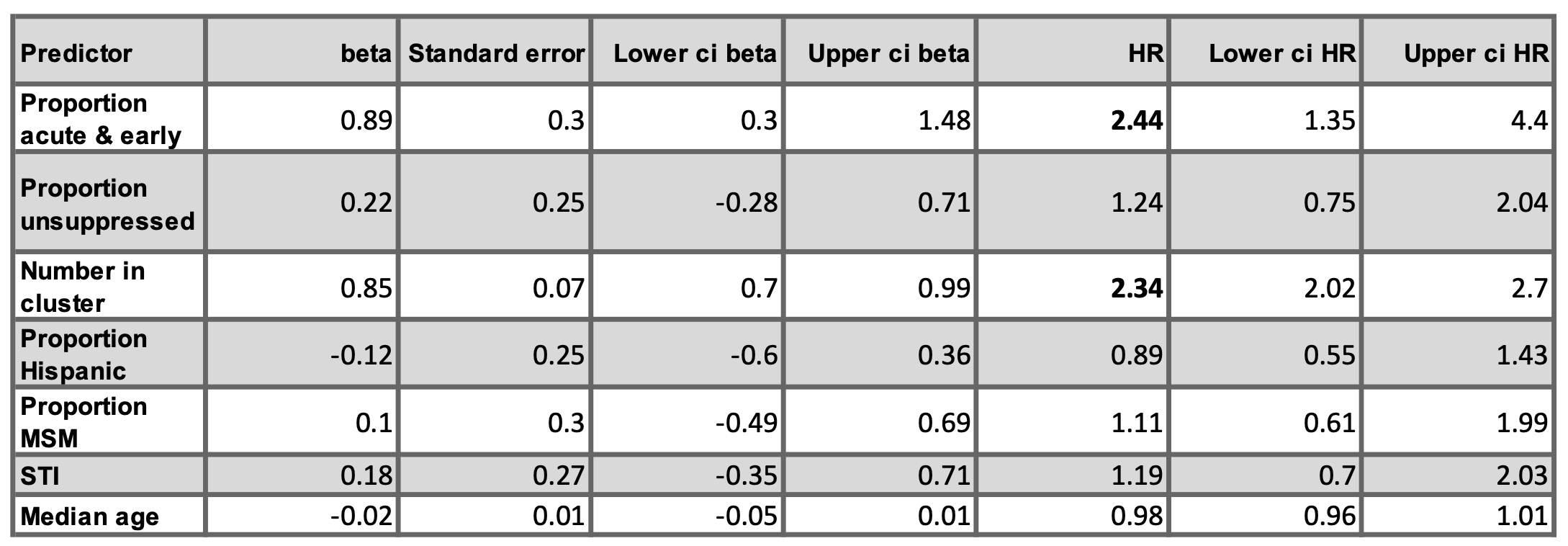
Among 3,676 individuals with diagnosed HIV, 1,938 PWH had at least one HIV sequence, collected a mean of 109 days following the date of HIV diagnosis (IQR 36). Overall, 16% of sequences were linked in 115 clusters (median cluster size 2; range 2-9). Cluster growth was strongly associated with larger size of the cluster (HR 2.5; 95% CI: 2.1, 2.8), proportion of PWH in the cluster with incident infection (HR 3.0; 95% CI: 1.6, 5.4), and proportion with a bacterial sexually transmitted infection (STI, including gonorrhea and syphilis) within 1 year of HIV diagnosis (HR 1.7; 95% CI: 1.1, 2.6) in univariate analysis. Only larger cluster size (HR 2.3; 95% CI: 2.0, 2.7) and incident infections (HR 2.4; 95% CI: 1.4, 4.4) were still associated with cluster growth in multivariable analysis (Table). Proportion of PWH with unsuppressed viremia (VL>200 copies/ml) in a cluster was not associated with growth of that cluster. None of the hypothetical interventions evaluated were shown to significantly reduce the predicted rate of cluster growth over the subsequent three years.
Conclusions:
This is the first use of public health data demonstrating that incident infection is a driver of community HIV cluster growth. No special testing for incident infection was required, only the reliance on previous negative HIV test results. In contrast to published reports, these data suggest that incident infection may drive ongoing community HIV transmissions.