Background:
Long COVID, also known as post-acute sequelae of COVID (PASC), affects more than 144 million people globally. While there is no broadly accepted consensus on a definition for the term “long COVID,” studies have found symptoms persist or begin weeks or months after the end of SARS-CoV-2 infection. This study assessed the incidence of codes found in medical claims and hospital chargemasters that were consistent with long COVID symptoms commonly found in the literature.
Methods:
Using the HealthVerity database, which provides closed claims and linked hospital chargemaster data on more than 25 million US patients, we examined patients aged 12 and above hospitalized between May 1, 2020 and September 30, 2021 with a diagnosis of COVID-19 who had at least 365 days of closed medical claims enrollment prior to index hospitalization admission and 90 days after admission, and did not have a long COVID diagnosis (ICD-10-CM U09.9) prior to the index hospitalization. Patients were allowed to have symptoms prior to hospitalization. The assessment period for the outcomes, which included 10 symptoms, was 90 days to 270 days after the date of hospitalization. Incidence rate per 100 person-years was calculated as the number of patients with the outcome divided by total person-time contributed (90 days after admission to the minimum of the following: outcome, inpatient death, disenrollment, end of data (April 30, 2022), or 270 days after admission).
Results:
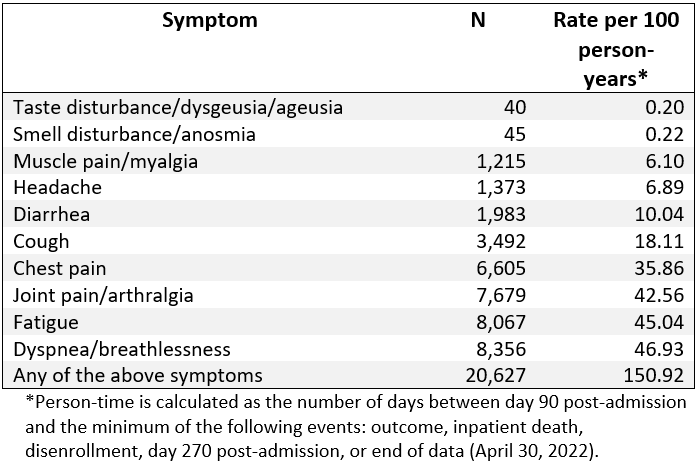
The dataset included 3,661,303 patients with an inpatient hospitalization during the study period. The final study cohort included 44,922 patients hospitalized with COVID-19, 20,627 of whom experienced at least one of the long COVID symptoms. Anosmia and dysgeusia were the rarest events captured in medical claims. More commonly found symptoms were joint pain, fatigue and breathlessness (see table).
Conclusions:
This study examined diagnosed symptoms commonly found post-hospitalization among COVID-19 patients and reported the incidence of these symptoms in a representative population. The start period of long COVID used in this study (90 days post hospitalization) is consistent with the WHO definition of long COVID. In the absence of an understanding of the pathophysiology of long COVID, the use of diagnosed symptoms to define long COVID has the advantage of ease of use and availability of data. Further studies of additional symptoms and predictors of long COVID are needed.
Number of diagnosed long COVID symptoms and rate per 100 person-years among patients who had been hospitalized for COVID-19