Background:
Prior studies have shown that a sizeable fraction of persons on antiretroviral therapy (ART) in Africa, once believed to be care-disengaged, have actually transferred to other healthcare facilities for continued HIV treatment. However, the relationship between facility switching and virologic outcomes, specifically HIV viral rebound, among persons on ART is poorly understood.
Methods:
We used population-level data collected between 2015 and 2020 from 40 continuously surveilled communities, including four hyperendemic Lake Victoria fish landing sites, in the Rakai Community Cohort Study. Persons aged 15-49 years with serologically confirmed HIV infection self-reporting current ART use and contributing ≥1 follow-up visits were included in the study. Facility switching and virologic outcomes were assessed between two consecutive study visits (i.e., index and follow-up visits, ~18-month visit-interval). Persons attending different HIV treatment facilities between index and follow-up visits were classified as having switched facilities. The primary outcome was laboratory-confirmed viral rebound, defined as ≥200 HIV RNA copies/mL at follow-up visit among individuals exhibiting viral load suppression (<200 copies/mL) initially. Multivariable Poisson regression with generalized estimating equations and robust standard errors was used to model associations between facility switching and viral rebound, reported as adjusted incidence rate ratios (adjIRR) with 95% confidence intervals (95%CI).
Results:
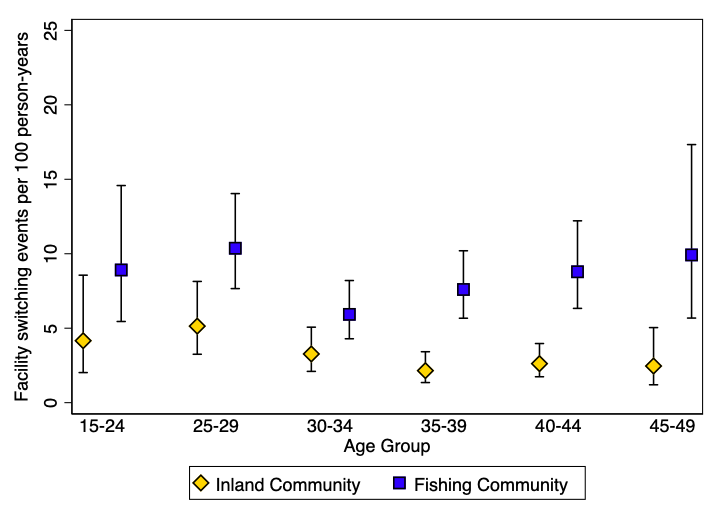
Overall, 2,257 persons self-reporting current ART use (median age: 35 years, 65% women, 92% virally suppressed at index visit) contributed 3,335 visit-pairs and 5,959 person-years (py) to the analysis. Facility switching was common (4.8 switches per 100 py, 95%CI: 4.2-5.5) and highest in persons aged 15-29 years (7.3 switches per 100 py, 95%CI: 5.9-9.1), fishing community residents (7.4 switches per 100 py, 95%CI: 6.3-8.6), and in-migrants (10.4 switches per 100 py, 95%CI: 8.3-13.1). Among initially suppressed persons (n=2,076), the incidence of viral rebound was over twice as high in persons switching facilities relative to those attending the same clinic over the visit-interval (adjIRR 2.27, 95%CI: 1.16-4.45).
Conclusions:
Facility switching was common and associated with viral rebound among initially suppressed persons. Investments in more agile, person-centered HIV care models for mobile clients are needed to address system inefficiencies and bottlenecks that can disrupt HIV treatment continuity.